- English
- French
- German
- Portuguese
- Spanish
- Russian
- Japanese
- Korean
- Arabic
- Greek
- German
- Turkish
- Italian
- Danish
- Romanian
- Indonesian
- Czech
- Afrikaans
- Swedish
- Polish
- Basque
- Catalan
- Esperanto
- Hindi
- Lao
- Albanian
- Amharic
- Armenian
- Azerbaijani
- Belarusian
- Bengali
- Bosnian
- Bulgarian
- Cebuano
- Chichewa
- Corsican
- Croatian
- Dutch
- Estonian
- Filipino
- Finnish
- Frisian
- Galician
- Georgian
- Gujarati
- Haitian
- Hausa
- Hawaiian
- Hebrew
- Hmong
- Hungarian
- Icelandic
- Igbo
- Javanese
- Kannada
- Kazakh
- Khmer
- Kurdish
- Kyrgyz
- Latin
- Latvian
- Lithuanian
- Luxembou..
- Macedonian
- Malagasy
- Malay
- Malayalam
- Maltese
- Maori
- Marathi
- Mongolian
- Burmese
- Nepali
- Norwegian
- Pashto
- Persian
- Punjabi
- Serbian
- Sesotho
- Sinhala
- Slovak
- Slovenian
- Somali
- Samoan
- Scots Gaelic
- Shona
- Sindhi
- Sundanese
- Swahili
- Tajik
- Tamil
- Telugu
- Thai
- Ukrainian
- Urdu
- Uzbek
- Vietnamese
- Welsh
- Xhosa
- Yiddish
- Yoruba
- Zulu
Tank Mixers vs Vertical Mixers for Blending Plastic Pellets
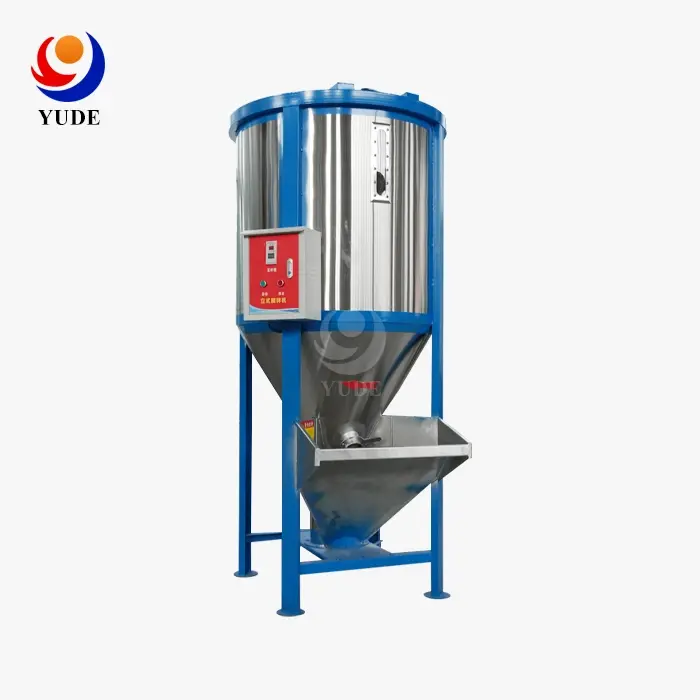
Tank mixers suit liquids, viscous compounds, and vessel-based processes, while vertical mixers suit dry plastic pellets that need blending and drying before extrusion or molding. For pellet work, I usually recommend a vertical design because gravity-assisted circulation moves resin gently and keeps floor space small. A 3 ton vertical plastic particle mixer with drying function https://www.yudemachinery.com/vertical-plastic-particle-mixer-with-drying-function/3-ton-vertical-plastic-particle-mixer-with-drying-function adds hot air to that circulation, so one machine blends PE, PP, ABS, and PVC granules and lowers surface moisture in a single batch. This guide compares both designs, explains where each fits, and shows what to request from a supplier before you buy.
Why the Choice of Mixer Matters for Plastic Pellet Processing
Because it is between where the resin is kept and where the parts are made, the mixer's work can be seen in every finished item.
Material Consistency and Product Quality
Mixed PVC, PP, PE, ABS, recovered pellets, masterbatch, additives, and color concentrates are used before extrusions, injection molds, blow molds, or films are made. The color changes, the wall width changes, and there is more scrap when the blend changes from batch to batch. Particles of different sizes and densities also tend to separate as they move. This is what the book "Mixing in the Process Industries" talks about for solids. When you mix the machines well, they don't separate too much, and every hour, each one gets the same amount of food. Repeatability is very important for pipe, profile, and film lines because a single color change can mess up a long run.
What "3-Ton Capacity" Really Means
"3-ton" is often used in a vague way in quotes. It could mean the working volume, the rating volume, the daily output, or the biggest batch load. When you compare prices, each reading changes it. With a bulk density of 0.6 to 0.8 g/cm³, this 3 ton vertical plastic particle mixer with drying function from Yude Plastic Machinery can hold up to 3,000 kg of stuff. It can hold between 4,500 and 4,800 L of important stuff. 3,000 kg of pellets take up about 4,286 L at 0.7 g/cm³, so density directly affects how much fits. The working amount may be reached before 3,000 kg if the material is less dense, so check the load with your own resin. Be sure to ask each provider what they think of the term.
Common Problems a Good Mixer Prevents
Problems with the mixing and drying step include uneven mixing, surface marks from water, resin breaking down from too much heat, chambers that are hard to clean, and export paperwork that is missing. Most of the time, it's because of too much water. Some resins can soak up water from the air, and pieces that are too wet can cause molded and extruded parts to spread out or bubble. According to the "Injection Molding Handbook," these materials need to be dried before they can be used. Too much heat can hurt things, so controlling the temperature is just as important as having a lot of heat. People who buy equipment and send it abroad must also get manuals, test records, and conformity documents on time. Make sure you know what paperwork you need before you place your order.
How Tank Mixers and Vertical Mixers Work and Compare
The rest of the comparison is based on the fact that the two designs move things in different ways.
How a Tank Mixer Works
A tank mixer has a container, a stirrer, a way to move the stuff, and sometimes parts that heat or dry the stuff. It moves things inside the vessel by shear and flow as it turns. This design can handle some dry materials as well as liquids, powders, and mixtures. A lot of food and chemical plants use it, as well as places that make plastics. There are times when the agitator has to move the whole load around the vessel. Utilize your own material to check the amount of power used, the wear parts, and the ease of cleaning. Still, a tank mixer is a good choice if your stuff is wet, thick, or needs to be mixed in a certain way.
How a Vertical Spiral Mixer Works
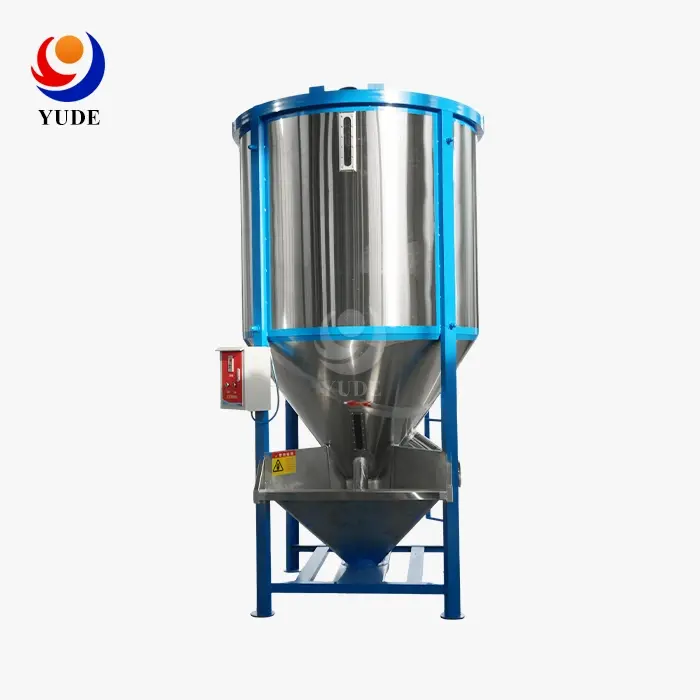
A vertical mixer moves the pellets up and down through a center tube. They are let go at the top, and the weight of the body pulls them down. The amount is mixed without taking up a lot of table space. This part of the 3 ton vertical plastic particle mixer with drying function moves air up and down the vertical axis. It also brings hot air into the room, so the drying and mixing happen at the same time. The machine that Yude made has a thicker carbon steel circle inside a Q235 carbon steel barrel that is insulated. It also has a feeding port that is sealed so hot air doesn't escape. Adding new colors, changing colors, and drying out PE, PP, ABS, and PVC granules by taking away water are some of the most common things that need to be done.
Technical Comparison for Plastic Pellets
Don't just look at the motor's size and shape. How well the mixture is mixed depends on the pellet density, particle size, speed, fill level, shape, and amount of additives used. For drying to happen, you need enough airflow, a powerful heater, correct temperature data, and protection for the resin. You should look at the effective working volume, cycle time, loading and unloading times, cleaning access, and the amount of work that needs to be done to switch between machines. It says that the 3 ton vertical plastic particle mixer with drying function mixes evenly 98% of the time or more and dries with a moisture content of 0.5% or less. In total, it takes 30 to 45 minutes to mix and dry something. Get similar numbers from any tank mixer provider, and then use your own pellets to test them and make sure they are correct.
When a 3 Ton Vertical Plastic Particle Mixer with Drying Function Fits Best
It's helpful to see what this machine can and can't do next to each other.
Core Specifications and Build
This is what I would show a group of experts. This 3 ton vertical plastic particle mixer with drying function can dry up to 3,000 kg of material. It has an electric heating tube motor that can produce 22 to 30 kW of power, and steam heating can be added as an extra. The hot air can go from being room temperature to 85 °C. This list tells you how much power you need and how much weight the floor can hold. Make sure you ask Yude Plastic Machinery for the right motor and heater for your resin and batch size.
Best-Fit Applications
VFDs are a good way to mix new and used resin, masterbatch, color concentrates, fillers, stabilizers, and processing additives in small or medium-sized plants. When getting ready for grinding, injection molding, and film blowing, a 3 ton vertical plastic particle mixer with drying function is useful because particles that are too wet can get in the way. Moving things with different densities up and down can help. Things that can be used with recycled feedstock are dust collection, wear parts that are stronger, and custom discharge systems. For me, the best plants are the ones that have their own blender and dryer. That way, they only need one machine and one step of handling instead of two.
Limits to Weigh Before You Buy
A vertical mixer dryer can only do so much. A line that needs to be fed all the time might need one or two overflow hoppers because it works in batches. Making the building tall is important because the hall and stairs need room above them. Wet surfaces can be dried with hot air up to 85 °C, but plastics that soak up water quickly, like nylon or PET, can't be dried with hot air alone. They need special drying agents. The 3 ton vertical plastic particle mixer with drying function can first dry this kind of stuff out. There is still no better way to mix liquids, thick mixtures, and processes that happen in a cylinder than with a tank mixer. As stated in ASTM D6980, one common way to check for moisture is to see if the material has lost weight.
How to Choose and Specify a 3-Ton Mixer Dryer?
Having a clear brief saves a lot of time and work, so write down these details before you ask painters to quote.
Define the Application First
First, you should think about the different types of glue, the different amounts of new and used materials, the ratios of additives, the batch size, the output goal, the moisture level, the fitting room, and the power that is available. You shouldn't just guess about output; you should do some math. Let's say a cycle takes 45 minutes, plus 15 minutes to load and unload. A 3,000-kg batch leaves the machine every hour. Real capacity, on the other hand, would hide that time on its own. What kind of power source do you have for the 3 ton vertical plastic particle mixer with drying function? In the US, the power source is 60 Hz. The motor, heater, and settings will then fit your plant. Manual settings can work for simple, low-volume jobs, but automatic settings are better when the mixer feeds equipment that moves or presses the material.
Specifications to Request in a Quotation
A full quote lists the rated volume, the effective working volume, the maximum batch size, the density range, the motor power, the heating power, the installed power, the machine's size, and its weight. Along with the mixing and drying times, it should also show the temperature range, how well the controls work, how well the moisture performs, the expected output, and how much energy each batch uses. You could look into choices like variable-frequency drives, automatic loading and discharge, dust collection, load cells, level monitors, and custom voltage. Along with your pellets, ask for a factory acceptance test for a 3 ton vertical plastic particle mixer with drying function. To keep track of everything, you should write down the test results, safety features, packaging, instructions, certificates, and extra parts.
Common Purchasing Mistakes
Most of the time, three things go wrong. First, when people compare prices, they don't always agree on how much something can hold. For example, a label that says "3-ton" can hide different working volumes. Second, they check the motor power to see how well the material is mixed. But the shape of the stirrer, how it heats up, and the flow of the material are all just as important. Third, they use the same temperature for all resins, even though different polymers can only use so much heat. The recycled stuff may also need to be cleaned of dust, screened, or given parts that won't wear out quickly. Before you sign, write down what you agree to about training, hardware, installation, wiring, testing, and extra parts. Brydson's Plastics Materials is a good place to find information about the properties of different resins.
A Practical Decision Guide and Supplier Support
It's usually easy to make a decision when you have all the facts. Choose a tank mixer if you work with liquids, thick substances, or special vessel operations. You can also choose a tank mixer if you already have separate equipment for drying pellets. A vertical mixer dryer is the best way to go if you need to mix and dry something all at once, save floor space, have flexible recipes, or need both new and used granules. It's best to use a 3 ton vertical plastic particle mixer with drying function for the second case. Let us know if you need a special build because of complex formulas, odd densities, a lot of automation, or different output heights. Before you make a choice, make sure that the technical and financial teams can both see the same paper that shows the specs, prices, delivery, warranty, service scope, drying performance, and power. This lets everyone see the same thing at the same time.
What a Professional Supplier Should Provide
Before making a quote, a good provider does more than just give you a price for the machine. You will likely talk about the material's features, how it was made, what it's supposed to do, how much moisture it needs, how it's laid out, what tools it has, and how it can be automated. Before you sign off on the order, you should try samples to make sure that the drying works, the cycle time is right, the discharge behavior is right, and the energy use is right. For projects in other countries, the service provider should also handle export packing, paperwork, commissioning from afar or on-site, training for operators, extra parts, and service guaranties. Make a list of the companies that make the 3 ton vertical plastic particle mixer with drying function that you're interested in. After that, write down what they say and put them next to each other to see how they differ.
How Yude Plastic Machinery Supports Your Project
Shandong Yude Plastic Machinery Co., Ltd. makes and sells plastic mixers, including stainless steel vertical color mixers that can hold up to 10 tons of plastic, small particle mixers that can hold up to 300 kg of plastic, and more. Its goods are bought in more than 30 places. The company makes sure that the whole process is good, from the raw materials that are sent in to the made machine. Their research and development team comes up with unique solutions, such as making operation interfaces that work in more than one language and adapting equipment to meet the standards of the local industry. The system has local service partners in other countries to help with support 7 days a week, 24 hours a day. They will first look at your resin, batch size, and layout to see if your project needs a 3 ton vertical plastic particle mixer with drying function.
Conclusion
Vertical and tank mixers are not the same. They are used for different tasks. Moving liquids and thick substances is easy with tank mixers. They are also good for processes that take place inside vessels. On the other hand, vertical mixers move dry pellets around in a circular pattern and don't take up much floor room. A vertical mixer dryer treats plastic pellets that need to be mixed and dried before they can be made or extruded. It does both at the same time. The story talks about a 3 ton vertical plastic particle mixer with drying function that can move a 3,000-kilogram load, mix evenly at 98% or higher, dry with wetness at 0.5% or lower, and blow hot air up to 85 °C. Some plastics, like PE, PP, ABS, and PVC, don't need to be dried with a desiccant, but those that do need to be. Any design you choose, make sure the capacity is clear, the resin is at the right temperature, and you test the results on your own pellets to make sure they are right.
FAQ
Can a 3 ton vertical plastic particle mixer with drying function handle PVC, PP, PE, and ABS?
Yes. The unit does a good job of drying out these pellets, changing their color, and making them less wet. It still depends on the mix, density, and moisture, so we test samples and look over each case in great detail to be sure.
Does it replace a desiccant dryer for nylon or PET?
Not as the last machine. The surface can be dried with hot air up to 85 °C, but highly hygroscopic resins need desiccant drying to lower the moisture level. After being dried in the mixer, they look good.
What should I include in a quotation request?
Feel free to send the name of the resin, the amount of chemicals, the batch size, the desired output, the desired moisture, the location, the power in the area, and the automation needs. After that, we make sure that the details about capacity, wait time, shipping, installation, warranty, and spare parts are all made clear.
Request a Mixer Recommendation from Yude Plastic Machinery
Yude Plastic Machinery sends goods to more than 30 countries and areas straight from its factory. Customers can make changes, use interfaces in multiple languages, and get help after the sale seven days a week, 24 hours a day. If you want to compare a 3 ton vertical plastic particle mixer with drying function provider, email sales@yudemachinery.com with the material, batch size, and voltage. Our professionals will give you one choice. Visit https://yudemachinery.com/ to learn more about this item.
References
- Handbook of Industrial Mixing: Science and Practice, 2004
- Mixing in the Process Industries, 1992
- Brydson's Plastics Materials, 2017
- ASTM D6980 Standard Test Method for Determination of Moisture in Plastics by Loss in Weight, 2017
- Injection Molding Handbook, 2000
- Extrusion: The Definitive Processing Guide and Handbook, 2005
Learn about our latest products and discounts through SMS or email