- English
- French
- German
- Portuguese
- Spanish
- Russian
- Japanese
- Korean
- Arabic
- Greek
- German
- Turkish
- Italian
- Danish
- Romanian
- Indonesian
- Czech
- Afrikaans
- Swedish
- Polish
- Basque
- Catalan
- Esperanto
- Hindi
- Lao
- Albanian
- Amharic
- Armenian
- Azerbaijani
- Belarusian
- Bengali
- Bosnian
- Bulgarian
- Cebuano
- Chichewa
- Corsican
- Croatian
- Dutch
- Estonian
- Filipino
- Finnish
- Frisian
- Galician
- Georgian
- Gujarati
- Haitian
- Hausa
- Hawaiian
- Hebrew
- Hmong
- Hungarian
- Icelandic
- Igbo
- Javanese
- Kannada
- Kazakh
- Khmer
- Kurdish
- Kyrgyz
- Latin
- Latvian
- Lithuanian
- Luxembou..
- Macedonian
- Malagasy
- Malay
- Malayalam
- Maltese
- Maori
- Marathi
- Mongolian
- Burmese
- Nepali
- Norwegian
- Pashto
- Persian
- Punjabi
- Serbian
- Sesotho
- Sinhala
- Slovak
- Slovenian
- Somali
- Samoan
- Scots Gaelic
- Shona
- Sindhi
- Sundanese
- Swahili
- Tajik
- Tamil
- Telugu
- Thai
- Ukrainian
- Urdu
- Uzbek
- Vietnamese
- Welsh
- Xhosa
- Yiddish
- Yoruba
- Zulu
Chemical Mixing Tank Alternatives for Dry Plastic Granules
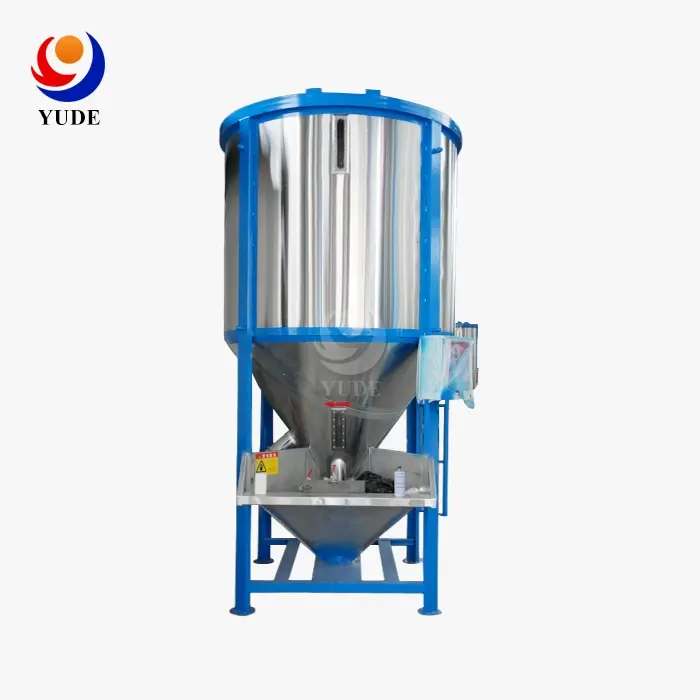
The best chemical mixing tank alternative for dry plastic granules is a machine built for solid pellets, not liquids. A 5 ton vertical plastic particle mixer with drying function https://www.yudemachinery.com/vertical-plastic-particle-mixer-with-drying-function/5-ton-vertical-plastic-particle-mixer-with-drying-functionlifts granules with a spiral, blends colors or additives, and removes surface moisture with hot air in one vessel. The Yude model holds 5,000 kg per batch, delivers mixing uniformity of at least 98%, and dries material to 0.5% moisture or less. It suits PE, PP, ABS, and PVC granules. In this guide, I explain how it works, what to check before buying, and how to verify performance.
Why Chemical Mixing Tanks Fall Short for Dry Plastic Granules
Where Chemical Mixing Tanks Work Well
It's clear that tanks that mix chemicals work. Different types of fluids are mixed with the help of an impeller that moves the fluid around the vessel. To stir liquids and mix solids, Perry's Chemical Engineers' Handbook has two different parts. This is because granules pile up, bridge, and slide while liquids move easily. All parts of a tank get heat and ingredients from the liquid in the tank. If your plant makes coatings, solution resins, or wet chemical blends, a tank is the right tool for it. Things don't work out when the same plan is used for dry pellets. That's when an option that was made just for you comes in handy.
Why Dry Pellets Behave Differently
Grains of plastic don't move around like liquids do. They are stacked, which creates dead zones, and spread out based on their size and density. Mixing in the Process Industries says that segregation happens a lot in the process industries when particles are different in size, shape, or density. To give you an idea, here are a masterbatch pellet and a natural resin pellet. It gets worse when you add water. The Injection Molding Handbook says that plastic with too much water in it leads to surface streaks, bubbles, and parts that aren't as strong. Most tanks don't have a way for hot air to get rid of the water. It takes more work, moves, and floor space for each team to buy its own dryer and blender after that.
Vertical or Horizontal: Choosing a Design for Dry Granules
Different kinds of dry-material mixers can be found in both vertical and horizontal styles. Something moves things up a middle circle, and then they fall back down into the barrel. One that is short and flat can fit on the floor with less trouble, and gravity helps it empty. It's not that one type is better than the other for all mixes and cleaning jobs, though. What you pick should depend on how the plant is set up, how the material acts, and how much it can handle. Discover how well your own grains did in tests from each provider. If you need to dry a lot of things in one place and keep the sizes small, a 5 ton vertical plastic particle mixer with drying function is a good choice.
How a 5 Ton Vertical Plastic Particle Mixer with Drying Function Works
What the Machine Is
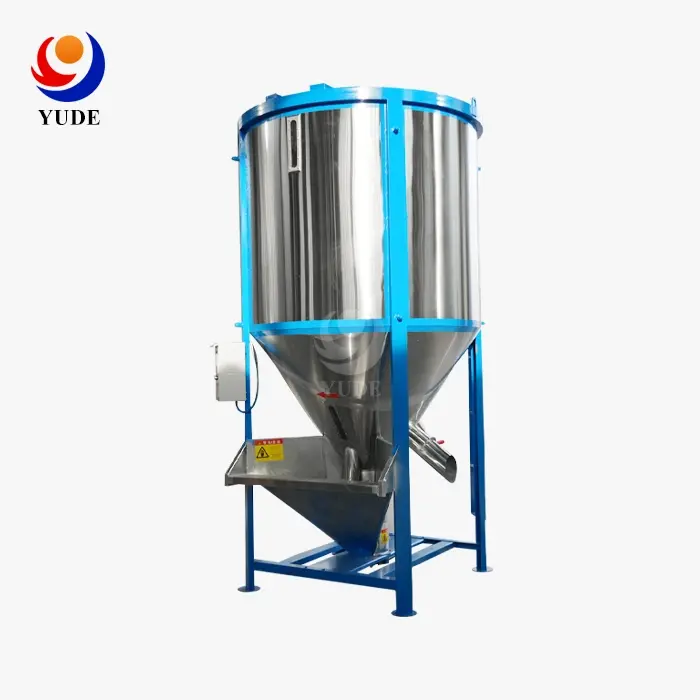
Things are mixed and dried with hot air in one vertical vessel by this machine. There is a spiral inside the barrel that moves the granules up and then lets them fall back down. Hot air moves through the things that are moving and dries them out. Yude Plastic Machinery made it so that PE, PP, ABS, and PVC granules could go through color changes and be dried out. It can hold up to 5,000 kg, and between 7,500 and 8,000 L is a useful amount. Its bulk density is 0.6 to 0.8 g/cm³. There is no need to switch between a dryer and a mixer in a plant because the same machine does both jobs.
The Mixing and Drying Cycle
This machine has a covered serving port that keeps hot air inside. People who work on it add powders through this port. The heating system makes the air warmer, and the swirl sends the stuff up and down. Anywhere from 0 to 85℃ can be set for the hot air. The water that is on the surface of the batch evaporates as the granules move through the warm air. It makes it easy for the colorants or other ingredients to spread. It takes thirty to fifty minutes to mix and dry something once. That time is different for each batch size, type of resin, temperature, and amount of water present at the beginning. When the cycle is over, the batch is sent to a roller, an injection mold, a film blowing line, or a storage bin.
Which Materials It Fits and Which It Does Not
The machine wants small pieces of plastic like PE, PP, ABS, and PVC. These are often found in molded parts, pipes, profiles, and films. PET or PP pellets that have been recycled often have water on the outside because they have been washed. ABS needs to be dried out before it can be used. The Plastics Engineering Handbook from the Society of the Plastics Industry says that drying is a normal part of getting plastics that don't like being wet ready to be used. There are different kinds of materials. If you want to dry PET, you need temperatures much higher than 85℃, and if you want to dry nylon, you usually need dry air. Now is the time to be honest. If your recipe has other ingredients, please let us know.
Key Specifications and How to Choose
Core Specifications to Verify
Here are the most important numbers to look for on any quote for a 5 ton vertical plastic particle mixer with drying function.
- Capacity and volume: It can hold up to 5,000 kg and has a volume of about 7,500 to 8,000 L. It has a bulk density of 0.6 to 0.8 g/cm³. To find out what the seller means when they say "rated," "working," or "maximum capacity," ask them. Before the barrel hits 5 tons, it is filled with something smaller.
- Mixing and drying results: When the mixture is mixed and dried, at least 98% of it must be evenly mixed, and the moisture level must be 0.5% or less after drying. 35 to 50 minutes is how long the cycle lasts. You should ask for a written test method that tells you how to measure moisture and where to take samples so that you can do the test again on your own stuff.
- Power and heating: Its motor is 37 to 45 kW. There is no need for steam heating because the electric heating tubes give off 80 to 100 kW. Hot air can be anywhere from room temperature to 85℃. Check that these loads will work with the switch, breaker, and power source at your company before you buy.
This is a good place to start when you want to compare quotes line by line.
Build Quality and Safety Features
There is protection between the Q235 carbon steel barrel and the heat inside the tank, which helps keep the heat inside. The thickened carbon steel spiral can mix heavy batch loads, and the sealed feeding port keeps hot air inside. You can use a lot of different materials with carbon steel, but some buyers would rather use stainless steel if they have light-colored or easily contaminated goods. You can also get Yude plastic mixers made out of stainless steel. Just let us know what color and purity you need as soon as possible. For each supplier, ask to show proof of thermal protection, emergency stops, and moving parts that are guarded. Also, be sure you know what levels of electricity your plant needs.
Choosing the Right Machine for Your Plant
You shouldn't look at the 5 ton label when choosing a 5 ton vertical plastic particle mixer with drying function. Instead, you should look at how you make things. Make a list of the batch size, the type of resin, the starting moisture, the target moisture, and how often the colors need to be changed. After that, look at the line it goes into. If the line that makes pipes needs 500 kg per hour, then a batch of 5,000 kg would be gone in 10 hours. That shows how batch size and feed rhythm are linked. Setting up and taking care of electric heat is easy, but steam heat works best in places that already have a boiler. To make sure that comparisons between groups are fair, price, service, drying results, volume, and power use are all weighted.
Cost, Installation, and Maintenance
Price and Total Cost of Ownership
A 5 ton vertical plastic particle mixer with drying function costs a range of things, including the type of vessel used, the heating power, the size of the motor, the controls, the insulation, the safety features, testing, and packing for export. Also, look at the quotes side by side. Look at what "capacity" means, what parts and extras come with it, how long the guarantee lasts, and the trade terms like "EXW," "FOB," and "CIF." For people in the US who want to buy, you should include ocean freight, import duties, delivery within the US, and setup. Next, add up all the costs of running the machine, like the cost of power, cleaning up the dust, training the user, buying new parts, and the time it takes to break down. It doesn't matter how cheap the machine is if it uses a lot of energy per ton. To find out, divide the number of kilowatt-hours by the batch's weight.
Installation Planning
Plan how you will get to the spot before the 5 ton vertical plastic particle mixer with drying function gets there because it will be heavy. Check how much weight is on the floor, how strong the foundation is, how high the ceiling is, and how much space there is around the barrel for service. These are the motor and heater loads for the electric model. They add up to about 117 to 145 kW, and that's before any extra gear is added. It is important to let the power provider know right away what your voltage and frequency are. Most businesses in the US use 60 Hz power. Figure out how the air will move and how the dust will be taken away. Pick how the flakes will enter and leave the barrel as well. They can go in and out by conveyor, vacuum lifter, or hopper. Before you use the machine, make sure the interlocks, safety stops, sensor signals, and that the shaft moves freely.
Operation and Maintenance Routines
Habits that stay the same lead to results that stay the same. For each item in your recipe, write down the amount, the mixing time, the temperature, and the time it shall stay. Do not put too much in the barrel, and do not heat it up more than the resin can handle. To keep the spiral in good shape, you should check the bearings, seals, discharge parts, heating tubes, insulation, sensors, and wires. Also, make sure you have extra parts for keys that wear out on hand. Sort the issues out in the right order. Most of the time, loads, airflow, or temperature settings can lead to uneven drying. Color changes, on the other hand, are usually brought on by heat or dirt. Short written logs help your team find patterns before they become a problem.
Applications, Verification, and Supplier Selection
Application Scenarios
Plants use the machine in various methods. Recycling plants washed PE and PP pellets in dry air before extruding them, and they need to be dust-free and easy to clean. Pipe and profile extruders mix a lot of color masterbatch with natural plastic. This makes sure that the color stays the same from the first to the last step. Modification plants add fillers and chemicals to the food before it is ground. Dry, mixed granules are used in lines for injection molding and film blowing to keep defects from happening because of moisture. Keep an eye on the temperature when you work with PVC. PVC doesn't like being near hot things, so don't leave it there for long amounts of time. Before the process starts, these steps work well with a 5 ton vertical plastic particle mixer with drying function.
Verifying Performance Before You Pay
If you want to buy a 5 ton vertical plastic particle mixer with drying function, you should make a list of the requirements before you pay for it. Write down the batch size, cycle time, mixing regularity, starting and ending moisture levels, stability of temperature, power use, and output consistency. In the plant, you can ask for a test run with your own powder or a close match. The type of material, how wet it was, the temperature, how long it took to mix, how much the whole batch weighed, and sample results from different parts of the batch should all be written down. It was an article by P.M.C. Lacey in the Journal of Applied Chemistry in 1954 that helped make sampling and statistics the way to figure out how good a mixture is. After installation, make sure the checks are done again on-site, and keep track of how much power is used, how much is output, and how much time is spent offline.
Choosing a Supplier You Can Verify
The 5 ton vertical plastic particle mixer with drying function makers you're interested in should give you models, a process description, technical data, capacity estimates, and notes on how well their products work with different types of materials. Then come back and look at the final testing, welding, milling, wiring, and wiring. You can buy plastic mixers from Yude Plastic Machinery. They have vertical models that can hold up to 10 tons of plastic, small granule mixers that can hold up to 300 kg of plastic, vertical color mixers made of stainless steel, and more. Inspection starts when the raw materials come in and ends when the last checks are made before the goods are sent out. Our control panels can be used in more than one language, and we change our gear to meet the needs of each business. We ship to more than 30 countries and regions. Requests that aren't usual are taken care of by our R&D team, and our after-sales system works with service teams in other countries 24 hours a day, seven days a week.
Conclusion
Chemical mixing tanks are good for mixing liquids, slurries, and other wet substances. On the other hand, they need a different design for dry plastic granules. Since they don't flow or mix like fluids do, it makes more sense to have a machine that can lift, mix, and dry them all in one vessel. The 5 ton vertical plastic particle mixer with drying function can dry 5,000 kg of PE, PP, ABS, and PVC. A level of mixing of at least 98% is reached, and the plastic is dried to 0.5% wetness or less in 35 to 50 minutes. The buyer should make sure they know what "capacity" means, as well as what the site and power needs are, how much it will cost, and what the trial results showed. It's also important to set limits for resins, since air at 85°F is bad for PET or nylon. Facts that have been checked and written acceptance standards are the best ways to make a choice.
FAQ
Can a 5 ton vertical plastic particle mixer with drying function replace a chemical mixing tank?
Yes, as long as the pellets are dry. A liquid tank can't move pellets around and dry them with hot air. Only this machine can do that. Keep the tank for liquids, slurries, and wet mixes.
What can the 5 ton vertical plastic particle mixer with drying function dry?
It can handle PE, PP, ABS, and PVC grains, and the hot air can be set to 85℃. It is best to use higher temperatures or dry air to dry PET and nylon, but please check with our experts first.
How long does it take to make a batch? What do I think it will do?
That's how long it takes to mix and dry something just once. At least 98% of the mixture is mixed evenly, and there is no more than 0.5% moisture left in the mixture after it has dried. Find out what happens first because it depends on the type of resin, the amount of water in the batch, and the size of the batch.
Is electric heating the only option?
Electric heat is commonplace with 80 to 100 kW heating tubes. There is no need to heat with steam.
Request a 5 Ton Vertical Plastic Particle Mixer with Drying Function Quote from Yude Plastic Machinery
Do you have a dry granule project going on? This machine is made by Yude Plastic Machinery, which also does research and development, full-process quality checks, and customer service 24 hours a day, seven days a week. In the 5,000 kg case, at least 98% of the mixture is spread out evenly. Email sales@yudemachinery.com with the type of resin, batch size, starting moisture, voltage, and address where the goods should be sent. Our professionals will give you one choice. Visit https://yudemachinery.com/ to learn more about a 5 ton vertical plastic particle mixer with drying function that can also dry things out.
References
- Perry's Chemical Engineers' Handbook, 2018
- Mixing in the Process Industries, 1992
- Injection Molding Handbook, 2000
- Plastics Engineering Handbook of the Society of the Plastics Industry, 1991
- Extrusion: The Definitive Processing Guide and Handbook, 2005
- Journal of Applied Chemistry, 1954
Learn about our latest products and discounts through SMS or email