- English
- French
- German
- Portuguese
- Spanish
- Russian
- Japanese
- Korean
- Arabic
- Greek
- German
- Turkish
- Italian
- Danish
- Romanian
- Indonesian
- Czech
- Afrikaans
- Swedish
- Polish
- Basque
- Catalan
- Esperanto
- Hindi
- Lao
- Albanian
- Amharic
- Armenian
- Azerbaijani
- Belarusian
- Bengali
- Bosnian
- Bulgarian
- Cebuano
- Chichewa
- Corsican
- Croatian
- Dutch
- Estonian
- Filipino
- Finnish
- Frisian
- Galician
- Georgian
- Gujarati
- Haitian
- Hausa
- Hawaiian
- Hebrew
- Hmong
- Hungarian
- Icelandic
- Igbo
- Javanese
- Kannada
- Kazakh
- Khmer
- Kurdish
- Kyrgyz
- Latin
- Latvian
- Lithuanian
- Luxembou..
- Macedonian
- Malagasy
- Malay
- Malayalam
- Maltese
- Maori
- Marathi
- Mongolian
- Burmese
- Nepali
- Norwegian
- Pashto
- Persian
- Punjabi
- Serbian
- Sesotho
- Sinhala
- Slovak
- Slovenian
- Somali
- Samoan
- Scots Gaelic
- Shona
- Sindhi
- Sundanese
- Swahili
- Tajik
- Tamil
- Telugu
- Thai
- Ukrainian
- Urdu
- Uzbek
- Vietnamese
- Welsh
- Xhosa
- Yiddish
- Yoruba
- Zulu
Industrial Mixers: When a Vertical Pellet Mixer Wins
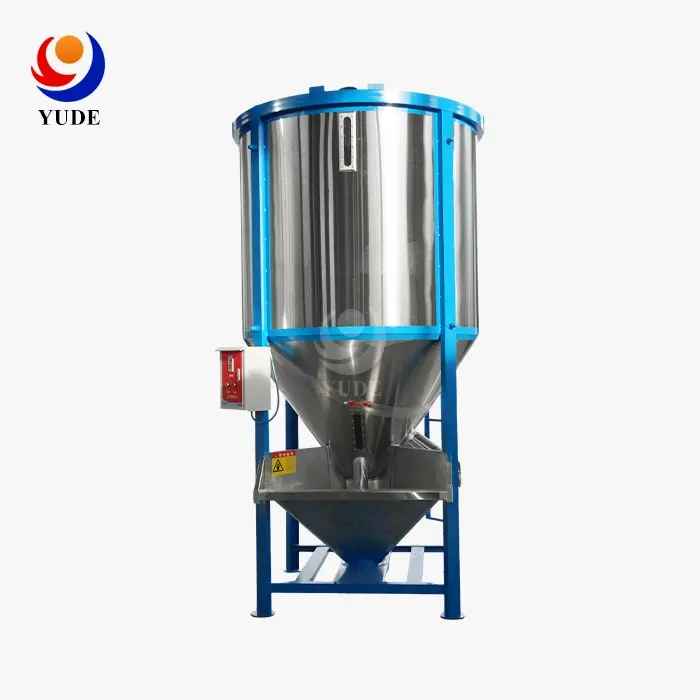
A vertical pellet mixer wins when you need blending and drying in one vessel, have limited floor space, and run batches near three tons. A 3 ton vertical plastic particle mixer with drying function https://www.yudemachinery.com/vertical-plastic-particle-mixer-with-drying-function/3-ton-vertical-plastic-particle-mixer-with-drying-function lifts pellets with a vertical spiral, circulates them with hot air, and reaches mixing uniformity of 98% or higher. Moisture after drying stays at 0.5% or lower, and one mixing and drying cycle takes 30 to 45 minutes. I wrote this guide for U.S. plant managers, engineers, and buyers who compare tank mixers. Below, I cover design, comparisons, specifications, applications, and supplier checks.
What Is a 3 Ton Vertical Plastic Particle Mixer with Drying Function?
How the Vertical Spiral Circulation Works
A 3 ton vertical plastic particle mixer with drying function has one barrel that uses hot air to mix and dry things. Being raised and lowered makes the pellets move in a way that looks like a circle. It moves around, so the base resin, masterbatch, and chemicals are spread out over the whole batch. The heat goes through more than just the top layer of particles because hot air moves through the moving pellets. Its spiral is made of thickened carbon steel, and its barrel is made of Q235 carbon steel with an insulating layer. The filling port is closed, so hot air can't escape. One tank can do two jobs, so pellets don't have to go between as many tools.
What "3-Ton Capacity" Really Means
People who provide it use the word capacity in various ways. The maximum loading weight, the hopper amount, or the hourly flow are all things that it could mean. This machine has a useful volume of between 4,500 and 4,800 L and a bulk density of 0.6 to 0.8 g/cm³. It can hold up to 3,000 kg. Just to be sure, 3,000 kg at 0.65 g/cm³ is equal to about 4,600 L, so it's in that range. Find out from each seller how much their pellets weigh in groups to see how much weight they can hold. Some of the time, a 3 ton vertical plastic particle mixer with drying function that can also dry things out does not work all the time.
Materials and Processes It Supports
A 3 ton vertical plastic particle mixer with drying function that can also dry out PE, PP, ABS, and PVC pellets. It can mix colors, change shapes, and dry them out. It gets rid of flaws that were caused by too much moisture and gets pellets ready to be ground, injected, or blown into films. You can change the temperature of the hot air from room temperature to 85 °C. This lets you set a lower limit for PVC and other plastics that don't like heat. Plastics making guides say that water can make parts spread out, bubble, and become weaker. Nylon and other resins that soak up a lot of water need a desiccant dryer. You can use this machine to dry them first.
When Does a Vertical Pellet Mixer Win Over a Horizontal Mixer?
Footprint and Gravity-Assisted Handling
Instead of the floor area, the height of a vertical vessel is used. In plants with enough space for the ceiling but not much for the floor, a vertical pellet mixer can work better than a long horizontal trough. Things can fall to the next step from the bottom of the jar, which also helps with mass. Get a copy of the plan that shows the general height and the layout for the discharge. Then, measure the crane's headroom, doors, and way in and out. You can dry things with this 3 ton vertical plastic particle mixer with drying function as well. You don't need a second machine on the floor because it does both in the same barrel. Putting tape on the floor to make a shape helps you see how it will fit.
Where a Horizontal Mixer or Ribbon Blender Fits Better
I'm not saying that one style is always the best. When the ceiling is low, ribbon blenders and horizontal mixers can work well because they sit lower. You can clean and fix them from the bottom up, and they might be better at moving powders or some other types of materials than pellets. Your line might work better with a constant feeder-blender than a 3-ton batch machine if it needs to blend all the time instead of just when it needs to. Find out how the cleaners can get to the base if the colors change every shift. Just because you think one plan is better doesn't mean that the other is better. Instead, compare them based on the size of the batches, the type of material, the height of the roof, and the way they are cleaned.
Vertical Mixer Dryer vs Separate Drying Machine
Because the 3 ton vertical plastic particle mixer with drying function has a built-in cooling feature, you don't have to move the materials or store them between steps or worry about getting them dirty. Plus, it saves time and space by not having to set up a second machine. With two different dryers, you can dry one resin while mixing the other. If you need more room later, you can always add it. To find out how efficient something is, you should look at its total running costs, not just its buy price. Make a list of how much it costs to set up, run, clean, change colors, maintain, and shut down. Some of the parts that use the most power are the hot tubes (60 to 75 kW) and the mixing motor (22 to 30 kW). So, ask each provider how many kWh were used for each batch under the same test conditions.
How to Choose the Right 3-Ton Plastic Granule Mixing and Drying Machine
Define Your Material and Batch Data
Start with your own number. Write down the type of resin, the amount of recovered material, any additives, the particle size, the starting moisture, the goal moisture, the batch weight, the daily output, and the kind of resin. All of these things affect how long, how hot, and how big of a batch can be used for drying. Because hot air can only go up to 85 °C, a PVC mix needs a different setting than PP pellets. This is because heat can damage PVC. Talk about the amount if you add masterbatch or powder. If there is a lot of powder, you may need to get new bearing seals or gather the dust. No more back and forth for weeks with a clear data sheet. It saves time and leads to a correct quote.
Check Mixing and Drying Performance
Look at how the supplier proves they can do what they say they can do. This 3 ton vertical plastic particle mixer with drying function should be able to mix evenly 98% of the time, dry the material to 0.5% moisture or less, and run for 30 to 45 minutes. How will the test be given? What will be on it? How long will it last? It's best for the form to be round, with no dead spots. This way, you can control the speed and use weak or heat-sensitive pellets. It takes less energy and dries things faster because the barrel is protected and the serving port is locked. You can also ask how the unit talks to your extruder or molding line.
Technical Specifications to Confirm Before Requesting a Quotation
Do these things before you ask for a price on a 3 ton vertical plastic particle mixer with drying function that can also dry things out:
- Capacity and mixing: Make sure the useful volume is between 4,500 and 4,800 L, the rated weight is 3,000 kg, the bulk density is what it says it is, and the fill ratio is right. To make it fair when you compare tools, you should ask the seller how they measure 98% accuracy and how long it takes to mix the mix. Also, ask what the batch weight is for the pellets you make.
- Power and drying: You should think about the 22–30 kW mixing motor, the 60–75 kW electric heating tubes, and the steam heating that you can add if you want to. Make sure that the temperature of the hot air can be controlled and that there is a total load connected. The temperature should be between room temperature and 85 °C. Then, before you place your order, check to see how much power and electricity your company has.
- Build and service: For build and service, look at the Q235 carbon steel barrel with the insulation layer, the thicker carbon steel spiral, the quality of the welds, and the sealed filling port. Ask about safety interlocks, overload protection, getting into the machine to do inspections, how to take care of the gearbox and bearings, spare parts, instructions, the terms of the warranty, and how to start the machine. Write down everything they say.
Application Scenarios for a 3 Ton Vertical Plastic Particle Mixer with Drying Function
Extrusion and Film Blowing Lines
Film lines and extruders work best when the feed is steady and dry. If the pellets are wet, the product may bubble and be uneven, and you can see color drift between batches as streaks. A three-ton batch makes enough for a long run on big lines. When you blow film, it's important to use even masterbatch distribution because lines are easy to see on thin film. When extruding, a dry batch that is mixed evenly makes the feed more stable for the screw. Due to its 30- to 45-minute cycle time, each 3 ton vertical plastic particle mixer with drying function can make several batches during a shift. That way, you can get the right batch size and run time. Tell them how much your line feeds every hour.
Injection Molding and Granulation Pre-Processing
Injection molders see water on the outside of parts as splay lines, silver streaks, and bubbles. The machine dries the PE, PP, ABS, and PVC pellets to less than 0.5% moisture before putting them in the molding hopper. It can also be used to mix color and other ingredients into plants that shred before they pelletize. For parts that people can see, ABS is often used. Dry pellets and even color help get rid of flaws on the surface. What moisture level does the company that sells you resin say it should have? Some engineering resins don't need as much water as hot air can give them. You should make batches at the right time so that the pellets don't sit around for too long while you mold them.
Color Mixing, Modification, and Recycled Pellets
Most of the time, it's used to mix and change colors. By moving the resin up, colorants, additives, and processing aids are spread out. This makes the resin 98% uniform or better. The materials can be mixed with new resin, binders, or fillers after they have been washed and turned into pellets. After that, they can use the same container to dry the mix. It depends on the condition of the rescued material, like whether it is dirty or wet, so be clear about your sample when you ask for a price. Do a small test mix first if you want to change the recipe. Our staff at Yude Plastic Machinery can look over your recipe and help you figure out how big of a batch to make, how hot to make it, and how long to mix it for.
Procurement Risks, Supplier Checks, and a Decision Guide
Common Procurement Risks and How to Avoid Them
Most problems start with words that aren't clear. It's best to stay away from drying claims that aren't backed up by tests, energy use that isn't included in the price, and weak terms for after the sale. To keep yourself safe, do these five things: write down the warranty, manuals, spare parts, commissioning, and response times; be clear on your goals for uniformity and moisture; look over the connected load and expected consumption per batch; check the site's height, foundation load, ventilation, access, and utilities; and ask for a working capacity based on the actual bulk density. The motors for cooking and mixing add up to 82 to 105 kW, so make sure you have enough power from the start. Getting written answers to these questions before you buy a 3 ton vertical plastic particle mixer with drying function that can also dry things out will save you a lot of money in the long run.
How to Evaluate a 3-Ton Plastic Mixer Manufacturer or Supplier
A good plastic grain mixer provider will be able to talk about the design of the shaft, the layout of the blades, how well the machine dries, the controls, and how the parts that touch the material are made. Find out if the company tests, builds, and integrates electrical parts on its own. A list of utility needs, inspection records, wiring plans, and a list of extra parts are also things you should ask for. The vertical plastic mixers that Yude Plastic Machinery makes can hold up to 10 tons of stuff. Around the world, people buy our machines. Our website can be used in more than one language, the machines can be changed to meet local standards, and you can get help with any problems at any time. You can also be sure that the whole process is quality-checked, from the materials that come in to the machines that are finished. People who buy from OEMs or distribute should also find out what language the interface is in and how it will be packed to send abroad.
Is a Vertical Pellet Mixer Right for Your Plant?
Take a simple test. If you need to dry and mix a lot of food at once, don't have much floor room but enough ceiling height, want to mix recycled pellets, or need to control the mixing time and temperature, a vertical mixer dryer is a good choice. Get different tools if your line is long, your roof is low, you need a separate place to dry, or you clean a lot at ground level. Next, make sure you agree on the type of material, its capabilities, its uniformity, its moisture goals, its uses, its safety, its shipping, its guarantee, its extra parts, and the terms for starting up. If most of the answers point to a vertical design, the 3 ton vertical plastic particle mixer with drying function should be near the top of your list.
Conclusion
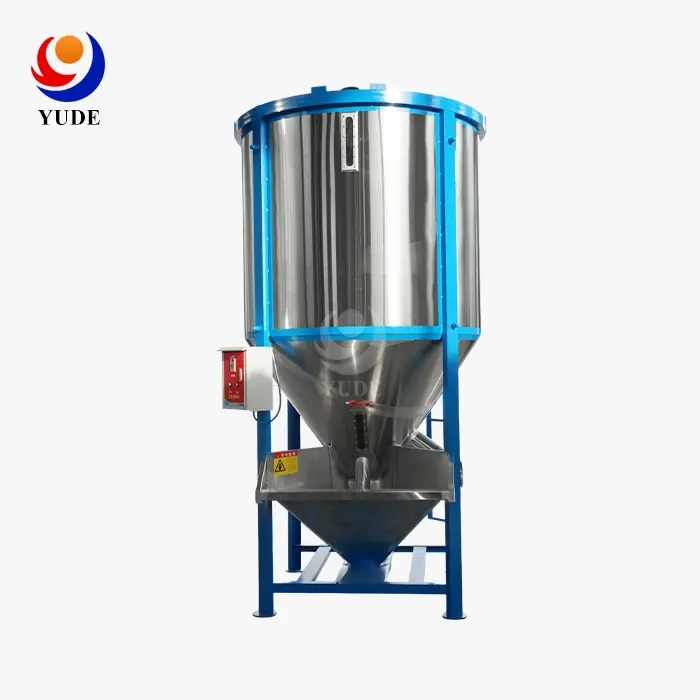
There is more floor space than ceiling height in a plant that makes batches and needs to mix and dry with hot air in the same batch barrel. A vertical pellet mixer is the best choice for this place. There is a story about a 3 ton vertical plastic particle mixer with drying function that can dry things out and can hold up to 3,000 kg of material. It has a 30 to 45 minute cycle and a mixing consistency of 98% or higher. It also doesn't have more than 0.5% moisture. It is still best to use horizontal mixers and separate dryers when there are low ceilings, long lines, or drying that needs to be done by itself. The bulk density should be used to figure out the capacity. The regularity and moisture should also be checked separately. The power and site conditions should also be looked at, and the total cost of running the business should be compared. Making sure the machine works with the job and the material is the best way to buy something.
FAQ
Can a 3 ton vertical plastic particle mixer with drying function replace a dehumidifying dryer?
Not all the time. A dehumidifying dryer uses desiccant to bring down the dew point very low. The pellets are dried in this 3 ton vertical plastic particle mixer with drying function with hot air until they are 0.5% wet or less. This is good for many PE, PP, ABS, and PVC jobs. It works well as a pre-dryer for nylon and other resins that soak up a lot of water.
How long does one batch take?
When you mix and dry something for 30 to 45 minutes, the mixing is even at least 98% of the time. Tell me the numbers for your resin, starting moisture, and target moisture. That way I can get a good idea of how long it will take. Plan your shifts and hoppers further downstream to fit that cycle time.
What information do I need to send for a quotation?
Send the type of resin, the additives, the bulk density, the batch weight, the starting and goal moisture levels, the temperature range, the plant voltage, the room that is available, the destination, and the schedule. Giving a price of "3 tons" is not enough to get an exact answer.
Request a Technical Proposal from Yude Plastic Machinery
There are 3 ton vertical plastic particle mixer with drying functions made by Yude Plastic Machinery that can also dry plastic for clients in over 30 countries. You can email sales@yudemachinery.com with your resin, batch weight, moisture goal, plant power, and delivery needs. After the sale, our experts will put together a detailed plan that includes a quote, a list of features, and terms for after the sale. Our service team is available 24 hours a day, seven days a week to help with any order. Visit https://yudemachinery.com/ to learn more about this item.
References
- Handbook of Industrial Mixing: Science and Practice, 2004
- Injection Molding Handbook, 2000
- Plastics Additives Handbook, 2009
- Polymer Extrusion, 2014
- Extrusion: The Definitive Processing Guide and Handbook, 2005
- Mixing in the Process Industries, 1992
Learn about our latest products and discounts through SMS or email