- English
- French
- German
- Portuguese
- Spanish
- Russian
- Japanese
- Korean
- Arabic
- Greek
- German
- Turkish
- Italian
- Danish
- Romanian
- Indonesian
- Czech
- Afrikaans
- Swedish
- Polish
- Basque
- Catalan
- Esperanto
- Hindi
- Lao
- Albanian
- Amharic
- Armenian
- Azerbaijani
- Belarusian
- Bengali
- Bosnian
- Bulgarian
- Cebuano
- Chichewa
- Corsican
- Croatian
- Dutch
- Estonian
- Filipino
- Finnish
- Frisian
- Galician
- Georgian
- Gujarati
- Haitian
- Hausa
- Hawaiian
- Hebrew
- Hmong
- Hungarian
- Icelandic
- Igbo
- Javanese
- Kannada
- Kazakh
- Khmer
- Kurdish
- Kyrgyz
- Latin
- Latvian
- Lithuanian
- Luxembou..
- Macedonian
- Malagasy
- Malay
- Malayalam
- Maltese
- Maori
- Marathi
- Mongolian
- Burmese
- Nepali
- Norwegian
- Pashto
- Persian
- Punjabi
- Serbian
- Sesotho
- Sinhala
- Slovak
- Slovenian
- Somali
- Samoan
- Scots Gaelic
- Shona
- Sindhi
- Sundanese
- Swahili
- Tajik
- Tamil
- Telugu
- Thai
- Ukrainian
- Urdu
- Uzbek
- Vietnamese
- Welsh
- Xhosa
- Yiddish
- Yoruba
- Zulu
What is PS plastic mixer?
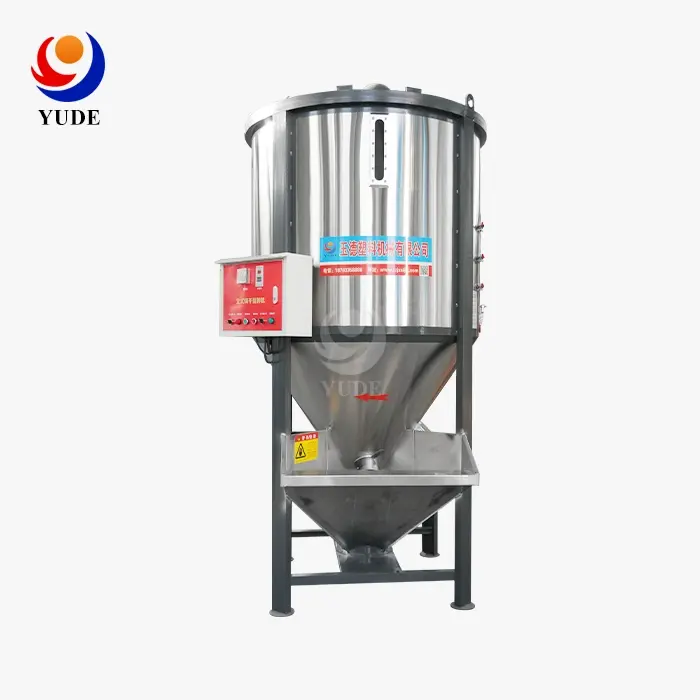
A PS plastic mixer https://www.yudemachinery.com/plastic-mixer/ps-plastic-mixeris industrial equipment that blends polystyrene pellets with color masterbatch, additives, and regrind until the batch is uniform. It does not melt the resin. It prepares an even blend before the material reaches an injection molding machine, an extruder, or a granulation line. I wrote this guide for plant managers, process engineers, and buyers who want to know how the machine works, which type fits their material, and what to ask a supplier before ordering. Each section below answers one question that buyers raise often.
Understanding PS Plastic Mixer Basics
Materials the Machine Handles
Polystyrene is an amorphous material. The grades I see most often are GPPS and HIPS. HIPS has pieces of rubber in it that make it stronger when it hits something. GPPS is clear and stiff. These resin mixers can also work with masterbatch, fillers, modifiers, processing aids, and recycled regrind. The machine further down the line gets a steady flow of material from the first shot to the last because every batch should have the same mix. For the most part, pellets are used as feed. Some plants mix powders and grind them again. The machine has to fit the material because each shape acts in a different way.
Mixing Versus Melting and Compounding
Buying people often get compounding and mixing mixed up. Solids that are at or below the point where they melt are mixed by a mixer. The resin is melted and mixed by an extruder. It is written about two ways to mix in books on polymer processes. The batch is split up into groups and parts that are spread out by distributive mixing and dispersive mixing. Spreading out the pellets is what dry mixing is mostly based on. Slip heat from high-speed hot mixers helps powders and chemicals mix. A compounding mixer is joined to an extruder. Being aware of this difference helps people temper their hopes. The mixer make a base mix, and the extruder or injection screw finish the job.
What Shapes the Right Configuration
What makes a design work depends on a number of things about the material. A batch's weight is based on how dense its bulk is. When it's wet, it can stick together. Fine fillers will stick to the walls of polystyrene if you let static electricity build up on it. How you feel heat is also important. PS turns into glass at around 100 °C, so any mixing that is done over heat must stay well below that temperature. The pellets will get soft and stick together if it gets above that. Flow rate and equipment further down the line also affect the size and direction of the discharge. Before I recommend a PS plastic mixer, I find out six things: the type of material, its bulk density, its moisture level, the type of addition, how much it must be mixed every hour, and how the machine is fed.
How a PS Plastic Mixer Works and Which Types Exist
The Operating Sequence
A motor turns a rod that has a spiral screw or blades on it. Pellets fall to the bottom of a vertical machine and are picked up by the spiral. The pellets then fall back along the barrel wall. It keeps the circulation moving. It has five steps: put in the ingredients and weigh them, mix them for a certain amount of time, heat or cool the mixture as needed for the process, check a sample, and let the machine go. The order of loading is important. A lot of people put the addition or masterbatch on top of the main mold. The uniformity can also be changed by the fill ratio, the mixing time, and the speed of the rotation. It's hard to move when it's too full, and cycle time is wasted when it's too empty.
High-Speed, Low-Speed, Vertical, and Horizontal Designs
The main differences between tools are how fast they work and where they are put. High-speed mixers create shear and friction heat. All of that helps the powders and ingredients spread out, but it makes the whole pieces feel very heavy. Low-speed mixers move things slowly, which is good for pellets because it keeps them from breaking. Vertical designs don't take up much space on the floor and empty out naturally from the bottom up. Horizontal ribbon or paddle units need more floor room and can be set up in different ways to load and unload. For recipes that need them, models that are heated will work. Models that aren't heated will mix dry pellets. You have more choices when you use drives that can change speeds. You should still try it with your own stuff, though, since catalog numbers can't tell you how a certain mix will work.
Yude's Vertical Mixer for PS Pellets
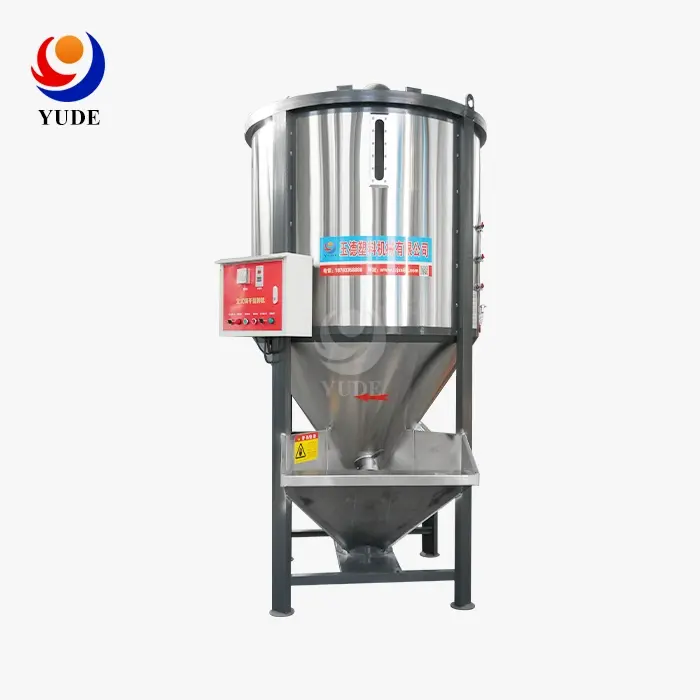
Yude Plastic Machinery makes a PS pellet vertical mixer. The spiral shape of this PS plastic mixer works with the way the pellets are made. The mixing conditions depend on how thick and thin PS is. They keep the mixing even by about 98% and keep the things from sticking together. For PS, the barrel is made of a certain material, and the equipment lasts longer because the mixing parts don't wear out. The machine is made for lines that make extrusions, injection molds, and PS grains. Yude also says that it can be used to mix pellets for making PP pipes, PE films, PVC profiles, and ABS shells for home appliances. Yude makes vertical mixers that can hold between 600 kg and 10 tons.
Where PS Plastic Mixers Are Used and How They Compare
Compounding, Masterbatch, and Color Work
A steady premix helps the additives spread out evenly and the extrusion stay stable during compounding. The mixer stops spotting and spreads the color evenly throughout the batch. This lowers the number of mistakes in injection molding. HIPS is often used to make housings for appliances and food service containers. Each lot of HIPS needs to have the same color. This is easier to do when you have recipes and batch records that you can use again and again. It's the same for companies that make foam and packages. There is more waste when an additive that foams doesn't spread out evenly. This is because the product's density can be different in different parts.
Recycled PS and Line Integration
PS that has been recycled has dirt, water, and pieces of different sizes. The mass densities of virgin pellets and regrind chips are different, so they can split when you move or shake them. A PS plastic mixer that moves from top to bottom mixes them again before they get to the machine. The mixer is connected to hoppers, belts, scales, dryers, and the extruder or shape machine, making a full line. It matters how big the line's mixer is. In general, you should choose a size that is about 1.5 times what the molding machine is used for every day. The screw doesn't run out of room because that area can be used to load, unload, and store buffers.
PS Plastic Mixer vs. PVC, PE, and Other Mixing Solutions
Mixing plastics in different ways is not the same. When PVC breaks down, it releases hydrogen chloride, which is very acidic, and it does not like heat. So, hot-and-cold mixer pairs that are made to last are often used in PVC lines. PE is softer, and it can get warmer and softer when it rubs against something. Static electricity builds up inside PS because it is rigid. Grounding and smooth surfaces inside PS are helpful. For heavy mixing, high-speed mixers are best, while low-speed blenders are best for soft mixing. A regular PS plastic mixer isn't good enough for processes that need vacuum, gravimetric dosing, special cooling, or melt mixing. Pick the answer from the whole process, not just the thing's name.
How to Choose the Right PS Plastic Mixer
Define Capacity and Working Volume
Pick up where it says "space" on the top of the page. How much space in the tank does not equal how much space can be used. The batch weight is equal to the working volume times the mass density. The working volume is based on the fill ratio. A light material quickly fills up a tank. Also, batch capacity and continuous throughput are not the same thing. You need to figure out which one your line needs. Yude has small plastic particle mixers that can hold up to 300 kg to 500 kg and tall vertical mixers that can hold up to 10 tons of plastic. You won't waste money on a unit that is too small if you match these numbers to how much you normally produce.
PS Plastic Mixer Specifications and Total Cost of Ownership
A good review checks out more than just what the machine can do. Find out about the working volume, speed range, barrel and blade parts, motor size with overload protection, discharge type, controls, measurements, and safety locks. It depends on the type of stainless steel used, how it is customized, how it is automated, how it controls dust, how it meets electrical standards, how it is tested, how it is shipped, and how it is installed. Ask the supplier to make a list of what the quote covers and what it doesn't cover. Next, add up all the costs of running the business, like energy costs, parts, cleaning, downtime, service life, and rejected materials. A low price doesn't seem as good if there are issues with the color or production that take away from the savings.
Common Mistakes to Avoid
When you judge a machine too narrowly, you end up with most selection problems. People often choose the capacity based on the tank volume instead of the working volume, or they choose the motor power without checking the recipe or blade design. Some people don't care about temperature control or believe that powders, pellets, regrind, PS, and PVC are all the same thing. Because PS is tough, it's important to have mix parts that last and a good barrel material. Pellets can also break if the spiral isn't made well. To make sure a machine works, test it with real-world materials and users. Compare suppliers on how much energy they use, how often they need maintenance, how much downtime they have, and how good their expert help is, not price alone.
How to Evaluate a PS Plastic Mixer Manufacturer?
Experience and Quality Control
It makes sense that many buyers are still not sure at this point. PS plastic mixer is a real investment. Get to know how much each supplier knows about PS, masterbatch, additives, and recycled materials. Check to see if it can be made, if it meets safety standards, what the warranty covers, and if spare parts are available. It is used by Yude Plastic Machinery as a full-process checking device. People on staff check the raw materials that come in, watch how the machines are made, and check each finished machine one last time before it is sent out. The company has a team of senior technical staff, modern tools for making things, and standard ways to do everything from making parts to putting together whole machines.
Customization, Export, and After-Sales Support
Some models don't work with all plants. When Yude Plastic Machinery makes machines, they can be made in sizes and shapes that aren't standard. Its R&D team can also quickly make changes to meet specific needs. People in more than 30 places buy things from this company. It can offer control interfaces in more than one language and make changes to equipment that are in line with standards in the local business. It has customer service centers open seventy-four hours a day in the US that can answer calls within 24 hours. It also has professional service teams in other countries that work with its US centers. If you are a U.S. business, you should make sure of the voltage, safety, and connection needs as soon as possible during the price process.
What to Send With Your RFQ
When you ask a clear question, you get a clear answer. Here's what I want buyers to share in three groups:
- Material and additives: What is the PS grade (GPPS, HIPS, or recycled?), the size of the pellets, the type and amount of masterbatch, the level of moisture, and the bulk density? Based on these details, engineers choose the spiral shape, the material of the barrel, and the amount of time for mixing. They can also point out problems with power or dust before giving you a quote.
- Output and process: What is the name of the machine that is being fed, such as an extruder or an injection molding machine, and how much is being made each hour? Then, they can choose a capacity that has the right buffer and a discharge method that works for your line.
- Plant and destination: Write down how much power, machinery, space, and country it will go to. Write down any language needs the GUI has. These things are in charge of shipping, packing, starting up, and plan drawings.
Then, a professional can give you a price for a standard or custom setup that works for your business.
Conclusion
One way to make a uniform batch is to use a PS plastic mixer to mix polystyrene pellets, masterbatch, additives, and regrind. The mixer does not melt or fully mix the resin, though. The right design changes for each formulation because the shape, bulk density, moisture, static, and heat sensitivity of the material all affect the results. A vertical, horizontal, high-speed, or low-speed machine is best for a different task. While PVC and PE don't change when it gets hot, PS is more likely to rust. The working amount and mass density are used to figure out what size to use. Not only price should be thought about, but also energy use, wear, downtime, and things that are not used. For the best results, test with real materials and buy from a seller who knows how to use PS, checks the quality, and offers help after the sale.
FAQ
Can a PS plastic mixer replace an extruder?
Not at all. It takes a mixer to make a smooth mixture of solid things. The resin is melted and mixed by an extruder. Many plants use both in sequence.
Can one machine handle both powders and pellets?
Sometimes. For powders, you need to cover them more tightly and keep out more dust. For pellets, you need to be careful not to break them when you handle them. You can be sure of the fit by trying it on with real materials.
Why do prices vary between machines?
Prices vary based on the item's size, the materials used, the controls, whether it's heated or cooled, testing, and any changes that are made. When more automation is added and stainless steel is used, the price goes up.
What information do I need for a quotation?
Tell them the PS grade, the chemicals, the mass density, the batch size, the hourly output, the voltage, the temperature, and where the things need to go. With these details, the right setup can be made.
Request a PS Plastic Mixer Quote from Yude Plastic Machinery
Yude Plastic Machinery makes PS plastic mixers that can hold anywhere from 600 kg to 10 tons of plastic. They also come in custom sizes and have interfaces that can be used in more than one language. If you email sales@yudemachinery.com with your resin grade, chemicals, group size, and hourly output, our engineers will help you figure out the best way to set up your machine. Please visit yudemachinery.com to see all of the items they offer.
References
- Modern Styrenic Polymers: Polystyrenes and Styrenic Copolymers, 2003
- Mixing and Compounding of Polymers: Theory and Practice, 2009
- Plastics Additives Handbook, 2009
- The Elements of Polymer Science and Engineering, 2013
- Materials Science of Polymers for Engineers, 2012
- Handbook of Plastics, Elastomers, and Composites, 2002
Learn about our latest products and discounts through SMS or email