- English
- French
- German
- Portuguese
- Spanish
- Russian
- Japanese
- Korean
- Arabic
- Greek
- German
- Turkish
- Italian
- Danish
- Romanian
- Indonesian
- Czech
- Afrikaans
- Swedish
- Polish
- Basque
- Catalan
- Esperanto
- Hindi
- Lao
- Albanian
- Amharic
- Armenian
- Azerbaijani
- Belarusian
- Bengali
- Bosnian
- Bulgarian
- Cebuano
- Chichewa
- Corsican
- Croatian
- Dutch
- Estonian
- Filipino
- Finnish
- Frisian
- Galician
- Georgian
- Gujarati
- Haitian
- Hausa
- Hawaiian
- Hebrew
- Hmong
- Hungarian
- Icelandic
- Igbo
- Javanese
- Kannada
- Kazakh
- Khmer
- Kurdish
- Kyrgyz
- Latin
- Latvian
- Lithuanian
- Luxembou..
- Macedonian
- Malagasy
- Malay
- Malayalam
- Maltese
- Maori
- Marathi
- Mongolian
- Burmese
- Nepali
- Norwegian
- Pashto
- Persian
- Punjabi
- Serbian
- Sesotho
- Sinhala
- Slovak
- Slovenian
- Somali
- Samoan
- Scots Gaelic
- Shona
- Sindhi
- Sundanese
- Swahili
- Tajik
- Tamil
- Telugu
- Thai
- Ukrainian
- Urdu
- Uzbek
- Vietnamese
- Welsh
- Xhosa
- Yiddish
- Yoruba
- Zulu
Why does low-temperature hot air drying below 85℃ protect PE PP ABS PVC materials?
Low-temperature hot air drying below 85℃ protects polymers that are sensitive to heat by stopping molecules from breaking down irreversibly. When PE, PP, ABS, and PVC particles are exposed to too much heat, chemical bonds break. This causes the particles to change colour, become brittle, and lose their mechanical properties. In order to achieve regular moisture removal without causing thermal damage, equipment like the 2000kg vertical plastic particle mixer with drying function https://www.yudemachinery.com/vertical-plastic-particle-mixer-with-drying-function/2000kg-vertical-plastic-particle-mixer-with-drying-functionkeeps the airflow under control within this important temperature range. This ensures that the products produced in the following steps are consistent and free of defects.
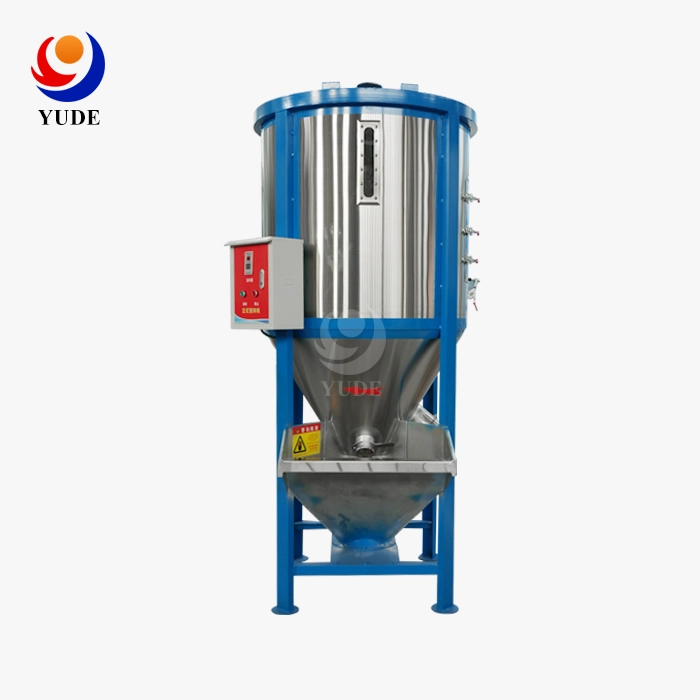
Understanding the Effects of Drying Temperature on Plastic Materials
Polymer science says that thermoplastics have different melting and glass transition temperatures. When compared to engineering-grade resins, PE and PP have lower melting points. On the other hand, ABS and PVC soften at very low temperatures. When cooling temperatures go above 85℃, oxidation speeds up, chemical chains break apart, and plasticisers move around or evaporate in PVC mixtures. These changes show up as yellowing, less resistance to impact, and surface cracks—defects that make it hard to meet product standards in extrusion and injection moulding.
Heat Tolerance Limits of Common Thermoplastics
Polyethylene (PE) usually stays stable up to 80°C for a long time, though high-density types can handle slightly higher temperatures. Polypropylene (PP) is also very sensitive. Long-term heat above 85℃ can cause the chain to split and the melt flow to become uneven. ABS is a styrene-acrylonitrile copolymer that is grafted onto polybutadiene rubber. It breaks down when butadiene segments oxidise under too much heat, which makes the material less tough and shiny. PVC is still very fragile because temperatures above 85℃ cause dehydrochlorination, which releases hydrochloric acid that speeds up the breakdown process even more.
Physical and Chemical Alterations Triggered by High Temperatures
High drying temperatures change things physically and set off chemical processes that can't be undone. Particle agglomeration is a physical change in which weakened surfaces stick together, making the feed into processing equipment less uniform. Changes in chemicals are worse: cross-linking in PE and PP makes it harder to melt process, and chromophore formation in ABS changes the colour permanently. When stabilisers and plasticisers in PVC formulations evaporate, they leave behind brittle, chalky material that can't be used for flexible applications.
Controlled low-temperature drying keeps molecules whole by keeping polymer chains below the levels of activation energy needed for breakdown processes. Modern vertical mixing systems move hot air around at precisely controlled temperatures, spreading the heat evenly across 2000kg batches. The vertical spiral circulation structure makes sure that every particle has the same temperature past. This gets rid of hotspots that cause degradation to happen only in certain areas. The amount of moisture drops below 0.5% without changing the colour, the surface finish, or the tensile strength. These are all important properties for car parts, building profiles, and consumer packaging.
Working Principle and Benefits of 2000kg Vertical Plastic Particle Mixers with Drying Function
By combining two important steps into one, 2000kg vertical plastic particle mixer with drying function technology changes the way materials are prepared in a big way. The machine has a central auger that lifts particles from the base and moves them around in a fountain-like pattern that keeps exposing the material to conditioned airflow. This Archimedes screw system makes handling soft, which keeps pellets from breaking, and it mixes evenly enough to exceed 98% of the time.
Operational Mechanics of Large-Capacity Models
The rated capacity of 2000kg can handle bulk densities of 0.6 to 0.8 g/cm³, which means that the effective volume can be anywhere from 3000 to 3200 litres. The thicker carbon steel spiral is turned at the best speeds by a mixing motor with a 15–18.5kW rating. This balances output against shear forces. At the same time, 40 to 50kW electric heating tubes bring temperature-controlled air into the insulated Q235 carbon steel barrel. Due to the blocked feeding port, no heat is lost, so the air stays the same during the 25- to 40-minute cycle.
With PID controls that can achieve ±2°C accuracy, the temperature can be changed from room temperature to 85°F. Hot air comes in through strategically placed openings and rises with the particles, creating a co-current flow pattern. As water vaporises, humidity sensors open vent valves, forcing out the humid air while warm air from outside comes in to fill the room again. This constant exchange keeps drying rates at their best without causing temperature jumps that damage the qualities of the material.
Instead of drying in different silos and then blending horizontally, combined vertical systems don't need to move the materials back and forth, which can cause contamination and handling losses. A single process cuts down on the number of workers needed, the space needed on the production floor, and the time it takes to complete a cycle. It becomes easier to keep track of batches, which ensures traceability for quality assurance processes that automakers and medical device makers need. As insulation layers cut down on idle heat loss, energy efficiency goes up, and capital investment is spread out over multiple process goals with dual-function operation.
Advanced Drying Technology in Vertical Plastic Particle Mixers: Performance and Energy Efficiency
Modern 2000kg vertical plastic particle mixer with drying function has sensor arrays and automatic feedback loops that change the drying settings in real time to get the best results. Temperature stratification is tracked by thermocouples placed at different room heights, and moisture concentration differences are found by humidity probes. Microprocessor-based control systems look at this stream of data and change the output of the heater and the rate of air flow to keep the conditions even across the 2-ton load.
Precise Temperature Regulation and Airflow Management
Keeping temperatures below 85℃ in a mixture of different types of particles takes a lot of complex airflow engineering. Variable-speed fans change the mass flow rates based on the density and moisture content of the material. This keeps condensation from building up in areas where the flow stops. Internal baffles change the smooth flow patterns of fluids, creating turbulence that improves heat transfer without creating too much shear. This means that every pellet in the 3000 litre volume is exposed to the same amount of heat, which achieves uniform moisture reduction that is necessary for consistent processing further down the line.
Optimising energy use comes from designing thermal protection and using smart heating controls. Radiant and convective losses are cut by multi-layer insulation around the barrel. This lowers idle energy draw by about 40% compared to designs that aren't insulated. The heating elements only work during the active drying phases. Any leftover heat is kept during the mixing cycle. This operational approach lowers the number of kilowatt-hours needed to dry one kilogram of material. For high-volume producers, this directly lowers their variable production costs.
Metrics that measure performance show that combining low-temperature drying with 2000kg vertical plastic particle mixers with drying function has real-world benefits. When processing regrind ABS for auto interior parts, industrial installations report 30% shorter cycle times than when processing in a sequential order. With combined systems, the range of moisture content changes from ±0.3% with different tools to ±0.08%, which reduces the number of splay mark defects in injection-molded parts. With automatic loading systems that allow constant extrusion lines that make HDPE pipe or PVC profiles, the throughput capacity can reach 48 to 58 batches per day.
Conclusion
Drying at low temperatures (below 85℃) saves PE, PP, ABS, and PVC materials by stopping thermal breakdown that hurts their strength and appearance. Integrated vertical mixing systems protect against this by precisely controlling temperature, distributing airflow evenly, and effectively getting rid of moisture. The 2000kg vertical plastic particle mixer with drying function capacity meets the needs for large-scale production while keeping operations efficient and product quality high. Long-term performance and production reliability are ensured by choosing the right equipment, taking into account technical capabilities and the infrastructure for supporting suppliers. Disciplined maintenance practices keep equipment working well, getting the most out of your investment while still meeting strict quality standards.
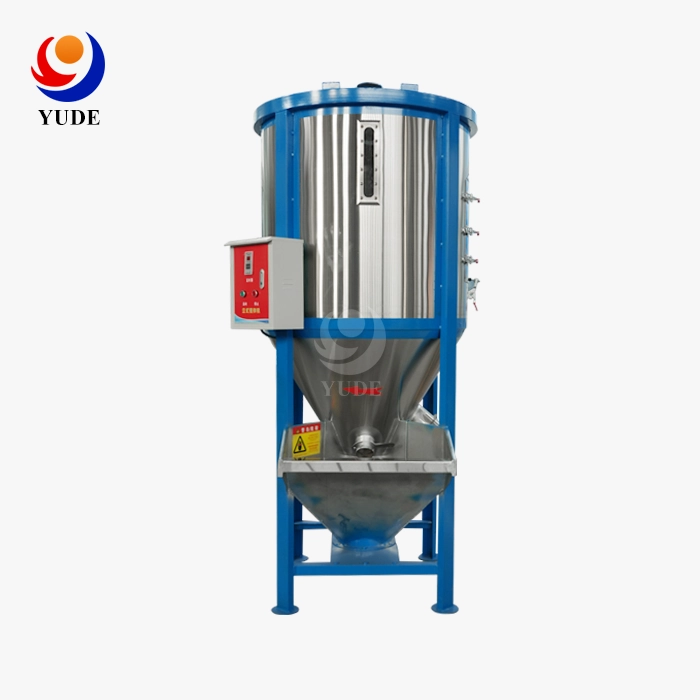
Partner with Yude Plastic Machinery for Superior Drying Solutions
For high-volume plastic processing operations to consistently produce high-quality materials, they need equipment that is built to be precise and reliable. Yude Plastic Machinery is a specialised 2000kg vertical plastic particle mixer with drying function supplier and seller that offers vertical plastic particle mixers with built-in drying functions. The strong 2000kg model is made for use with PE, PP, ABS, and PVC. Our processing skills allow us to keep temperatures well below 85°F, which protects your products and keeps the moisture level below 0.5%. We offer full expert support, customisation services that are in line with regional standards, and an after-sales system that is open 7 days a week and is backed up by field service teams. Contact our team at sales@yudemachinery.com to talk about your needs with procurement experts who know what the automotive, pipe extrusion, and recycling industries need.
FAQs
What specific temperature range works best for drying PVC particles?
When drying PVC particles, you need to be extra careful with the temperature. The best range for drying is between 60°C and 75°C. Going above 80℃ can cause the plasticiser to break down and start dehydrochlorination reactions that damage the material's properties. For building profiles and wire insulation, PVC needs to be able to stay flexible and stay the same colour. This can only be done with equipment that gives exact control within this small window.
How does mixing uniformity affect final product quality in injection molding?
Uniform mixing has a direct effect on the regularity of colour, the spread of mechanical properties, and the stability of moulded parts' dimensions. With equipment that achieves 98% uniformity or higher, colourants, additives, and regrind are spread out evenly across batches, getting rid of flaws like streaking or weak spots in the construction. This level of consistency cuts down on scrap and keeps the tight tolerances that auto and appliance makers need.
Can vertical mixers handle recycled materials with varying moisture content?
Advanced vertical mixing systems can handle different types of recovered materials by having longer cycle times and temperature control that adapts to the material. Moisture sensors measure the original content levels and change the drying time automatically to meet the requirements. These systems are perfect for processing rPET and rHDPE because they have gentle vertical circulation that keeps pellets from breaking down and removes moisture from washed flakes or agglomerates.
References
- Crawford, R.J. (2017). Plastics Engineering: Processing and Properties of Thermoplastic Materials. Butterworth-Heinemann Advanced Materials Series.
- Throne, J.L. (2016). Thermoplastic Processing: Principles and Practice for Drying and Mixing Applications. Hanser Publishers Technical Reference.
- Michaeli, W., Greif, H., Kaufmann, H., & Vossebürger, F.J. (2019). Technology of Plastics Processing: Material Preparation and Drying Systems. Hanser Gardner Publications.
- Rauwendaal, C. (2018). Polymer Mixing and Compounding: Fundamentals of Processing Technology. Hanser Publications Manufacturing Engineering Series.
- Goodship, V. (2020). Practical Guide to Injection Molding: Material Preparation and Pre-Processing Requirements. Smithers Rapra Technology Limited.
- Tolinski, M. (2015). Additives for Polyolefins: Drying and Handling Best Practices for Processing Operations. William Andrew Applied Science Publishers.
Learn about our latest products and discounts through SMS or email