- English
- French
- German
- Portuguese
- Spanish
- Russian
- Japanese
- Korean
- Arabic
- Greek
- German
- Turkish
- Italian
- Danish
- Romanian
- Indonesian
- Czech
- Afrikaans
- Swedish
- Polish
- Basque
- Catalan
- Esperanto
- Hindi
- Lao
- Albanian
- Amharic
- Armenian
- Azerbaijani
- Belarusian
- Bengali
- Bosnian
- Bulgarian
- Cebuano
- Chichewa
- Corsican
- Croatian
- Dutch
- Estonian
- Filipino
- Finnish
- Frisian
- Galician
- Georgian
- Gujarati
- Haitian
- Hausa
- Hawaiian
- Hebrew
- Hmong
- Hungarian
- Icelandic
- Igbo
- Javanese
- Kannada
- Kazakh
- Khmer
- Kurdish
- Kyrgyz
- Latin
- Latvian
- Lithuanian
- Luxembou..
- Macedonian
- Malagasy
- Malay
- Malayalam
- Maltese
- Maori
- Marathi
- Mongolian
- Burmese
- Nepali
- Norwegian
- Pashto
- Persian
- Punjabi
- Serbian
- Sesotho
- Sinhala
- Slovak
- Slovenian
- Somali
- Samoan
- Scots Gaelic
- Shona
- Sindhi
- Sundanese
- Swahili
- Tajik
- Tamil
- Telugu
- Thai
- Ukrainian
- Urdu
- Uzbek
- Vietnamese
- Welsh
- Xhosa
- Yiddish
- Yoruba
- Zulu
What mixing uniformity can a PS plastic mixer achieve?
A well-engineered PS plastic mixer can achieve a polystyrene blending uniformity of ≥ 98%, provided the equipment is matched to the density and flow characteristics of PS pellets. This figure is not theoretical — it reflects what purpose-built vertical spiral mixers consistently deliver in EPS packaging lines, XPS foam board production, and injection molding facilities. When foaming agents, color masterbatches, or functional additives must be evenly distributed throughout a PS batch, this 98% threshold is the industry benchmark that separates acceptable output from rejected product.
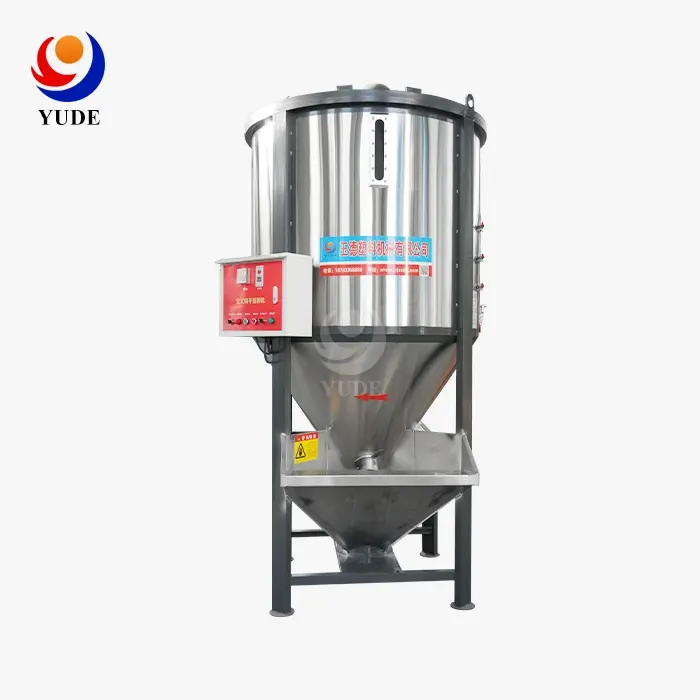
Understanding Mixing Uniformity in PS Plastic Mixers
Mixing uniformity is the degree to which every component in a blend — resin, additive, colorant, or regrind — is distributed evenly across the entire batch. For polystyrene processing, this metric directly determines whether your final product foams consistently, holds color across all shots, or warps under extrusion stress.
How Uniformity Is Measured?
The industry standard approach follows a tracer-pellet methodology. A known percentage of brightly colored tracer pellets (usually 0.5%) is added to a batch. From the top , middle and bottom of the chamber samples are taken and tallied . The standard variation for all three places is less than 1% which is good homogeneity. In most polymer processing audits, the approved pass criterion is a Coefficient of Variation (CV) of less than 5%.
Material Properties That Affect Blending
Polystyrene has several physical issues of its own. It possesses an irregular form resulting in a relatively low bulk density (about 0.6 g/cm3 for EPS beads). Due to its high electrical insulating nature, it develops static charge when disturbed. These qualities lead to the fine additives, in particular foaming agents such as HBCD replacements or nucleating agents to be separated from the pellets rather than to coat the pellets, which directly contributes to the density variance in the final foam product.
Why Generic Mixers Fall Short?
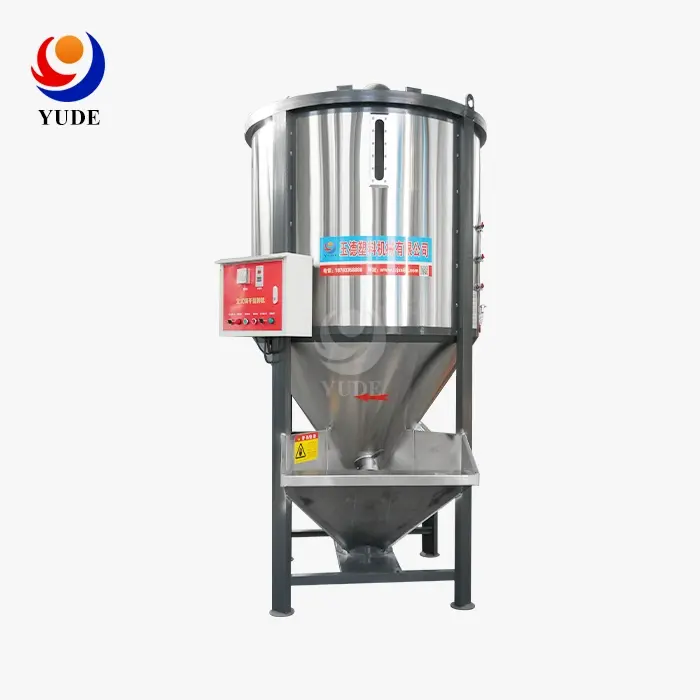
Low density PS beads require a vortex circulation pattern, which standard horizontal drum or paddle mixers for PVC compound can not achieve. A vertical PS mixing unit with spiral geometry, specially designed to force material from the bottom of the barrel up into the center and then out along the walls and down. This continual up and down circulation stops density stratification and dead zones where additives can form.
Types of PS Plastic Mixers and Their Uniformity Performance
Polystyrene is not mixed the same way by all mixing tools. When buying teams know how the different combinations work differently, they can make decisions based on production reality instead of catalog specs.
Vertical Spiral Mixers
The most frequent form of mixer used for combining PS pellets is the vertical screw type. The screw type auger provides constant flow that can handle PS low density and electrostatic qualities without fracturing the pellets. The rotation speeds are usually adjusted at 85 to 200 RPM to obtain sufficient movement for adequate mixing, but not to generate shear heat that could soften PS near its glass transition temperature, which is about 100 °C for GPPS.
Fixed vs. Portable Configurations
Fixed-installation vertical PS plastic mixers with batch capacities from 600 kg to 10 tons work well in ongoing production settings like XPS board extrusion lines. Moving units between 300 and 500 kg are handy for smaller EPS packaging plants or job-shop injection molders who change between PS grades all the time. When it comes to throughput, a fixed unit feeds an extrusion screw without stopping, while a portable unit acts as a buffer.
PS vs. PVC Mixer Design Differences
PVC compound mixers work faster and create frictional heat on purpose to mix plasticizers into the resin matrix. That method would hurt PS by creating hot spots in certain areas and breaking up fragile GPPS pellets. A PS-specific mixer has smooth, polished SUS304 stainless steel interiors (Ra < 0.2 µm) and wear-resistant mixing parts to keep the integrity of the pellets and evenly distribute foaming agents.
Optimizing PS Plastic Mixer Performance for Enhanced Uniformity
Getting ≥ 98% regularity on paper is one thing, but keeping it up for thousands of production runs takes careful equipment design and consistent operation.
Routine Maintenance That Protects Uniformity
In a vertical spiral mixer, the part that is under the most stress is the bearing system. External bearing placement, in which the case of the bearing sits outside the mixing room, keeps the PS batch from getting contaminated with grease. Every 1,000 hours of use, the lubrication should be topped off. Every year, shaft seals should be checked. Any cracks or crevices in internal weld lines must be ground smooth and polished. Any pigment or additive waste that gets stuck in them can contaminate the next batch.
Static Control Measures
In PS the static charge builds up such that the fine additives tend to adhere to the barrel wall rather than coating the pellets. Minimum correct grounding lines must be on the mixer body. Anti-static liquid dosing ports allow a controlled charge neutralizing chemical to be fed directly into the mixing cycle. This restores the additive-to-pellet contact needed for proper dispersion in high throughput or low humidity locations.
Monitoring and Process Control
The data from motor loads shows in real time how consistent a batch is. A motor with a gearbox and overload safety can handle high-torque start-up loads from thick PS charges. It can also record patterns of current draw that show when blade wear is starting to lower the circulatory efficiency. At commissioning, full-load capacity tests must be run for four hours, and the motor housing temperature must stay within Class F insulation limits and noise levels must stay below 75 dB. This sets a performance standard that workers can use to keep an eye on.
Procurement Considerations: Selecting a PS Plastic Mixer for Optimal Uniformity
Selecting a polystyrene blending unit is a capital decision with direct consequences for waste rates and machine uptime. The specifications that matter most are often underrepresented in standard catalogs.
Key Technical Specifications to Evaluate
Here are the parameters procurement teams should confirm before shortlisting any supplier:
- Mixing uniformity guarantee: Require a documented ≥ 98% uniformity rating with test methodology disclosed.
- Barrel material and finish: Mirror finish SUS304 stainless steel (Ra < 0.2 μm) minimizes stickiness and enables easy color changeovers.
- Drive system: Overload protected geared motors meet the heavy torque demands of dense PS loads without premature failure.
- Discharge efficiency: 0.1% to less than 0.1% of the material from one cycle to the next can be kept by conical barrel bottoms or pneumatic help.
- Safety interlocks: CE standard mechanical and electrical switches that stop operation when the feed lid opens are a must to make a facility compliant.
These specifications collectively protect both product quality and operator safety. Suppliers who cannot document each item in writing present an unquantified operational risk.
After-Sales Support and Spare Parts
In a foam packing business, PS plastic mixer downtime means a standstill for molding machines and missed delivery timetables. Confirm that the supplier keeps supplies of spare parts, especially for bearing assemblies and blade components, that are readily available. The risk of extended downtime is reduced by providing a 24-hour on-site response capacity for domestic facilities and a vetted local service partner for international installations.
Total Cost of Ownership
Price-per-unit comparisons between suppliers miss the more significant cost drivers: waste rate reduction, energy consumption, and maintenance frequency. A mixer that delivers consistent ≥ 98% uniformity and reduces foam density defects by even 2% across a daily production run of 5 tons generates measurable material savings that can recover equipment cost well within a 12–18 month payback window.
Real-World Applications of PS Mixers Achieving Superior Uniformity
EPS Foam Packaging Production
When making EPS beads for protective packaging, the density of the expanded product is directly affected by how evenly the foaming agent is spread out. Even a difference of ±0.5 g/L in density from one batch to the next makes parts that don't meet the requirements for padding performance. When compared to manual mixing, vertical PS mixers that run continuous cycles at matched throughput rates have cut the rate of foam density rejection at packaging plants by 15–20%.
HIPS Injection Molding for Electronics Enclosures
High Impact Polystyrene is used to make the housings for consumer electronics. These housings need to be completely consistent in color and have flame retardants spread out evenly. Thin-walled cases for routers and monitors are especially vulnerable to weak spots that are caused by high levels of additives in one area. Special PS mixing units make sure that the flame retardant and color masterbatch are spread out at the pellet level before the material goes into the injection screw.
Post-Industrial Regrind Blending
To keep costs down, many PS processors mix new resin with up to 40% in-house regrind. The difference in bulk density between uniform fresh pellets and irregular regrind chips makes it possible for the chips to separate during transport and shaking. This difference in density can be handled by a vertical spiral mixer with enough capacity. It does this by forcing continuous recirculation, which keeps the melt flow index (MFI) stable within acceptable process windows.
Conclusion
A well-designed polystyrene blending unit or PS plastic mixer should feature spiral circulation geometry, matched rotation rates, polished stainless steel barrel surfaces, and good static control to achieve > 98% mixing homogeneity. That level of performance isn’t just a marketing term; it’s a true, measurable standard that defines the uniformity of foam density, color fidelity and additive dispersion quality in your finished product. Buying teams who focus on these concrete elements, not just price, consistently have shorter payback periods and reduced rejection rates. With the appropriate tools and the correct materials, you will see a difference in your production figures.
FAQ
Does mixer capacity affect blending uniformity?
Yes. Running the mixer at a much lower level than its rated capacity affects the circulatory flow efficiency of the spiral mechanism and can cause lighter additives to float on top of the denser pellets. Running it over rated capacity doesn’t allow proper circulation from top to bottom. Best uniformity results are obtained at operating levels between 70% and 90% of rated capacity.
How do I switch between black HIPS and transparent GPPS without cross-contamination?
This change requires the ability to disassemble the blade without tools, to purge the chamber with compressed air and to clean off the stainless steel surfaces using an appropriate solvent such as isopropyl alcohol. For example, in a typical precision color-change operation a sacrificial purge batch of natural-grade material is run prior to the final clear run.
What maintenance schedule protects long-term uniformity?
Lubricate the bearing assembly every 1,000 operating hours. Shaft seals inspected annually. Inspect interior weld seams and polished surfaces every quarter for pitting or corrosion. Conduct a tracer-pellet uniformity test after any blade change or large maintenance event to confirm the system is back in specification.
Can a standard mixer handle glass-fiber reinforced PS?
No. Standard stainless steel blades will wear quickly with GF content of 10-30%. For GF reinforced PS grades hardened alloy steel blades or tungsten carbide coated components are needed to ensure structural integrity and prevent metallic contamination of the melt.
Get Consistent Blending Results with Yude Plastic Machinery
Yude Plastic Machinery makes vertical PS plastic mixer units with capacities ranging from 300 kg to 10 tons. Each one is made with wear-resistant parts and SUS304 stainless steel barrels to make sure that the blending is uniform to within ≥ 98%, which is what your production line needs. Our company is a reliable PS plastic mixer supplier with offices in more than 30 countries. We back up every unit with full installation help and a 24x7 after-sales service system. To get a quote, email our team at sales@yudemachinery.com or go to yudemachinery.com.
References
- Harper, C. A. (Ed.). Handbook of Plastics Technologies. McGraw-Hill, 2006.
- Rosato, D. V., & Rosato, M. G. Injection Molding Handbook (3rd ed.). Springer, 2000.
- Tadmor, Z., & Gogos, C. G. Principles of Polymer Processing (2nd ed.). Wiley-Interscience, 2006.
- Brydson, J. A. Plastics Materials (7th ed.). Butterworth-Heinemann, 1999.
- Giles, H. F., Wagner, J. R., & Mount, E. M. Extrusion: The Definitive Processing Guide and Handbook. William Andrew Publishing, 2005.
- Todd, D. B. (Ed.). Plastics Compounding: Equipment and Processing. Hanser Gardner Publications, 1998.
Learn about our latest products and discounts through SMS or email