- English
- French
- German
- Portuguese
- Spanish
- Russian
- Japanese
- Korean
- Arabic
- Greek
- German
- Turkish
- Italian
- Danish
- Romanian
- Indonesian
- Czech
- Afrikaans
- Swedish
- Polish
- Basque
- Catalan
- Esperanto
- Hindi
- Lao
- Albanian
- Amharic
- Armenian
- Azerbaijani
- Belarusian
- Bengali
- Bosnian
- Bulgarian
- Cebuano
- Chichewa
- Corsican
- Croatian
- Dutch
- Estonian
- Filipino
- Finnish
- Frisian
- Galician
- Georgian
- Gujarati
- Haitian
- Hausa
- Hawaiian
- Hebrew
- Hmong
- Hungarian
- Icelandic
- Igbo
- Javanese
- Kannada
- Kazakh
- Khmer
- Kurdish
- Kyrgyz
- Latin
- Latvian
- Lithuanian
- Luxembou..
- Macedonian
- Malagasy
- Malay
- Malayalam
- Maltese
- Maori
- Marathi
- Mongolian
- Burmese
- Nepali
- Norwegian
- Pashto
- Persian
- Punjabi
- Serbian
- Sesotho
- Sinhala
- Slovak
- Slovenian
- Somali
- Samoan
- Scots Gaelic
- Shona
- Sindhi
- Sundanese
- Swahili
- Tajik
- Tamil
- Telugu
- Thai
- Ukrainian
- Urdu
- Uzbek
- Vietnamese
- Welsh
- Xhosa
- Yiddish
- Yoruba
- Zulu
What advantage do the screw blades of plastic particle powder screw feeder have?
Screw blades in a plastic particle powder screw feederhttps://www.yudemachinery.com/plastic-particle-feeder/plastic-particle-powder-screw-feeder move material positively and repeatedly—each flight carries a measured pocket from hopper to machine, so output tracks screw speed rather than gravity. Capacity can be adjusted via speed, pitch, or diameter; the right geometry reduces surging and bridging while cutting manual bag dumping and dust. Hard-wearing blades also last longer with abrasive fillers like calcium carbonate. For pipe, profile, film, or compounding lines, uneven feed quickly shows up as thickness swings and scrap—so blade design is a process question, not just a catalog detail.
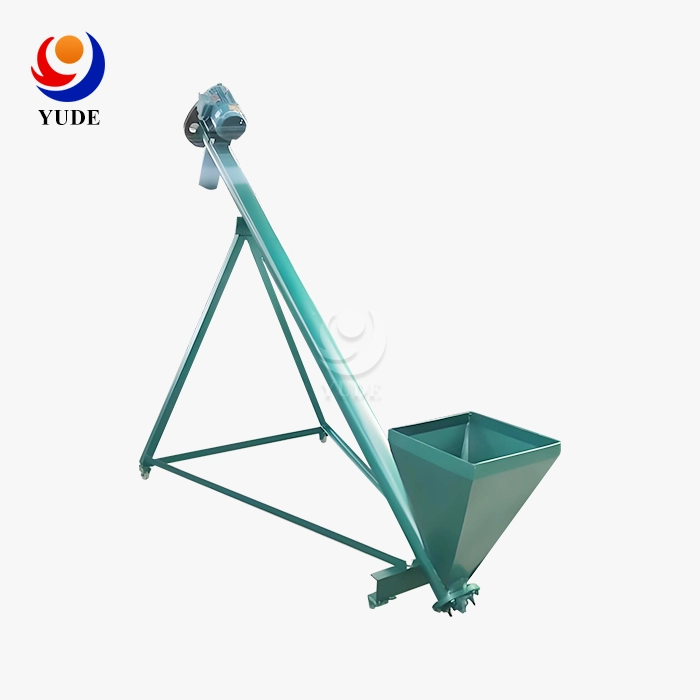
How a Plastic Particle Powder Screw Feeder Works
The Basic Working Principle
A rotating shaft carries helical flights inside a tube or trough. Material drops from the hopper into the space between the flights and moves forward one turn at a time. Because each turn carries a fairly consistent volume, output rises and falls with screw speed. The CEMA screw conveyor standard lists screw diameter, pitch, speed, and trough loading as the main drivers of capacity. Bulk density and flowability shift the result. A rating for free-flowing pellets can overstate what the same screw delivers with fine powder. I like to picture each flight as a measuring scoop that keeps turning without pause, which explains why blade details matter so much.
The Parts Around the Screw
The screw is only one piece of the system. A complete plastic particle powder screw feeder also includes a hopper, drive motor, gearbox, and often a variable-frequency drive. Many lines add an agitator, level sensors, dust collection, and a PLC or touchscreen. Weighing components turn a volumetric unit into a gravimetric one. When output drifts, the cause often sits in the hopper shape or the drive setting, not only the blade. I always check the full path from bag or silo to the receiving machine before I judge any single part.
Feeder or Conveyor: Why the Difference Matters
A general screw conveyor moves material from point A to point B, and it can run flooded without trouble. A feeder has a harder job because it must meter. That calls for tighter clearances, a controlled inlet, and a drive that holds speed at low RPM. If you only need to lift powder to a silo, a conveyor works. If you need a steady rate into a mixer or extruder, you need a feeder. Treating the two as the same machine is a common reason new lines miss their dosing targets.
What Advantages Do the Screw Blades Offer?
Positive Conveying That Beats Gravity Alone
Powders in a hopper do not always flow on their own. They pack, arch over the outlet, or tunnel through the middle. In a plastic particle powder screw feeder, the blades push material forward mechanically, so the feed does not depend on gravity alone. This matters on a PVC pipe or profile line, where a short interruption in powder flow can change wall thickness. I want to be clear on one point: bridging is a design issue shared by the hopper, the blade, and the material. Jenike's classic flow research showed that hopper geometry decides whether a powder arches over the outlet.
Adjustable Capacity and Repeatable Dosing
You can tune output in three ways: change the screw speed, swap to a different pitch, or choose a different diameter. Speed gives quick adjustment during production, while pitch and diameter set the working range. A volumetric feeder gives repeatable output when bulk density stays steady. When density shifts, a gravimetric loss-in-weight design corrects the rate by weight. When you size a plastic particle powder screw feeder, ask for the capacity range at your bulk density, not one maximum figure. Your goal is to match your mixer's batch time, not to buy the biggest number on the datasheet.
Compact Layout, Less Dust, Less Manual Work
A screw feeder sits directly under a hopper, silo, or mixer, so it fits where space is tight. A closed tube also keeps powder out of the air, which helps with dust complaints. In the United States, NFPA 652 requires a dust hazard analysis where combustible dust is present, and a closed feed path makes that review simpler. Automatic feeding also replaces bag dumping, which lowers labor needs and weighing errors. Steadier feed means fewer rejected batches and less scrap, and workers spend less time in the dust.
How Blade Geometry and Materials Shape Performance
Pitch, Diameter, and Flight Depth
A short pitch supports fine control at low output, since each turn moves a small volume. A long pitch carries more material per turn and raises capacity. Variable-pitch screws draw material evenly along the hopper opening, so the powder does not leave only from the front. Diameter and flight depth set the fill ratio, and the room material has to move. Single-flight screws suit standard jobs. Twin, ribbon, or open-helix designs help with sticky or cohesive powders because they leave less chance for material to pack around the core. Match the design to the powder, not the other way around.
Surface Finish and Wear Resistance
On a plastic particle powder screw feeder, filler content determines wear. Calcium carbonate has a Mohs hardness of about 3, and heavy loadings can wear screws and shaft seals within months. Polished or coated flights cut friction and help powder release, which shortens cleaning time. Harder steel, replaceable wear sections, and protective coatings extend blade life under abrasive loads. Ask for the exact material grade and an expected replacement interval for your filler level, not only a phrase like "wear-resistant steel." Then check how fast your crew can pull the screw and fit a new one, because downtime often costs more than the part.
Matching Blades to Powders, Pellets, and Blends
Free-flowing resin pellets work well with solid-flight screws and tight clearances. Fine, cohesive powders often need an open spiral, an agitator, or a larger inlet to stop packing. Pellet and powder blends add segregation risk. A fast screw can break pellets or separate the mix, so speed and inlet design matter. Regrind brings uneven bulk density, which suits a loss-in-weight setup. Polymer extrusion texts, such as Rauwendaal's, link steady feeding to steady melt output. The only dependable way to confirm a blade choice is to run your own formulation through it.
Choosing a Plastic Particle Powder Screw Feeder Configuration
Single-Screw or Twin-Screw
Single-screw units cost less and are simpler to clean and maintain, so they fit free-flowing pellets and many dry powders. Twin-screw units feed cohesive or difficult materials more evenly because the intermeshing screws help clear material from each other. They cost more and take more care to service. If your powder bridges or smears, test a twin-screw design or add agitation before you buy a bigger motor. If your material flows well, a single screw usually does the job at a lower price.
Volumetric or Gravimetric
A volumetric feeder fits materials with steady bulk density. A gravimetric feeder weighs the hopper and adjusts speed to hold a set mass rate, so it handles changing density and tight formulations. It has one trade-off: during refill, the weight signal is disturbed. Most loss-in-weight systems hold the last known speed during that period, and accuracy can dip. Ask any supplier what accuracy they promise during refill and under what test conditions. A figure such as ±0.5% means little without the material, feed rate, and test length behind it.
Selection Data and Common Mistakes
Before you buy a plastic particle powder screw feeder, start with your material: particle size, bulk density, moisture, temperature, abrasiveness, and flow behavior. Then set minimum and maximum feed rates, your accuracy target, and the operating mode. Those numbers decide diameter, pitch, length, and speed. The most common mistake is choosing by hourly capacity alone. Others include treating pellets and powders as interchangeable, ignoring humidity, and skipping a spare-parts plan. Check that screws, shafts, and seals come out easily. Confirm your plant's voltage, since many U.S. plants run 460 V or 480 V at 60 Hz, and ask about dust-control needs.
Testing, Customization, and Yude's Vertical Mixer
Testing With Your Own Material
Generic material labels do not predict how your powder behaves. A dependable supplier runs your actual powder, pellets, or formulation and checks flow, bridging, discharge consistency, and minimum and maximum capacity. A longer run shows wear, material buildup, seal performance, and cleaning effort. Ask for drawings, motor and control details, test results, a spare-parts list, warranty terms, and installation support. Before you approve a plastic particle powder screw feeder, I recommend a continuous trial of a full shift or longer, because short tests hide drift.
When Customization Pays Off
Standard equipment does not fit every layout or material. A supplier can adjust flight pitch, length, materials, hopper shape, drive arrangement, and controls to match your line or an OEM station. Yude Plastic Machinery builds non-standard sizes and special-material solutions, and it can supply multilingual operation interfaces and modifications that meet local industry standards. When you compare quotes, add up cleaning time, maintenance labor, downtime, scrap, and spare parts, not only the purchase price. A cheaper machine that blocks once a week costs more in the end.
Yude's Vertical Mixer and Its Wear-Resistant Screw Blades
Shandong Yude Plastic Machinery Co., Ltd. makes vertical plastic mixers from 600 kg to 10 tons, small pellet mixers from 300 kg to 500 kg, stainless steel mixers, and vertical color mixers. Buyers who pair a plastic particle powder screw feeder with a mixer should know our vertical model. It is a mixer, not a metering feeder, but the same blade principles apply. It uses a single-screw structure that keeps material circulating smoothly and suits PE, PP, ABS, and PVC pellets. Mixing uniformity is 98% or higher, and stirring shaft speed runs from 30 to 60 r/min. The effective volume is customizable by model. A three-phase asynchronous motor, matched to tonnage, drives a heavy-duty gear reducer. The barrel is Q235 carbon steel with an anti-stick inner coating, and the screw blades are wear-resistant. It suits granulation, injection molding, and film blowing preparation, including pellet color mixing and modification.
Conclusion
Screw blades give a plastic particle powder screw feeder its core strengths: positive conveying, adjustable capacity, and repeatable dosing that gravity alone cannot match. Pitch, diameter, and flight depth control how finely the feed can be set, while surface finish and hardness decide how long blades last with abrasive fillers such as calcium carbonate. Powders, pellets, and blends each call for a different screw, and cohesive powders may need agitation or a twin-screw layout. Volumetric feeders suit steady density, and loss-in-weight models suit changing density, with accuracy dipping during refill. Choosing by capacity alone leads to errors, so material data, test runs on the real formulation, and a clear spare-parts plan matter more. Customization solves layout or material problems when standard units fall short.
FAQ
Can one plastic particle powder screw feeder handle both powder and pellets?
It can, but the result is rarely ideal. Pellets suit solid flights with tight clearances, while cohesive powders suit open spirals. Interchangeable screw and tube sets on one drive often solve this.
How do I stop bridging in fine powder?
Combine an agitator or flexible hopper section with a larger inlet and a screw geometry that resists packing. Test your own powder, because moisture and particle size change the outcome.
Do I need a gravimetric feeder?
Choose gravimetric when bulk density changes, as with regrind, or when your formulation needs tight mass accuracy. Volumetric works when density stays steady.
What should I send for a recommendation?
Send material type, bulk density, particle size, target capacity, accuracy goal, hopper size, temperature, and space limits.
Request a Plastic Particle Powder Screw Feeder Recommendation from Yude Plastic Machinery
Looking for a plastic particle powder screw feeder supplier that understands mixing and wear? Send your material type, bulk density, particle size, and target capacity to Yude Plastic Machinery at sales@yudemachinery.com. Our team offers full-process quality inspection, quick customization, and 7×24-hour after-sales support, and we export to more than 30 countries and regions. Visit yudemachinery.com for details.
References
1. Conveyor Equipment Manufacturers Association, Screw Conveyors for Bulk Materials (ANSI/CEMA 350), 2015
2. Schulze, D., Powders and Bulk Solids: Behavior, Characterization, Storage and Flow, Springer, 2008
3. Jenike, A. W., Storage and Flow of Solids, Bulletin 123, University of Utah Engineering Experiment Station, 1964
4. Rauwendaal, C., Polymer Extrusion, Hanser Publications, 2014
5. Wypych, G., Handbook of Fillers, ChemTec Publishing, 2016
6. National Fire Protection Association, NFPA 652: Standard on the Fundamentals of Combustible Dust, 2019
Learn about our latest products and discounts through SMS or email