- English
- French
- German
- Portuguese
- Spanish
- Russian
- Japanese
- Korean
- Arabic
- Greek
- German
- Turkish
- Italian
- Danish
- Romanian
- Indonesian
- Czech
- Afrikaans
- Swedish
- Polish
- Basque
- Catalan
- Esperanto
- Hindi
- Lao
- Albanian
- Amharic
- Armenian
- Azerbaijani
- Belarusian
- Bengali
- Bosnian
- Bulgarian
- Cebuano
- Chichewa
- Corsican
- Croatian
- Dutch
- Estonian
- Filipino
- Finnish
- Frisian
- Galician
- Georgian
- Gujarati
- Haitian
- Hausa
- Hawaiian
- Hebrew
- Hmong
- Hungarian
- Icelandic
- Igbo
- Javanese
- Kannada
- Kazakh
- Khmer
- Kurdish
- Kyrgyz
- Latin
- Latvian
- Lithuanian
- Luxembou..
- Macedonian
- Malagasy
- Malay
- Malayalam
- Maltese
- Maori
- Marathi
- Mongolian
- Burmese
- Nepali
- Norwegian
- Pashto
- Persian
- Punjabi
- Serbian
- Sesotho
- Sinhala
- Slovak
- Slovenian
- Somali
- Samoan
- Scots Gaelic
- Shona
- Sindhi
- Sundanese
- Swahili
- Tajik
- Tamil
- Telugu
- Thai
- Ukrainian
- Urdu
- Uzbek
- Vietnamese
- Welsh
- Xhosa
- Yiddish
- Yoruba
- Zulu
Is the effective volume of plastic particle tilt spiral feeding machine customizable?
The effective volume of a plastic particle tilt spiral feeding machine https://www.yudemachinery.com/plastic-particle-feeder/plastic-particle-tilt-spiral-feeding-machinecan be customized within engineering limits. Effective volume means the amount of pellets the hopper stores and feeds steadily, not its full geometric size. Your pellet density, feeding rate, refill interval, conveying height, and floor space all set the right number. At Yude Plastic Machinery, we match effective volume to the model and the line, and our vertical plastic mixers already offer effective volume customizable by model specification. The sections below show how to define, calculate, and verify that volume before you order.
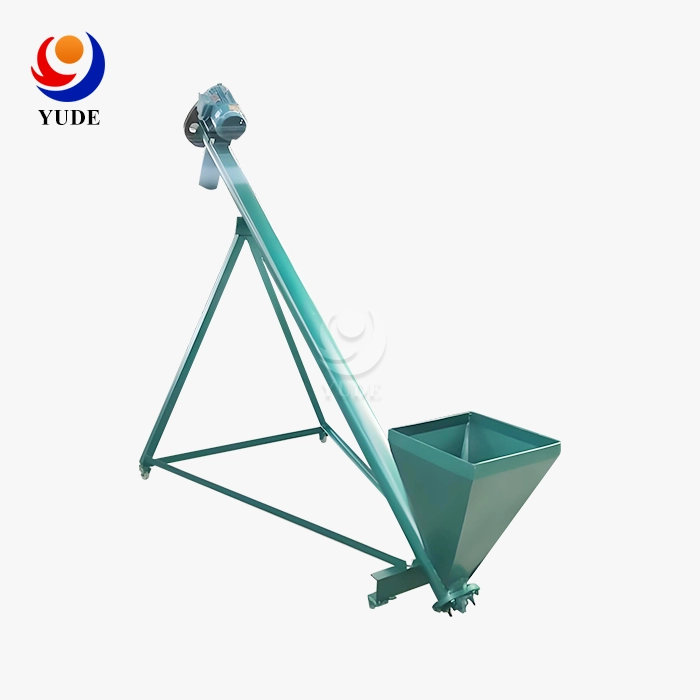
What Does "Effective Volume" Mean in a Plastic Particle Tilt Spiral Feeding Machine?
Effective Volume vs. Total Hopper Capacity
A hopper has a geometric volume, which is the space inside its walls. Effective volume is smaller. It is the quantity of pellets the hopper can store and still feed steadily. Several things take space away. Operators leave safety clearance below the rim so pellets do not spill. Sloped corners create dead zones where pellets cling. Pellets can also form a bridge over the outlet and stop flowing, and the screw intake needs a steady supply of material to fill each flight. A hopper that looks large on a drawing may therefore deliver noticeably less usable volume. When I review a specification, I ask for the effective figure, not the drawing figure.
How Pellets Travel Through the Inclined Spiral
In a plastic particle tilt spiral feeding machine, pellets drop from the hopper to the outlet and meet a rotating screw inside a closed tube. The screw lifts them along the incline and releases them at the upper end. From there they can feed an injection molding machine, dryer, extruder, mixer, or storage bin. Each destination changes the volume you need, because a mixer takes batches while an injection machine pulls a slow, steady stream. The closed tube also limits dust and moisture pickup compared with open handling. That is why I size effective volume from the whole line, not from the hopper alone.
Why Effective Volume Affects Cost and Workload
Effective volume sets how often someone refills the hopper. When you buy a plastic particle tilt spiral feeding machine, a volume that is too small means extra trips, interrupted work, and a higher chance that the screw runs empty. A volume that is too high costs more to build, takes more floor space, and takes longer to clean at a color or resin change. It also keeps pellets in the hopper longer, which matters for moisture-sensitive resins. Total cost of ownership adds labor, downtime, cleaning time, and purchase price together. A bigger hopper is not automatically better. The right size matches your real feeding requirement and refill routine.
Is the Effective Volume Customizable?
What Engineers Can Adjust
Yes, within limits. For a plastic particle tilt spiral feeding machine, the hopper dimensions and outlet shape control how much the hopper holds and how well pellets reach the screw. The spiral tube diameter, pitch, rotation speed, and drive setup control how fast the screw moves them. Conveying length and inclination angle decide how much lifting the unit does. Yude's vertical plastic mixers follow the same principle: effective volume is customizable according to model specifications, and the stirring shaft runs at 30 to 60 r/min. For a feeder, we compare each of these items with your pellets and layout instead of copying a standard size.
Why a Bigger Hopper Alone Does Not Raise Output
Many buyers assume a larger hopper means more kilograms per hour. It does not. Output depends on the screw, and the screw depends on the motor, shaft strength, and discharge opening. A bigger hopper simply holds more pellets between refills. If the tube is too small or the motor is underpowered, the extra volume sits idle. Flowability matters as well, because sticky or irregular regrind can bridge over a wide outlet. Structural stability counts too, since a full, heavy hopper loads the frame. I therefore treat the hopper, screw, drive, and discharge as one feeding system and size them together.
How to Calculate the Required Effective Volume
For a plastic particle tilt spiral feeding machine, start with one formula: required effective volume = feeding rate × desired refill interval. A line that consumes 100 kg per hour and refills every two hours needs about 200 kg of effective volume. Next, convert to liters with bulk density. PE and PP pellets often weigh roughly 450 to 650 kg per cubic meter loose, so 200 kg takes about 310 to 440 liters. Add a safety reserve, and allow for regrind content, moisture, and usable filling ratio. Keep hopper capacity (liters or kilograms) separate from conveying capacity (kg/h). Ask every supplier to state both, along with the density and test conditions.
What Affects Feeding Accuracy, and Which Options Should You Specify?
Material Properties That Change Flow
Feeding accuracy depends on more than motor speed or rated capacity. Pellet size, shape, density, and surface friction all change how material fills each screw flight. Round virgin pellets flow smoothly. Recycled content, flakes, and powder mixtures flow less evenly and can bridge over the outlet. Jenike's research on solids flow showed that hopper wall angle and outlet size decide whether material flows or arches, so outlet geometry matters as much as the screw. Agitators and anti-bridging devices help with difficult materials, and inspection windows let operators watch the flow. I always ask for a sample of the real material before I confirm a design.
Controls and Installation Quality
A variable-speed drive or frequency converter lets you adjust screw speed to match demand. A PLC with a level sensor can start and stop the feeder as the receiving hopper empties or fills. These controls hold the feed rate steadier than a fixed-speed motor. Installation matters just as much. A wrong angle, a vibrating frame, poor alignment with the receiving equipment, overfilling, or leftover residue can all cause swings in output. Capacity also drops as the incline rises, and the CEMA screw conveyor standard lists correction factors for inclination. To check accuracy, weigh the actual output over a set time under real operating conditions instead of trusting a catalog number.
Options to Specify Before You Ask for a Quote
When you specify a plastic particle tilt spiral feeding machine, write down effective hopper volume, material weight, refill interval, hopper shape, inlet and outlet sizes, discharge height, and connection direction. Then choose the construction material. Stainless steel suits hygienic, corrosive, or frequently cleaned work, while coated carbon steel costs less for standard industrial duty. Our single-screw vertical mixer shows how we handle this choice: a Q235 carbon steel barrel with an anti-stick inner coating, wear-resistant screw blades, a three-phase asynchronous motor matched to tonnage, and a heavy-duty gear reducer. It reaches mixing uniformity of 98% or higher on PE, PP, ABS, and PVC pellets. For US plants, confirm 60 Hz power, panel needs, sensors, emergency stops, quick-release parts, cleaning access, and spare parts.
How Does a Tilt Spiral Feeder Compare with Other Plastic Particle Feeding Machines?
Versus Screw Feeders and Vacuum Loaders
A tilt spiral feeder fits lines that need inclined lifting, flexible discharge positioning, simple maintenance, and local material transfer. A standard screw feeder often works better on a short, tightly controlled route. A vacuum loader suits central distribution to several machines or longer distances, but it moves pellets with air, so noise, energy use, and filter upkeep enter the comparison. I do not treat any one technology as the winner. Compare actual kg/h, material behavior, conveying distance, noise, energy use, automation, cleaning, and maintenance for your own line. A plastic particle tilt spiral feeding machine usually makes the most sense on short, one-to-one transfers.
Vertical Conveyors and Low-Ceiling Plants
Vertical conveyors save floor space, but they need full height and careful layout planning. That becomes a problem in older plants. Think of a building from the 1990s with a 4.2-meter (about 13.8 ft) ceiling, existing pipes, and no room for a straight vertical run. A plastic particle tilt spiral feeding machine can follow a tilted route around obstacles and reach the receiving point at the right height. Batch systems move material in loads, while continuous systems deliver a steady stream, so choose by process need. In retrofits, I start with site photos and a sketch. Then we propose an angle, a length, and a layout drawing before anyone orders steel.
Common Design Risks When Customizing Volume
Oversizing a plastic particle tilt spiral feeding machine raises equipment cost, floor space, cleaning effort, and residence time, and it can let different materials separate. Undersizing forces frequent refills, adds labor, interrupts production, and risks the screw running empty. Designs also fail when they ignore changes in bulk density, regrind content, pellet shape, or flowability. Regrind usually flows worse than round pellets, so it often needs a lower angle than virgin pellets, and the final angle needs a test with your material. Judge a machine by its recommended operating capacity, not its maximum theoretical output. Then confirm motor load, noise, safety, voltage, documentation, and service support.
How Should Buyers Request a Quote and Verify the Machine Before Shipment?
What to Include in Your Request for Quotation
Send material names, photos, bulk density, pellet size, required kg/h, effective hopper volume, refill interval, conveying height, incline, operating hours, destination, electrical standard, construction material, and control needs. Photos of the installation spot help most because they show obstacles that drawings miss. Tell us which equipment receives the pellets from the plastic particle tilt spiral feeding machine: an injection machine, extruder, dryer, mixer, or bin. In the United States, also state which safety rules your plant follows, such as NFPA 79 for the electrical equipment of industrial machinery or OSHA machine guarding requirements. A complete request shortens quoting time and prevents guesswork.
What a Good Quotation and Supplier Should Show
The quotation should state overall dimensions, nominal and effective volume, recommended capacity, motor power, spiral and tube materials, safety features, spare parts, warranty, and commissioning support. Judge the supplier as well. Yude Plastic Machinery is a plastic mixer manufacturer that produces and sells vertical mixers from 600 kg to 10 tons, small mixers from 300 kg to 500 kg, and stainless steel and color-mixing models. We run quality checks from incoming materials to final inspection, export to more than 30 countries and regions, and provide 7×24 after-sales support. We can also modify equipment to meet local industry standards. Application-based customization beats picking a standard model on price alone.
Verifying the Machine Before Shipment
Ask for a factory acceptance test of the plastic particle tilt spiral feeding machine with your actual pellets. Check effective volume, feeding rate, start-up behavior, continuous running, discharge stability, noise, vibration, and motor performance. Request a general arrangement drawing, electrical diagram, operation manual, maintenance schedule, spare parts list, test report, and shipping documents. On site, mount the unit securely, wire it correctly, align it with the receiving equipment, and run it at the specified speed. Then track kg/h, refill frequency, stoppages, pellet damage, and maintenance needs during the first weeks. These records show whether the volume you specified fits real production.
Conclusion
The effective volume of a plastic particle tilt spiral feeding machine is customizable, but only within the limits of the whole feeding system. Effective volume counts the pellets that are stored and fed steadily, so it sits below the hopper's geometric size. Engineers set it from feeding rate, refill interval, bulk density, and material flow, then match it to the hopper, screw, motor, discharge, and installation height. Controls, installation quality, and construction material affect accuracy and lifecycle cost. A tilt spiral feeder suits inclined, local transfers, while screw feeders, vacuum loaders, and vertical conveyors fit other layouts. Oversizing and undersizing both cause problems, so a full specification, a clear quotation, and a factory test with real pellets give the surest match.
FAQ
Can I choose a smaller or larger hopper than the standard size?
Yes. Hopper volume can be customized, but effective volume stays below total geometric capacity because of safety clearance and flow needs.
How do I estimate the capacity I need?
Multiply feeding rate by refill interval, convert with bulk density, and add a safety reserve.
Can one feeder handle virgin pellets, regrind, and masterbatch?
Often yes, but flow differs. Regrind bridges more easily, so share samples and test them before ordering.
When does a tilt spiral feeder suit better than a vacuum loader?
It fits short, inclined, one-to-one transfers with simple upkeep. A vacuum loader fits central distribution to many machines.
Should I choose stainless steel or carbon steel?
Stainless steel suits hygienic or frequently cleaned work. Coated carbon steel suits standard industrial duty at a lower cost.
What information do you need for a quote?
Material, kg/h, hopper volume, refill interval, incline, height, voltage, and site photos.
Request a Custom Plastic Particle Tilt Spiral Feeding Machine Proposal
Send your pellet data, kg/h target, layout photos, and voltage to Yude Plastic Machinery at sales@yudemachinery.com. As a plastic particle tilt spiral feeding machine supplier with 7×24 after-sales support and customization capability, we will review your site and reply with a recommended volume, a drawing, and a quotation. For details, please refer to the website: yudemachinery.com.
References
1. Storage and Flow of Solids (Jenike), 1964
2. Screw Conveyors for Bulk Materials (ANSI/CEMA Standard No. 350), CEMA, 2015
3. Powders and Bulk Solids: Behavior, Characterization, Storage and Flow (Schulze), 2008
4. Injection Molding Handbook (Rosato, Rosato and Rosato), 2000
5. NFPA 79: Electrical Standard for Industrial Machinery, NFPA, 2021
6. Safety of Machinery: General Principles for Design (ISO 12100), ISO, 2010
Learn about our latest products and discounts through SMS or email