- English
- French
- German
- Portuguese
- Spanish
- Russian
- Japanese
- Korean
- Arabic
- Greek
- German
- Turkish
- Italian
- Danish
- Romanian
- Indonesian
- Czech
- Afrikaans
- Swedish
- Polish
- Basque
- Catalan
- Esperanto
- Hindi
- Lao
- Albanian
- Amharic
- Armenian
- Azerbaijani
- Belarusian
- Bengali
- Bosnian
- Bulgarian
- Cebuano
- Chichewa
- Corsican
- Croatian
- Dutch
- Estonian
- Filipino
- Finnish
- Frisian
- Galician
- Georgian
- Gujarati
- Haitian
- Hausa
- Hawaiian
- Hebrew
- Hmong
- Hungarian
- Icelandic
- Igbo
- Javanese
- Kannada
- Kazakh
- Khmer
- Kurdish
- Kyrgyz
- Latin
- Latvian
- Lithuanian
- Luxembou..
- Macedonian
- Malagasy
- Malay
- Malayalam
- Maltese
- Maori
- Marathi
- Mongolian
- Burmese
- Nepali
- Norwegian
- Pashto
- Persian
- Punjabi
- Serbian
- Sesotho
- Sinhala
- Slovak
- Slovenian
- Somali
- Samoan
- Scots Gaelic
- Shona
- Sindhi
- Sundanese
- Swahili
- Tajik
- Tamil
- Telugu
- Thai
- Ukrainian
- Urdu
- Uzbek
- Vietnamese
- Welsh
- Xhosa
- Yiddish
- Yoruba
- Zulu
The Future of Plastic Granules Mixing Technology: What to Expect
The future of plastic granules mixing technology points toward tighter control, lower energy use, and equipment matched to each material. I expect the modern plastic granule mixer to deliver measurable uniformity, simple automation, and easy cleaning instead of larger capacity alone. Recycled resin, color masterbatch, and frequent formulation changes push buyers to demand repeatable results. Vertical designs already meet many of these needs in injection molding, extrusion, film blowing, and granulation lines. In this article, I explain where the technology is heading, what to check before you buy, and how Yude Plastic Machinery supports processors worldwide.
Why Plastic Granule Mixing Technology Is Changing
Where Traditional Mixing Systems Struggle
Usually, old ways don't work well when pellets aren't all the same size, density, moisture level, or shape. Things split a lot because of the size of the particles, so small additives can fall to the bottom of heavy pellets while they are being moved. Mix-ins don't spread well, the color isn't even, and the melt doesn't work right in the shape machine. Hand filling and settings that work with timers give each shift's worker something different to do. The cost of repairs goes up when blades, bearings, and seals are worn out. It also takes longer to change the color when the inside is tough to clean. These problems mostly happen in plants that mix old pellets with new ones, since their bulk densities don't match. You can use a plastic granule mixer that keeps lifting and moving the material around so it doesn't settle.
Cost, Quality, and Material Pressures
High prices and low quality are becoming more and more of a problem. EU Plastics said that in 2022, the world made 400.3 million tons of plastic. If energy use and scrap go up even a little, it adds up over time in the industry. Too big of motors, blades with the wrong shape, and cycles that last too long are all things that waste electricity. Operators can't do anything else when they have to blend by hand. Also, people want to keep track of their food, which means that farms have to show how they mixed each batch. People who buy things tell me they want three things: consistent color, shorter cycles, and fewer stops for repairs. The mixing tools used have an effect on all three.
New Drivers: Recycled Content, Customization, and Compliance
New resin, recovered pellets, regrind, bio-based polymers, and combinations with fillers all act in different ways. A lot of the time, they need to be able to change speeds, feeds, and recipes. Buyers in the US and other export markets also want technical paperwork, safety interlocks, and electricity compliance that follows the rules in those places. For this reason, providers are not making just one model for all processes. Instead, they are making tools that are modular and can be changed to fit each job. In response, Yude Plastic Machinery customizes, for example by making control screens that work with more than one language and adapting equipment to meet the standards of the local industry. Now, a good mixer starts with the things that are in it, not the list. This makes more trash, not less, because the tools can't handle it.
How a Modern Plastic Granule Mixer Works
Mechanical Design and Material Flow
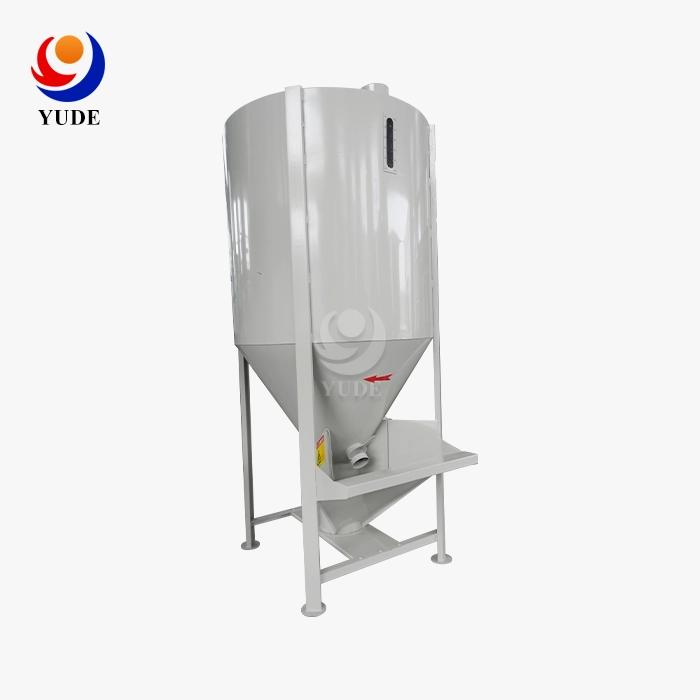
The blades, shaft, and chamber shape determine how well the mixer moves things. Most vertical designs have a screw that turns and moves the pellets from the bottom of the cylinder to the top. After that, the stuff falls back down. This steady flow gets rid of dead spots and mixes light additives with heavier granules. Gravity helps the flow go down, so the machine doesn't have to push each particle to the side. It's well thought out so the pellets don't turn into dust either. These are the kinds of vertical mixers for plastic granules that are made to mix things in this way. Just-for-mixing types can get the accuracy level to 98% or higher.
Heating, Cooling, Drying, and Dosing
The types of this equipment can do different things, but some of them are mixing, stirring, moving, and drying. Some resins can go bad if they get wet, so it's important to dry things out. Heat or cold control can be added to compounding work, and automated dosing and discharge make it easier for operators to work together. As I go through a project, I ask myself what it needs to really work. Plants that only mix masterbatch and PE might not need temperature control, but recycle lines that deal with wet regrind might need to be dried. You can keep costs and difficulty in check by only doing the jobs that need to be done.
Vertical, Horizontal, and Other Mixer Types
Horizontal and vertical mixers have different shapes, flow patterns, ways to load and clean them. Because it goes up, a vertical unit takes up less floor room. This helps when classes are already full. High-speed machines quickly spread out additives, but they may heat up, make dust, or stress the material. When machines are slow, they mix things more slowly, but they need longer rounds. Don't just look at the name of the machine to decide whether to buy a plastic pellet mixer or a plastic granule mixer. Instead, you should look at how the particles are made, how big the batches need to be, how much heat they need, and how they output. The best way to get clear answers about hard formulas is to look at a material sample.
Future Standards and Smart Controls for Mixing
Measurable Performance Standards
Going forward, standards will be based on results instead of machine size. It sounds like you should check how stable the bulk density is, how consistent the color is, and how many batches can be made. Mixing consistency is the best example of this. When it comes to mixing, our vertical models get accuracy of 98% or higher. You can check this number with your own material. Any service will be happy to tell you how they check for consistency and let you see the test being done with your own glue and core mix. You can't tell much from a number that you can't test. By making test conditions clear, you can also help your quality team keep track of old batches so they can compare them to new ones.
Capacity and Total Cost of Ownership
The smallest amount of material that a plastic granule mixer can hold is different from the largest amount that it can hold. How much the bulk density, the filling ratio, the loading time, and the release time change is what changes the real output. How much resin do you use every hour? Divide that number by the number of batches you can make in an hour. After that, add a space. A line needs 100 kg per hour, and each run takes 30 minutes. This means that a 50 kg lot would be enough to meet the demand, leaving no room for mistake. This is why I would size up. To find out how much it will really cost, add up all the costs: the energy used for each batch, repairs, spare parts, labor, the chance of downtime, and the time the machine will be used. A low price doesn't seem as good if the machine stops all the time.
Automation and Smart Manufacturing
A plastic granule mixer is automatic and connected to a bigger system for getting things ready. A recipe manager keeps track of how long, how fast, and what order the ingredients are mixed in so that different jobs and workers can make the same batch. With sensors that check for vibration, torque, temperature, and motor load, issues can be found before they cause huge amounts of downtime. When a buyer is from another country, online tests help them get help faster. Still, technology should depend on how much work needs to be done, how many people are available, and how much money is available. A medium-sized molding plant might only need a clear control panel and a motor that is stable and can keep itself from overheating and overloading. They save money, not because they're in a brochure.
How to Choose and Buy a Plastic Granule Mixer
Define Your Application First
Write down the polymer, the additives, the amount of recycled material, the particle size, the bulk density, the amount of water in the material, and how easily it melts in hot water. Then write down how much the machine can work, how long it takes to mix, how much power it has, how it discharges, what it's made of, and any safety features it has. Things you choose are important. 304 stainless steel is better for jobs that need to be cleaned more often, like color changes. Q235 carbon steel is good for most jobs. When those things happen, our vertical color mixers and stainless steel plastic mixers can handle them. You can get a good quote on the right plastic granule mixer from any supplier as long as you give them a clear written brief. You can also look at three to five prices that are all the same.
Vertical Mixers for Plastic Granules from Yude
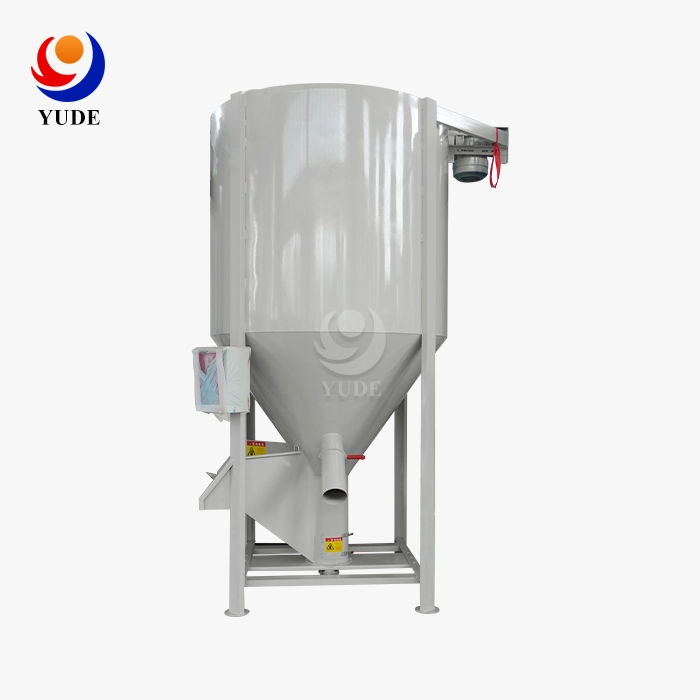
Plastic granules made of PE, PP, ABS, and PVC can all be mixed in our vertical mixers. To meet the needs of the industry, we make them for extra or pre-process steps in lines for film blowing, extrusion, granulation, and injection molding. The electric motor in the machine is three-phase asynchronous, and it runs smoothly because it has safety features that stop it from overheating or burning out. You can pick either 304 stainless steel or mild steel Q235. Depending on what kind of machine it is, each plastic granule mixer in this line can mix, stir, move, or dry. Small plastic particle mixers that weigh 300 kg to 500 kg and vertical plastic mixers that weigh 600 kg to 10 tons are the two types we have.
Procurement Checklist for Global Buyers
Before you sign, confirm these three items in writing:
- Quotation scope: As the supplier, ask them to break down the price of the base machine, any extras, spare parts, shipping, setting up, and starting it up. You can easily see the price of each line, so you won't be surprised by extra costs after you place your order. It also lets your finance team look over the budget and see bids from different buyers on the same terms.
- Lead time and testing: Find out how long it takes to make something, test it in the factory, package it for export, and train the operators. Find out who is in charge of setting up the spot and offering utilities as well. Not having written dates and roles helps keep things on time at the port and during installation. They also tell your team when to plan the first run of production.
- Wear parts and service: Make a list of the motors, seals, sensors, valves, motors, and blades you may need early on. Not having the machine running will cost you money, so order these parts along with the machine. Check with the service provider to see how they handle service calls and who can help you in your area. You need to answer quickly if the mixer runs every shift.
A checklist like this removes most hidden costs. It is best to get custom or OEM tools if the plan, materials, or services are not standard.
Industry Impact and How to Prepare
Impact on Plastics Production and Business Models
Having more control over the mixing process makes production more flexible and better uses of resources. Small, automatic plastic granule mixers enable regional makers, contract processors, and multi-product plants to handle smaller amounts and make formulation changes more quickly. With better control, you can use less energy, waste less, and lose less when you switch. Also, it can make it easy to deal with things that have been recovered. These days, customers also expect more from suppliers. For example, they want suppliers to test the process, teach workers, plan for spare parts, and help customers who are far away. Providers don't just compete on price; they also compete on how long a machine lasts, how well it works, and how quickly it responds. More people want mixers that can work with recycled plastic because of goals for a circular economy, such as those in the Ellen MacArthur Foundation's New Plastics Economy.
Build Baseline Data Before You Buy
Without a starting point, you can't show growth. Write down the batch time, energy use, output, reject rate, switching time, and fix downtime for your present setup so that you can keep track of them. With these numbers, you can make goals that you can reach and make the case for investment that your finance team needs. Give yourself a time frame to see if the new plastic granule mixer can pay for itself, like 12 to 18 months. During the plant acceptance test, compare your noise, vibration, cycle time, and regularity numbers to the ones that were given to you. Modular controls, replaceable mixing tools, and standard communication interfaces make it possible to make changes in the future as well.
What Support Should Back the Machine
There needs to be something to hold up a mixer for it to be useful. Shandong Yude Plastic Machinery Co., Ltd. is a business that makes and sells things. We send our goods to more than 30 places in the Middle East, Southeast Asia, South America, and Europe. Quality control checks the work that is being done and the raw materials that are coming in. They also do one last check before the work is delivered. Our after-sales team is available 24 hours a day, seven days a week to help customers. They keep records of service and information about the tools in files for each customer. Needs are met within 24 hours by service outlets in major cities, and needs in other countries are met by local service partners.
Conclusion
Mixing plastic granules is changing from just blending to controlled processing that is made to fit each need. Traditional systems have problems like wear, energy waste, separation, and having to change things by hand. The bar has been raised, though, by recycled resin, compounds that are full of fillers, and frequent color changes. New designs allow more material to move, do only what is needed for the process, and have been shown to be more uniform, with 98% or higher uniformity on mixing-specific vertical models. The total cost of ownership and the amount of space that can be used should be used to judge capacity. They should also make sure that the technology fits the plant's size and budget. To make better choices, people need to keep track of the materials they use, the first data they collect, thorough quotes they get, and tests they do with their own resin. A plastic granule mixer is the best choice if the quality goal, batch size, and polymer all meet.
FAQ
How does a vertical plastic granule mixer work?
Petals are moved from the bottom of the cylinder to the top by a screw that turns. After that, the stuff falls back down. By circulating the base resin over and over, the additives and masterbatch are spread out equally.
Which plastic materials can a vertical mixer handle?
Plastic granules made of PE, PP, ABS, and PVC can all be mixed in our vertical mixers. If the formula is complicated, test the material first to make sure it works before you buy it.
How do I choose the right capacity?
Check out how much glue is used every hour and how long the cycle lasts. After that, add a cushion. Because the actual volume may not be the same as the usable capacity, you need to think about the bulk density, the filling ratio, and the times of loading and unloading.
What should a quotation include?
It should include the test terms, shipping time, guarantee, and any extra features that can be added. It should also include the base machine, any spare parts, freight, installation, and commissioning. It should also say what language the display is in.
Can the control interface use another language?
Yes. We can make changes to the equipment to make it work with more than one language and meet the standards of the local industry.
Start Your Plastic Granule Mixer Project with Yude Plastic Machinery
Yude Plastic Machinery produces plastic granule mixers. Their vertical mixers weigh between 600 kg and 10 tons, are made of stainless steel, can have their interfaces changed to work with more than one language, and come with 7x24 customer service after the sale. Send an email to sales@yudemachinery.com with the type of material, batch size, and process you need. Our team will help you pick the right model and send you a full quote. Look at yudemachinery.com to learn more about our goods, and let us know what your line needs.
References
- Plastics Europe, Plastics – the Fast Facts, 2023
- Polymer Mixing: A Self-Study Guide, 1998
- Mixing and Compounding of Polymers: Theory and Practice, 2009
- Injection Molding Handbook, 2000
- Ellen MacArthur Foundation, The New Plastics Economy: Rethinking the Future of Plastics, 2016
- International Energy Agency, Energy Efficiency 2023, 2023
Learn about our latest products and discounts through SMS or email