- English
- French
- German
- Portuguese
- Spanish
- Russian
- Japanese
- Korean
- Arabic
- Greek
- German
- Turkish
- Italian
- Danish
- Romanian
- Indonesian
- Czech
- Afrikaans
- Swedish
- Polish
- Basque
- Catalan
- Esperanto
- Hindi
- Lao
- Albanian
- Amharic
- Armenian
- Azerbaijani
- Belarusian
- Bengali
- Bosnian
- Bulgarian
- Cebuano
- Chichewa
- Corsican
- Croatian
- Dutch
- Estonian
- Filipino
- Finnish
- Frisian
- Galician
- Georgian
- Gujarati
- Haitian
- Hausa
- Hawaiian
- Hebrew
- Hmong
- Hungarian
- Icelandic
- Igbo
- Javanese
- Kannada
- Kazakh
- Khmer
- Kurdish
- Kyrgyz
- Latin
- Latvian
- Lithuanian
- Luxembou..
- Macedonian
- Malagasy
- Malay
- Malayalam
- Maltese
- Maori
- Marathi
- Mongolian
- Burmese
- Nepali
- Norwegian
- Pashto
- Persian
- Punjabi
- Serbian
- Sesotho
- Sinhala
- Slovak
- Slovenian
- Somali
- Samoan
- Scots Gaelic
- Shona
- Sindhi
- Sundanese
- Swahili
- Tajik
- Tamil
- Telugu
- Thai
- Ukrainian
- Urdu
- Uzbek
- Vietnamese
- Welsh
- Xhosa
- Yiddish
- Yoruba
- Zulu
Mixing Tank with Agitator vs Vertical Screw Mixer for Pellets
With dry plastic pellets, a vertical screw mixer is usually a better choice than a mixing tank with agitator. An agitated tank works well for liquids, slurries, and thick pastes, but pellets need gentle lifting and falling, not heavy stirring. A 300kg vertical plastic particle mixer lifts material with a central spiral and lets it fall back along the vessel wall. This blends PE, PP, ABS, and PVC granules evenly in 8 to 15 minutes. Yude Plastic Machinery builds this type of machine with a mixing uniformity of at least 98%. Below, I explain how the two designs differ and how to choose between them.https://www.yudemachinery.com/vertical-plastic-particle-mixer-with-only-stirring-function/300kg-vertical-plastic-particle-mixer
What Is a 300kg Vertical Plastic Particle Mixer?
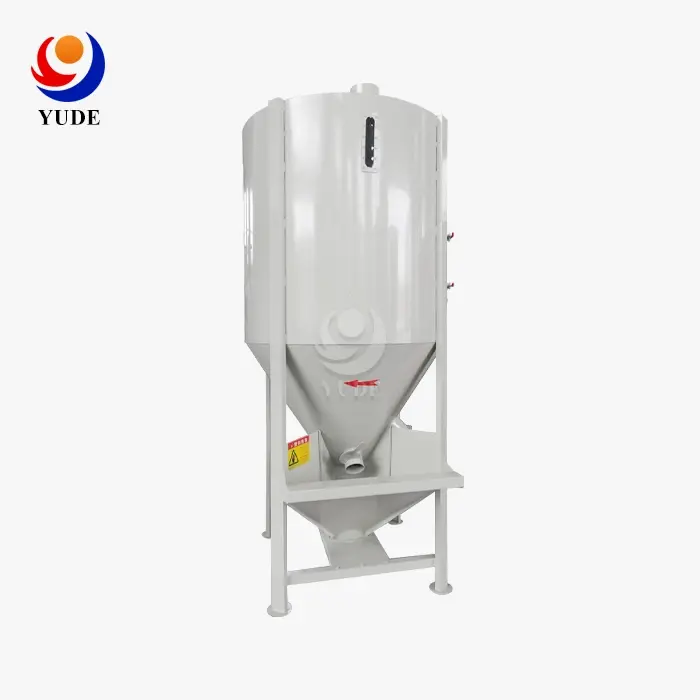
How the Vertical Spiral Circulation Works
There is no sitting for a straight screw mixer. Petals move from the bottom to the top of the vessel on a spiral shaft that turns in the middle. That's where the pellets fall out and hit the wall before being caught again by the screw. It does this loop again and again until the virgin resin, masterbatch, and regrind are evenly distributed in the batch. As the pellets slide and tumble instead of being cut or crushed, the granules stay in a soft state. Some books on industrial mixing, like the Handbook of Industrial Mixing, talk about mixing solids and liquids as two different issues. Because of this difference, a spiral works well for dry pellets.
Specifications of the Basic Model
A clean mixing function is provided by the Yude 300kg vertical plastic particle mixer. It can hold up to 300 kg of plastic pieces with a bulk density of 0.6 to 0.8 g/cm³. The total capacity of the machine is about 500 L, and at least 80% of that is used for mixing. At least 98% of the mixture is mixed evenly, and each batch can be made in 8 to 15 minutes, depending on the material. With these numbers, it's easy to see how different quotes are. Make sure that the rated load is the same as the density of your pellets. Pellets that are lighter take up more space per kilogram than pellets that are heavier.
Where It Fits in Production
This 300kg vertical plastic particle mixer can handle PE, PP, ABS, and PVC plastic particles. It works with pre-processes that come before granulation, injection molding, and film blowing. To get rid of color streaks, color masterbatch is mixed with natural resin in an injection molding shop. Additives are mixed into the base resin before the hopper in a film blowing line. Before extrusion, a recycling machine can mix new pellets with recovered granules, and a research lab can make trial batches that can be used again and again. The machine only works with dry, loose granules, so it can't be used instead of machines made for liquids or fine powders.
Mixing Tank with Agitator vs Vertical Screw Mixer for Pellets
Operating Principles Compared
A mixing tank with an agitator stirs things that flow like a fluid with a propeller or paddle. In industrial mixing references, agitated tanks are mostly used for liquids, slurries, and thick materials. The impeller drives flow, heat transfer, or a chemical reaction. Dry pellets act in a different way. They can slide, pile up, and even cross, so a blade that stirs can leave empty spaces near the bottom or wall. Pellets are moved through the whole batch by a vertical screw, which makes sure that each granule goes around the same loop. Because it lifts over and over, a screw usually mixes pellets more evenly than a stirrer.
Which One Fits Plastic Pellets
One easy test I can think of is to see if your stuff pours. Pick a screw if it pours like pellets. Pick a bubbling tank if it needs to be heated, cooled, or dissolved. It takes more work to clean around a tank because the shafts, baffles, and seals collect dirt. Since the vessel of a vertical screw mixer is smooth and there is only one central shaft, it is easier to clean between colors. It moves slowly, which also helps protect the shape of the pellet. When pellets are damaged, they make dust and fines that can make it hard for a molding or extrusion line to feed. A 300kg vertical plastic particle mixer with a screw shape works best for pellets.
Vertical Screw Mixer vs Horizontal Mixer and Ribbon Blender
Ribbon blenders and horizontal mixers can also mix dry things. The shaft is laid on its side, and the material is moved in opposite directions. This gives powders and sticky blends strong mechanical action. Pellets don't need that much force very often. A vertical unit takes up less floor space, but it needs space above it to load and unload. It may be easier to feed from the side of a horizontal unit, but it takes up more room space. Perry's Chemical Engineers' Handbook lists a number of powders blenders. The best one to use will depend on tests of the material and the layout of the plant. Most of the time, the vertical design is the most compact way to handle free-flowing pellets in 300 kg batches.
Key Performance Factors for a 300kg Plastic Granule Mixer
Capacity, Bulk Density, and Fill Level
There are three things that the label "300kg" can mean: the maximum fill, the rated working load, or the nominal vessel size. Plastic particles with a bulk density of 0.6 to 0.8 g/cm³ can weigh up to 300 kg on our basic model. The whole volume of the vessel is about 500 L, and at least 80% of that is used for mixing. Since bulk density is different for each resin, ASTM D1895 can be used to measure it in a lab. This standard covers apparent density, bulk factor, and the ability of plastics to be poured. Tell the supplier what you measured, and they can let you know if your batch weight fits in the vessel.
Mixing Time and Uniformity
It takes our basic model 8 to 15 minutes to mix one batch, and it mixes evenly at least 98% of the time. It doesn't always help to mix for longer. Once the batch is even, adding more minutes will only use more energy and wear out the machine. The amount of time you need depends on the pellet's size and shape, the difference in density between the parts, the masterbatch ratio, the order in which the parts are loaded, and the fill level. When pellets are different sizes or densities, they tend to separate. This behavior is talked about in a review of particulate division published in Powder Technology in 1976, and the same reasons are given in Introduction to Particle Technology. Before you set a time, do a test with real materials and a small amount of the batch.
Energy Use and Temperature
The amount of energy in a batch is equal to the motor's power times the time it runs times the real load factor. Instead of just looking at motor rating, compare cost per batch as well. A bigger motor with a short cycle may use less energy per batch than a smaller motor that runs for a longer time. Ask for the motor specifications and your anticipated cycle time when you size a 300kg vertical plastic particle mixer. Heat is also important. The temperature goes up when there is friction, and heat-sensitive polymers can soften or stick. A slow screw motion and a set mixing time help keep the temperature from rising too much, but you should still check the material right away after making a test run.
Choosing the Best 300kg Vertical Plastic Particle Mixer for Your Process
Material, Design, and Automation Options
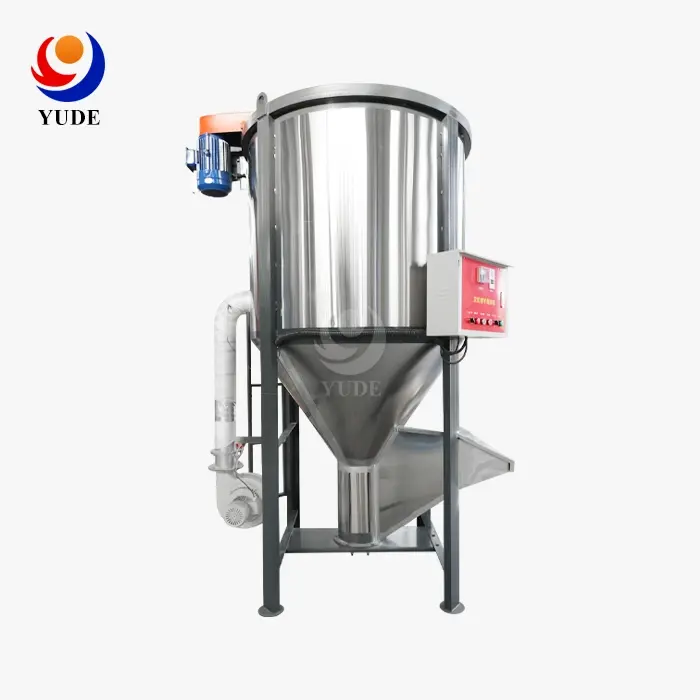
Start with what the vessel is made of. Stainless steel doesn't rust and is easy to clean, which is good for shops and labs that change colors a lot. A lot of the time, carbon steel costs less for dry pellet work. Yude Plastic Machinery makes different types of stainless steel plastic mixers. If you are researching food-contact or medical materials, make sure you ask about the grade and paperwork that fits your project. Pure mixing is available from the basic 300kg vertical plastic particle mixer. Talk about any extras you need early on, like weighing, automatic loading, or a different control panel. This is because extras change both the price and the wait time. In small labs, it's best to keep things simple so that students can safely use the machines.
Common Purchasing Mistakes
It's a mistake to buy something based only on the 300kg mark or the motor grade. As well as the gap between the working load and the highest load, check the mass density and the fill level. The second one doesn't do the site check. Check the voltage, frequency, and three-phase power, as well as the height of the ceiling, doors, and elevators. Plan the route to your next machine before you order a 300kg vertical plastic particle mixer. If the pellet sizes are different, the mix can separate again while being moved or stored, so keep that path short. Lastly, make sure you know what the quote covers and who is responsible for installation, training, and remote support.
Verification, Testing, and Total Cost of Ownership
Request that the supplier test a small amount of your material and give you a report on its uniformity, mixing time, noise level, discharge, and safety functions. Then check the motor, bearings, seals, and screw, among other extra parts. The total cost is more than just the price. You should add up the costs of electricity, labor, cleaning, repairs, shipping, installation, and the waste that a bad blend makes. The Injection Molding Handbook and other injection molding resources say that consistent material feed leads to consistent part quality. This means that an uneven color blend can cause rejects. A slightly higher price can be worth it if it cuts down on scrap and downtime. From the time the raw materials come in to the time they are delivered, Yude Plastic Machinery checks each machine.
Why a Vertical Screw Mixer Can Be a Practical Choice for Pellet Processing
Compact Footprint and Easy Line Integration
For the same batch size, a vertical design takes up less floor space than a horizontal one. That helps in study rooms and groups that are full of people. An injection molding machine, an extruder, or a film blowing line can all be fed by a 300kg vertical plastic particle mixer that can be placed close to a loader, bin, or conveyor. Before you place your order, make sure that the general height and discharge height will work with your roof and handling equipment. The lab teams should also measure the elevator and doorway, since the machine needs to get to its room before it can save any room.
Support for Labs, Molders, and Distributors
People who buy things look for different things. Research labs need a small machine that can fit through doors, is easy for students to use, and comes with clear instructions on how to use it. The most important things for injection molders are low downtime and uniformity of at least 98%. This is because color variation leads to scrap. Export packaging, branding, and local language controls are things that distributors and OEM buyers look at. Yude Plastic Machinery can make operation interfaces that work with multiple languages and equipment that meets local industry standards. At the beginning, tell the quoter what power and market needs you have so it can fit your site.
What Yude Plastic Machinery Offers
That company, Shandong Yude Plastic Machinery Co., Ltd., makes and sells plastic mixers that range from small 300 kg to 500 kg units to large 600 kg to 10 tons vertical models. More than 30 countries in Southeast Asia, the Middle East, Europe, and South America buy our goods. We've helped thousands of people. Our R&D team works with non-standard sizes and materials. A 7x24 after-sales system answers questions about how to use the equipment, and we work with local service teams in other countries. This same manufacturing and quality control method produced our 300kg vertical plastic particle mixer.
Conclusion
A mixing tank with an agitator is not good for dry plastic pellets. Instead, a vertical screw mixer is better. Granules are gently mixed by spiral lifting and falling, while liquids, slurries, and thick materials work best in stirred tanks. The vertical design takes up more space in the ceiling but saves floor space compared to horizontal and ribbon blenders. Before grinding, injection molding, and film blowing, a 300kg vertical plastic particle mixer can handle pellets of 0.6 to 0.8 g/cm3, has a total capacity of about 500 L, at least 98% consistency, and 8 to 15 minute cycles. Labels that show the capacity, mass density, mixing time, energy used per batch, material grade, site conditions, and test results all play a role in making the right choice. The total cost of ownership is more important than just the purchase price.
FAQ
Can it mix fine powder?
Pellets and powders are what vertical screw mixers are made for. It's okay for a small amount of powder to stick to the pellets, but pure powder can bridge the screw and stop it. It's better to use a horizontal paddle mixer for powder. Tell us before you order if your blend has more than a little powder in it so we can suggest a better one.
How long does one batch take?
Our basic model can finish one batch in 8 to 15 minutes, and the time can be changed for each material. Test your own glue and masterbatch to see how long it takes to reach your symmetry goal in the shortest amount of time.
Does the basic model dry material?
A clean mixing tool is built into the basic model. If your resin soaks up water, dry it first in a different dryer, or talk to our team about other options.
What should I send with an inquiry?
Send the type of material, its bulk density, batch size, desired mixing time, voltage, and where the goods should be sent. Describe the use, like "injection molding" or "film blowing." Our team can quickly confirm a setup if you give us these information.
Contact Yude Plastic Machinery for a 300kg Vertical Plastic Particle Mixer Quote
If you buy a 300kg vertical plastic particle mixer from Yude Plastic Machinery, they offer after-sales support seven days a week, in multiple languages, and they can change the equipment to meet local standards. Please email sales@yudemachinery.com with the type of material, bulk density, batch size, voltage, and delivery location. Our team will then suggest a configuration that will work best for your project. You can find out more at yudemachinery.com.
References
- Handbook of Industrial Mixing: Science and Practice, 2004
- Perry's Chemical Engineers' Handbook, 2018
- Introduction to Particle Technology, 2008
- Injection Molding Handbook, 2000
- ASTM D1895 Standard Test Methods for Apparent Density, Bulk Factor, and Pourability of Plastic Materials, 2017
- Powder Technology: The Segregation of Particulate Materials, A Review, 1976
Learn about our latest products and discounts through SMS or email