- English
- French
- German
- Portuguese
- Spanish
- Russian
- Japanese
- Korean
- Arabic
- Greek
- German
- Turkish
- Italian
- Danish
- Romanian
- Indonesian
- Czech
- Afrikaans
- Swedish
- Polish
- Basque
- Catalan
- Esperanto
- Hindi
- Lao
- Albanian
- Amharic
- Armenian
- Azerbaijani
- Belarusian
- Bengali
- Bosnian
- Bulgarian
- Cebuano
- Chichewa
- Corsican
- Croatian
- Dutch
- Estonian
- Filipino
- Finnish
- Frisian
- Galician
- Georgian
- Gujarati
- Haitian
- Hausa
- Hawaiian
- Hebrew
- Hmong
- Hungarian
- Icelandic
- Igbo
- Javanese
- Kannada
- Kazakh
- Khmer
- Kurdish
- Kyrgyz
- Latin
- Latvian
- Lithuanian
- Luxembou..
- Macedonian
- Malagasy
- Malay
- Malayalam
- Maltese
- Maori
- Marathi
- Mongolian
- Burmese
- Nepali
- Norwegian
- Pashto
- Persian
- Punjabi
- Serbian
- Sesotho
- Sinhala
- Slovak
- Slovenian
- Somali
- Samoan
- Scots Gaelic
- Shona
- Sindhi
- Sundanese
- Swahili
- Tajik
- Tamil
- Telugu
- Thai
- Ukrainian
- Urdu
- Uzbek
- Vietnamese
- Welsh
- Xhosa
- Yiddish
- Yoruba
- Zulu
Can PS plastic be recycled?
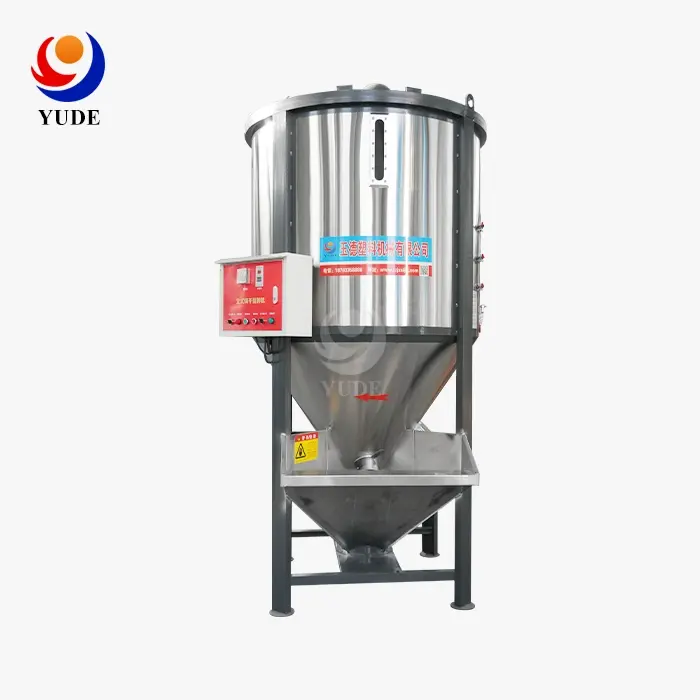
PS plastic can be recycled, but the result depends on the grade, the cleanliness, and local collection. Clean GPPS and HIPS scrap can go through shredding, washing, drying, extrusion, and pelletizing. EPS and XPS foam needs extra steps, such as compaction, before it re-enters a line. Once you have recycled pellets, a PS plastic mixer https://www.yudemachinery.com/plastic-mixer/ps-plastic-mixerblends them with virgin resin, color masterbatch, and additives so the melt stays consistent. I wrote this guide for plant managers, molders, and distributors who want clear answers about recycling routes, mixing steps, and equipment choices.
Can PS Plastic Be Recycled?
Which PS Types Can Go Back Into Production?
Polystyrene is a family of materials. EPS and XPS are both foams, while GPPS is clear and stiff. HIPS is stronger because it has rubber in it. They can be ready to be recycled in a number of ways. To make recycling easier, use clean production trash like sprues, trimmed sheets, and foam offcuts that have been cut to the right size and don't have any food on them. Getting things after they've been used is harder. It's not as useful when there are labels, grease, or different colors on the recycled resin. PS is made of plastic with the code 6 on it, but it doesn't say what grade it is. Putting the parts in order by grade before processing will protect their quality and keep the number of scrap parts low.
Mechanical and Chemical Recycling Routes
Most of the time, people recycle with machines. It takes work to sort the scrap, wash it, grind it, dry it, melt it, and shape it into pellets. Reviews in Waste Management (2017) and Macromolecular Rapid Communications (2021) say that manually recovered plastic is less useful when it is contaminated or heated over and over again. This is why many manufacturers mix it with new resin. This is not the same as recycling paper. Heat or chemicals can be used to break PS down into styrene or other building blocks. It has been looked into for decades, as shown in the study in Polymer-Plastics Technology and Engineering (2007), but it is still not used as often as grinding and re-melting. That is where most processors begin because they already know how to use the tools and it costs less to begin.
Why Recycling Rates Stay Low and Where Mixing Fits
The numbers show how hard it will be. A study that came out in 2017 in Science Advances found that only 9% of all the trash made from plastic up to 2015 was recycled. The EPA of the United States said that 8.7 percent of plastics were recycled in 2018. Foam is added to make things tougher. It costs a lot to move EPS before it is pushed down because it is mostly air. Recycling doesn't work very often because it's hard to do and costs a lot. A PS plastic mixer won't be able to set up a collection in your plant. It is in charge of the blend stage, which is where recovered pellets and new resin and chemicals come together. There is no need for shredders, densifiers, or extruders to use this. It can be used with them.
How Does the PS Plastic Recycling and Mixing Process Work?
Sorting and Size Reduction
The first step in everything is to sort. PS should not be mixed with PVC, PE, PP, or ABS because they don't always stick together well in the melt, creating weak spots and rough surfaces. Of course, plants can sort by hand, by density in a float tank, or with optical sorters for different amounts. A granulator then breaks the clean scrap into small flakes. The first thing foam goes through is a densifier. What it does is melt or pack the foam into thick blocks that a granulator can handle. When the flake size is stable, it's easier to feed and mix, so check the screen sizes before you start a full shift.
Washing, Drying, and Extrusion
PS that is dirty needs to be washed to get rid of glue, food, and dust. Then, the wet flakes need to be dried because bubbles and streaks of water show up on the surface when they are pushed out. Because the extruder is hot and has a screw, the plastic melts inside. Melt goes through a screen that picks up paper, dirt, and pieces that haven't melted yet. After that, it's cut into cubes. PS is amorphous and softens at 100°C, which is also the point at which it turns into glass. During the process, it gets hotter than that. Pay close attention to the melt temperature because too much heat changes the color or smell of plastics and breaks them down. The pellets will flow and have a more even color if you keep the temperature the same.
Where the Mixing Stage Fits
It's possible to blend either before or after pelletizing. Before pressing, the operators mix the flake or regrind with the other ingredients. This is how the recovered pellets are mixed with new resin and masterbatch before they are sent to an injection or extruder machine. Controlled flow and rest time, not heavy cutting, are what a PS plastic mixer does to make sure the mix is even. The ingredient amounts, mixing speed, and batch time should all match the recipe. The machine that shapes things gets a steady supply of a fixed mix, like a set amount of virgin to recycled paper. This keeps the color the same from one batch to the next. If you mix too long or too hard, you'll get dust and heat without getting much else.
What Can a PS Plastic Mixer Be Used For?
Blending Pellets, Regrind, and Additives
It is possible to use a PS plastic mixer to make a smooth mix that can be injected, compounded, or extruded. A lot of different things are used as inputs, like new PS pellets, recycled granules, regrind, color masterbatch, and powdered additives. Even distribution makes it less likely that there will be color lines, weak spots, or surface flaws. Foam makers also care about it for another reason. Foaming and changes in density can happen between batches if the additives aren't spread out evenly. This makes more waste. The mixer can only mix dry things together. After the melt compounding, glass-fiber inclusion, and reaction processing steps, you need an extruder. The mixer makes the mix, and the extruder melts it.
Vertical or Horizontal, High-Speed or Low-Speed?
This plan works best for this material, batch size, and floor space. There is less room on the floor for a vertical mixer, which can be used to mix pellets. It has a spiral that lifts material and lets it fall back through the batch. On automated lines, horizontal mixers are often used to work with bigger groups. Models with a high speed spread powders very well and add heat, while models with a low speed mix pellets softly. Models that aren't heated are best for dry blending, while models that are heated can help adding things stick. The ways that single-shaft and double-shaft systems move fluid, use power, and move filler are different. For plain PS pellets, a low-speed vertical helix design works well.
Yude Vertical Mixer Designed for PS Pellets
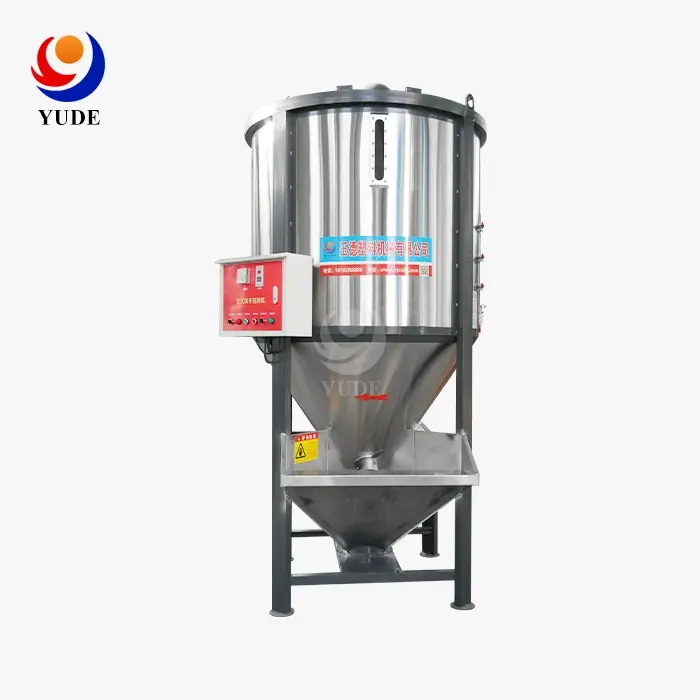
Yude Plastic Machinery makes a vertical mixer that is only for PS pellets. The spiral shape of this PS plastic mixer works with the way the pellets are made. Because the mixing conditions are right for the PS's density and fluidity, the consistency of the mix is at least 98%, and the materials don't stick together. The PS qualities help choose the material for the barrel, and mixing parts that don't wear out quickly make the machine last longer. Granulation, injection molding, and extrusion lines can all be used with it. It can also mix pellets for PP pipes, PE films, PVC profiles, and ABS appliance shells. Small particle mixers that weigh between 300 kg and 500 kg are also made by Yude. So are vertical color mixers made of stainless steel and ones that weigh between 600 kg and 10 tons.
How to Choose a PS Plastic Mixer for Recycling and Compounding?
Start With Your Material Data
To find out how much a job costs, you should first know what it is. Write down the PS grade, particle size, bulk density, moisture level, additive ratios, and recycled-to-virgin ratio. How many color changes you want to make each week and how much work you want to do each hour. How much something weighs in bulk is important for sizes because light things take up less space than heavy ones. You need to find out how many kilograms of material a molding cell needs every hour. Pick a size that is about 1.5 times the rate. This is a simple way to do it. This will give people time to load and unload. Also, companies that sell foam should know what kinds of additives are used and how much of each to send.
Key Specifications to Compare
Look at the engine power, speed range, mixing time, release method, building material, and power needs of each. Check that the frequency and power are right for your spot. This means 60 Hz in the US. Take a look at the worn-out parts too. If the grade is glass-filled, standard blades wear out quickly. Ask the seller what kind of blade material they have. It takes less time to clean for color work when the surfaces are smooth and made of stainless steel. Find out the supplier's mixing uniformity number and how they come up with it. You know what number to look for during a test because Yude's vertical mixer for PS pellets needs to be at least 98% effective.
Test the Supplier, Not Just the Spec Sheet
On a spec sheet, you can only see the potential capacities. Ask the PS plastic mixer provider to run your own material and let you know how accurate the color is, how long the cycle takes, how much energy it uses, and how much it dries. A easy way to do this is to mix clear pellets with colored tracer pellets. Next, look at the samples from the top, middle, and bottom and compare the number of tracer pellets in each. Also, find out if they can customize, install, provide extra parts, offer a warranty, and know how to export. A lot of places around the world use the things that Yude Plastic Machinery makes. It has control panels that can be used in multiple languages, and the tools can be changed to meet local norms. Distributors should check the language and packaging for sea freight as soon as possible.
Maintenance, Common Problems, and Value of a PS Plastic Mixer
Installation, Cleaning, and Routine Checks
Set the mixer down on a steady, level surface that lets air flow, service, and loading happen. Make sure that the nameplate and the plug match up. Carry out a test batch first, then an empty run. If the color changes, turn down the power, clean the chamber and blades of any dust, and look at the area where the stuff comes out. First, blow out the barrel with compressed air. This is the next step: clean the stainless steel parts. Keep the motor, gears, bearings, shafts, blades, seals, and safety interlocks in good shape at all times. Lots of people leave many plants every day, so a short written list helps new operators do their jobs safely.
Common PS Recycling Problems and Fixes
There are a lot of problems that are caused by things, not machines. This is the first thing that needs to be done because mixed polymers make extrusion unstable and make surfaces rough. If there is any water in the flakes, bubbles will form. Food, labels, and dust all make the work less good, so wash it well. Keep an eye on the temperature and air flow, because too much heat can make things stick, color, and smell bad. PS is also a good insulator, which helps fine additives stick to the chamber walls by building up static electricity. Grounding the PS plastic mixer makes this less of a problem. These four numbers are not the same. They are GPPS, HIPS, EPS, and XPS. Set up different grades and write down all the recipes you use.
Is a PS Plastic Mixer Worth It?
It is smart to mix old PS with new resin, masterbatch, fillers, or flame retardants. This makes the batches more regular, which lowers the number of color changes and feeding swings. It might not work well for runs with only one grade, very small tests done by hand, or lines where another machine has already mixed the material. You should look at the price, the amount of energy it uses, the wear and tear on parts, the time it takes to clean, and the downtime. You shouldn't just compare estimated sizes; you should also look at test results. Before they are sent out, during production, and after they are delivered, Yude Plastic Machinery checks the raw materials. Delivery times are stable because it makes a lot of things at once.
Conclusion
PS plastic can be recycled, but the results rely on the grade, how it is gathered, and any additives or scraps that are in it. Recycling by hand is still the most popular way to do it. Recycling chemicals is looked into, but not used very often. It costs money to pick up and sort trash, which is why not many people recycle. The best place to start is with clean scrap from inside the plant. A PS plastic mixer manages the blend of recovered pellets, new resin, and additives after they have been cleaned, dried, organized, and pushed through a die. But it's not a densifier or an extruder. Customers should use real material data to find the right equipment size. They should also compare uniformity and wear parts, and they should ask to test the equipment with their own feedstock. Sorting, drying, controlling temperature, and cleaning often can keep most quality problems from happening.
FAQ
Can black or mixed-color PS be recycled?
Yes. Because the colors mix, they turn gray or brown. This method works better on dark or cheap items than on clear ones.
Can a PS plastic mixer replace an EPS densifier or extruder?
Not at all. A mixer mixes the ingredients and makes them even. It melts, filters, and pelletizes foam, and it packs it down with a densifier.
Do I always need a heated mixer?
No, you can dry blend seeds in a machine that isn't hot. Only heat your blend when it needs it, like when you want to help the different parts stick together.
How do I size mixer capacity?
The bulk density, batch size, and hourly consumption are more telling than the stated amount when it comes to how much it will really work.
Contact Yude Plastic Machinery for a PS Plastic Mixer Quote
Yude Plastic Machinery is a business that makes professional PS plastic mixers. Our small powder mixers range from 300 kg to 500 kg. We also offer customized language interfaces and after-sales service 24 hours a day, seven days a week. Your PS grade, recovery ratio, chemicals, and goal output should be sent to sales@yudemachinery.com. Our team will then help you choose a model that meets your needs. Visit yudemachinery.com to learn more about this item.
References
- Science Advances, 2017 – Production, Use, and Fate of All Plastics Ever Made
- U.S. Environmental Protection Agency, 2020 – Advancing Sustainable Materials Management: 2018 Fact Sheet
- Waste Management, 2017 – Mechanical and Chemical Recycling of Solid Plastic Waste
- Macromolecular Rapid Communications, 2021 – Mechanical Recycling of Packaging Plastics: A Review
- Polymer-Plastics Technology and Engineering, 2007 – Review Article: Recycling of Polystyrene
- Angewandte Chemie International Edition, 2020 – Beyond Mechanical Recycling: Giving New Life to Plastic Waste
Learn about our latest products and discounts through SMS or email