- English
- French
- German
- Portuguese
- Spanish
- Russian
- Japanese
- Korean
- Arabic
- Greek
- German
- Turkish
- Italian
- Danish
- Romanian
- Indonesian
- Czech
- Afrikaans
- Swedish
- Polish
- Basque
- Catalan
- Esperanto
- Hindi
- Lao
- Albanian
- Amharic
- Armenian
- Azerbaijani
- Belarusian
- Bengali
- Bosnian
- Bulgarian
- Cebuano
- Chichewa
- Corsican
- Croatian
- Dutch
- Estonian
- Filipino
- Finnish
- Frisian
- Galician
- Georgian
- Gujarati
- Haitian
- Hausa
- Hawaiian
- Hebrew
- Hmong
- Hungarian
- Icelandic
- Igbo
- Javanese
- Kannada
- Kazakh
- Khmer
- Kurdish
- Kyrgyz
- Latin
- Latvian
- Lithuanian
- Luxembou..
- Macedonian
- Malagasy
- Malay
- Malayalam
- Maltese
- Maori
- Marathi
- Mongolian
- Burmese
- Nepali
- Norwegian
- Pashto
- Persian
- Punjabi
- Serbian
- Sesotho
- Sinhala
- Slovak
- Slovenian
- Somali
- Samoan
- Scots Gaelic
- Shona
- Sindhi
- Sundanese
- Swahili
- Tajik
- Tamil
- Telugu
- Thai
- Ukrainian
- Urdu
- Uzbek
- Vietnamese
- Welsh
- Xhosa
- Yiddish
- Yoruba
- Zulu
Mixing Tank with Agitator for Plastic Granules: Pros and Limits
A mixing tank with agitator works well for plastic granules when the barrel, blades, and drive match the material. Its main pros are gentle batch blending, easy cleaning, and flexible capacity. Its limits include segregation after discharge, weak results with cohesive powders, and wear from abrasive fillers. A stainless steel plastic particle mixer https://www.yudemachinery.com/plastic-mixer/stainless-steel-plastic-particle-mixersuits food, medical, and daily chemical packaging because 304 stainless steel resists corrosion and leaves no material residue. In this guide, I explain how the machine works, where it performs best, where it falls short, and how to choose the right size for your plant.
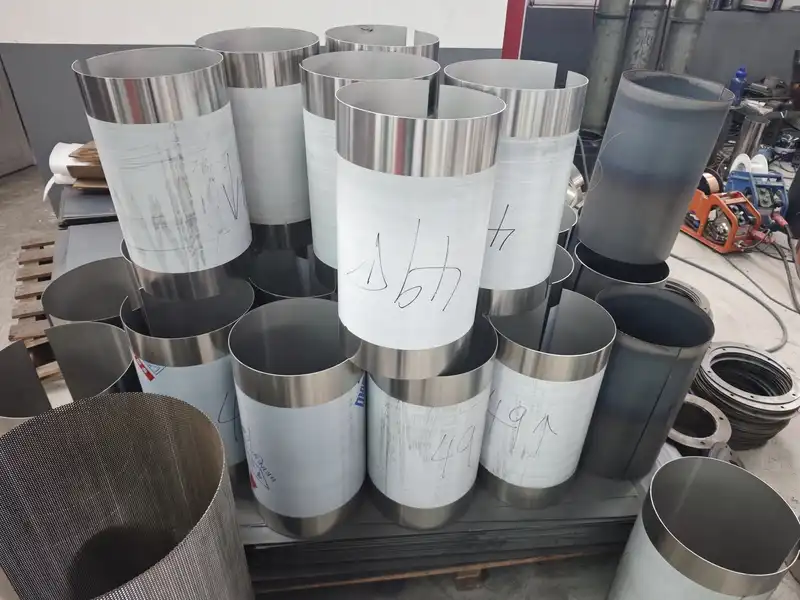
What Is a Stainless Steel Plastic Particle Mixer with an Agitator?
We can all understand each other better when we talk about your project if I start with that.
Basic Structure of a Mixing Tank with Agitator
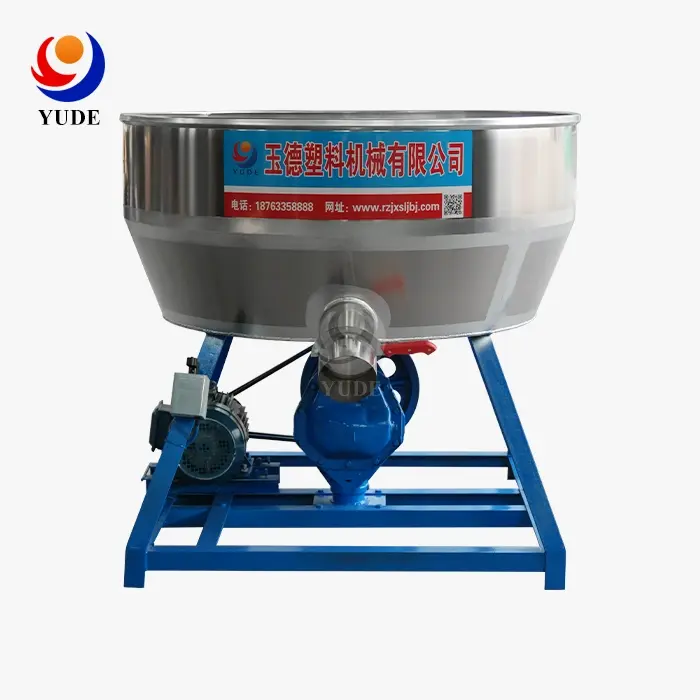
Another type of mixing tank has an engine, a gearbox, an output port, and a vertical barrel. The engine has blades on the center shaft. A lot of them have a lookout hole and a safety cover as well. The blades move through the pellets when you turn the handle. Our stainless steel plastic particle mixer has a barrel and other parts that are also made of 304 stainless steel. This means that every surface that touches the resin is the same grade. Each model has a different useful volume, and we make it fit the size of your batch. Yude Plastic Machinery has plastic mixers that range in size from 600 kg to 10 tons. There are also small plastic particle mixers that weigh between 300 kg and 500 kg.
How a Stainless Steel Plastic Granule Mixer Works
You can add or load pellets, masterbatch, or seasonings from the top. The shaft will then turn 30 to 60 times per minute. The blades pick it up from the bottom and throw it back through the batch. By raising and lowering the load over and over, the pellets are mixed without being crushed. A slow speed is important because fast blades can scratch pellets, stir up dust, and cause static electricity to build up. A three-phase asynchronous motor moves the shaft. The motor runs smoothly and quietly because it has three phases. The motor is safe because it has protections against overload, burning, and phase failure. It has been mixed evenly at least 98% of the time.
Typical Plastic Particle Mixer Applications
Plastics that are used to package food, medical supplies, and high-tech chemicals that are used every day are all things that this machine can handle. A lot of the time, people have to mix new resin with masterbatch, reuse granules with new polymer, and spread ingredients out before extrusion, injection molding, or blow molding. Changing the color is another good use. Because stainless steel is smooth, cross-contamination is less likely to happen when the barrel is cleaned between batches of dark and light. A clean surface that can be touched is also easier to check during a customer audit. Let's see why the steel is so important.
Key Benefits of Using Stainless Steel Construction
After years of daily use, the type of steel a mixer is made of changes how it works. These are the perks I see most often.
Corrosion Resistance and Material Compatibility
Austenitic is the word for grade 304 stainless steel. ASTM A240 says that the nickel content should be between 8 and 10.5% and the chromium content should be between 18 and 20%. The chromium makes a thin film that rust and many cleaning products can't get through. This is important to keep in mind when mixing hygroscopic plastics, damp regrind, or chemicals in a wet workshop. People who want to buy something should always check the grade, since SUS201 has less nickel and can rust over time in certain situations. After getting the item, get a mill test report and ask for a hand-held XRF check. A stainless steel plastic particle mixer made from verified 304 keeps parts that are clear and medical-grade from rusting.
Hygienic and Easy-to-Clean Mixing Surfaces
If the walls and welds are smooth, pellets and dust have less place to hide. It is easy to clean the surface of our stainless steel plastic particle mixer, and it doesn't leave any residue behind. This means it is clean enough to be used to make plastic that is safe for food and medicine. A barrel with a smooth surface can be cleaned more quickly than one with a rough or coated surface. This is important if you change products often. Still, every maker has their own style of polish and join. Get a written copy of the surface roughness (Ra) value. When you go to the factory, check the corners and the area around the shaft seal. That's where extra stuff tends to gather.
Mechanical Strength and Service Life
It is true that stainless steel is very strong when pulled apart, but how long it lasts depends on the whole machine. It is important to check the width of the blades, the stiffness of the shaft, the design of the gearbox, the safety for the bearings, and the quality of the welds. Dust and oil don't get into the bearings or the batch because of metal or air-purge seals. We need to think about rough fillers more. Tell us what kind of filler you're using and how much of it you're using. When loaded with a lot of force, glass fiber can rough up any steel surface. We can then talk about finishes that don't scratch or edges that are stronger. They clean the batch better and make the blades last longer.
Operating Principles and Mixing Performance Factors
It's not enough to mix things quickly; you also need to move them around well. These things decide what will happen.
Agitator Movement and Particle Circulation
Plates can be moved by blades in two main ways. Radial movement means moving something away from the wall and up and down through the barrel. Axial movement means moving something side to side. Both are used in blades that are balanced so that each pellet moves through the whole batch. Pile-ups don't need to be cut up very often, but lumps do. To give them a smooth, steady flow, our shaft turns at 30 to 60 r/min. Things might mix faster with a faster shaft, but there is a greater chance that heat, dust, and broken pellets will happen. That's why you should always test it with your own stuff. The flow can be changed by small particle size, shape, moisture, and friction.
Mixing Time, Fill Ratio, and Discharge Behavior
Each pellet size, type of addition, and blade shape needs a different amount of time to mix. Usually, it takes 10 to 15 minutes to blend pellets into each other and 15 to 20 minutes to blend pellets into powder. Check your number to make sure it's right. Do not fill the barrel all the way to the top; the stuff inside needs room to move around. You also need to pay attention to discharge. Different sized or denser pellets can separate as they fall or move along a conveyor belt. Lessen the drop heights, slowly empty the barrel, and move the blend quickly to the next step.
Capacity Calculation for a Plastic Particle Mixer
To find the working batch weight, just multiply the working volume by the bulk density. Working volume is the amount of room that can be used, not the tank's total size. A batch that weighs about 300 kg can be made with 500 liters of space to work and 0.6 kg of pellets per liter. Fresh pellets are not the same as masterbatch, regrind, or filled compounds, so you need to measure your own mass density. The cycle time is made up of the times it takes to load, mix, and release. To get the hourly output, divide the batch weight by the cycle time. You can tell the seller how dense it really is and how much you want to make, and they will figure out the useful volume for you.
Pros and Limits of a Mixing Tank with Agitator for Plastic Granules
Every machine has good and bad points. I like to give you both sides so you can decide what to do.
Main Advantages for Industrial Applications
A stainless steel plastic particle mixer can be used for many types of batch processes. The recipe can be changed from one batch to the next for plants that make many things. There are many ways to connect the tank to lifters, elevators, and scales. The tank can also be changed in size. Soft pellets are moved by blades that move slowly, and clean steel surfaces make color changes easy. The running is stable and quiet thanks to the safe three-phase motor. Plants that package and compound things that work with small to medium-sized batches and can't handle contamination can use these strengths.
Important Technical and Operational Limits
A stainless steel plastic particle mixer is only meant to mix things gently; it can't be used to spread dirt out. You might need high-shear tools for powders that stick together. If the pellets are different sizes or densities after they are discharged, they may separate. Since the method works in groups, it can't match the exact dose of a system that always works. It doesn't dry things that are wet either. Fillers that are very rough wear down blades more quickly, and going fast creates heat, dust, and static. To ground the steel body, it helps get rid of static electricity. You will save money and avoid being let down if you know about these limits early on.
Situations Where Another Mixer May Be More Suitable
Other machines work better sometimes. If you always need to make sure the doses are right, a gravimetric blender is better. You can melt fine fillers like calcium carbonate or talc with a high-speed heated mixer or a twin-screw extruder. When there are a lot of things going through a line, horizontal ribbon mixers are often better. Wet pellets need to be dried before they can be mixed. I'd rather tell you this now than sell you the wrong machine because a good match lasts a long time.
How to Choose the Best Stainless Steel Mixer for Plastic Pellets and Additives
When you have a plan, it's easy to make a choice. Do these three things.
Define the Production Scenario and Batch Requirements
Start with the real recipe. It is important to write down the type of resin, pellet size, additive ratio, goal batch weight, hourly output, and filling method. You need to add the floor room and details about the power supply, such as the frequency and voltage of the three-phase power supply. These are the things you should tell the supplier when you ask for a price on a stainless steel plastic particle mixer. So, they can make sure that the functional amount and motor are the right size. Prices depend on the type of steel, how thick it is, how much of it there is, the motor, the surface finish, and how it is packed. You'll get a vague quote if you ask for one, but a detailed one will let you compare prices with confidence.
Match Agitator Design to Material Characteristics
The steel blade must be right for the job. It is easy for round pellets of the same size to flow when you lift them gently. To mix things like color or stabilizer that are fine powder, it might take longer or a blade of a different shape. Moving things slowly is important if they are flimsy or easily broken by heat. This is important to know because friction changes which blade to use. You can change the size of our stainless steel plastic particle mixer, and our R&D team can figure out how to work with materials and sizes that aren't often used.
Verify Performance Before Purchase
You should believe the seller, but first check that the machine works. Any company that makes a stainless steel plastic particle mixer should be able to give you a 304 material report, a surface roughness value, records of weld inspections, and information on shaft balance. You can ask for test results that were done with materials that are like the ones you have. When raw materials come into Yude Plastic Machinery, inspectors check them. They also watch the production line and test every finished machine before sending it to a customer. For requests from other countries, we can make an operation interface that works with more than one language and change the tools to meet the needs of those markets. Once you get the machine, our after-sales service is here for you 24 hours a day, seven days a week.
Conclusion
A tank with an agitator in a plastic granule processor lets it mix batches in a gentle and flexible way. It's made of stainless steel, which makes it resistant to corrosion, easy to clean, and long-lasting. Results depend on more than just how fast the machine is going. They also depend on how the blades move, how full the machine is, how long the mixing takes, and how the waste is handled. The working space times the mass density gives you the capacity. It doesn't work well with powders that stick together, it splits after discharge, it can't do continuous doses, and it gets worn out quickly by fillers that are rough. Because of these things, some jobs are better done with gravimetric blenders, high-shear mixers, or extruders. There is a stainless steel plastic particle mixer with 304 contact parts that works well for food, medicine, and everyday chemicals. It has a 30 to 60 r/min shaft and at least 98% uniformity. First, make sure you have real recipe data and documents that have been checked.
FAQ
What is a stainless steel plastic particle mixer used for?
Before they are pushed through a die or shaped in an injection mold, it mixes the masterbatch, the regrind, the plastic pellets, and the chemicals. People who use it often make plastics that are used to package food, medical supplies, and high-end chemicals that are used every day. All of these need clean surfaces that can't get contaminated.
How do I calculate the required mixer capacity?
Work room and mass density must be added up. Since each liter of pellets weighs 0.6 kg, a 500-liter work area can hold around 300 kg of pellets at a time. To begin, find out how dense you are.
Should I choose a vertical or horizontal plastic granule mixer?
This type of unit works well in small plants that load from the top and make batches that are fairly large. Long, thin ribbon units work best for large batches that need to be processed quickly. Once you send us your floor space and batch size, we'll look at your options.
How can I get a quotation for a custom stainless steel plastic particle mixer?
Send an email to Yude with the resin type, batch weight, ingredient ratio, mixing time, voltage, discharge method, and country where the resin is going.
Request a Stainless Steel Plastic Particle Mixer Recommendation
Yude Plastic Machinery ships stainless steel plastic particle mixers to over 30 different countries and regions. These mixers are made of 304 stainless steel and have been fully inspected for quality. The volume can be changed, the operation interface can be used in more than one language, and there is support 24 hours a day, seven days a week after the sale. Send sales@yudemachinery.com the type of pellets you want, their bulk density, batch size, and the address where you want them sent, and we'll help you set them up. Visit yudemachinery.com to learn more.
References
- Handbook of Industrial Mixing: Science and Practice, 2004
- Mixing in the Process Industries, 1992
- Plastics Additives Handbook, 2009
- Handbook of Stainless Steels, 1977
- ASTM A240/A240M Standard Specification for Chromium and Chromium-Nickel Stainless Steel Plate, Sheet, and Strip, 2020
- Perry's Chemical Engineers' Handbook, 2018
Learn about our latest products and discounts through SMS or email