- English
- French
- German
- Portuguese
- Spanish
- Russian
- Japanese
- Korean
- Arabic
- Greek
- German
- Turkish
- Italian
- Danish
- Romanian
- Indonesian
- Czech
- Afrikaans
- Swedish
- Polish
- Basque
- Catalan
- Esperanto
- Hindi
- Lao
- Albanian
- Amharic
- Armenian
- Azerbaijani
- Belarusian
- Bengali
- Bosnian
- Bulgarian
- Cebuano
- Chichewa
- Corsican
- Croatian
- Dutch
- Estonian
- Filipino
- Finnish
- Frisian
- Galician
- Georgian
- Gujarati
- Haitian
- Hausa
- Hawaiian
- Hebrew
- Hmong
- Hungarian
- Icelandic
- Igbo
- Javanese
- Kannada
- Kazakh
- Khmer
- Kurdish
- Kyrgyz
- Latin
- Latvian
- Lithuanian
- Luxembou..
- Macedonian
- Malagasy
- Malay
- Malayalam
- Maltese
- Maori
- Marathi
- Mongolian
- Burmese
- Nepali
- Norwegian
- Pashto
- Persian
- Punjabi
- Serbian
- Sesotho
- Sinhala
- Slovak
- Slovenian
- Somali
- Samoan
- Scots Gaelic
- Shona
- Sindhi
- Sundanese
- Swahili
- Tajik
- Tamil
- Telugu
- Thai
- Ukrainian
- Urdu
- Uzbek
- Vietnamese
- Welsh
- Xhosa
- Yiddish
- Yoruba
- Zulu
Best Practices for Mixing PS Plastic
The best way to mix PS plastic is to match the equipment to the material and then control every step. I start with a PS plastic mixer https://www.yudemachinery.com/plastic-mixer/ps-plastic-mixersized for the batch, set a fixed loading order, and keep speed and temperature moderate so the pellets stay intact and the resin does not degrade. I add colorants and additives in a repeatable sequence, mix for a tested time, and check samples from the top, middle, and bottom of the batch. This approach gives steady color, even additive dispersion, and fewer rejected parts in extrusion and injection molding.
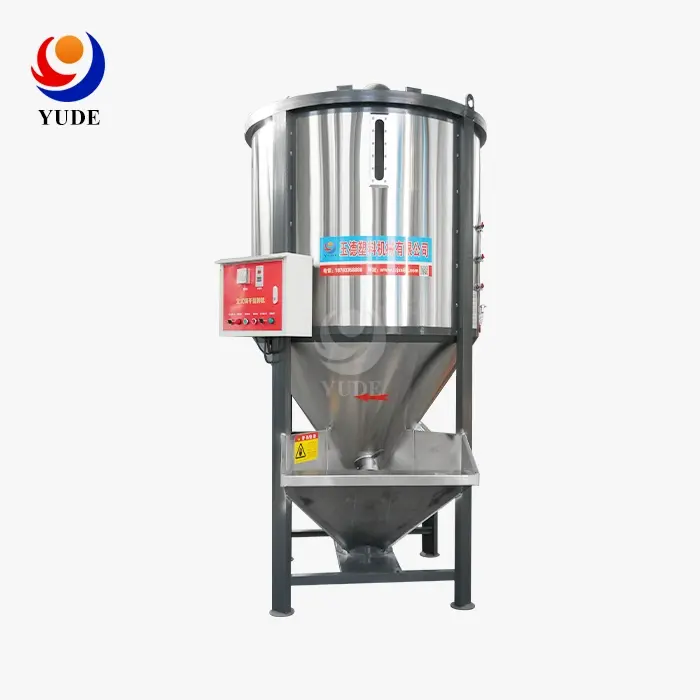
PS Plastic Mixing Process Before Selecting Equipment
Define the Blend and Follow the Material Flow
Before PS resin is extruded, injected, or pelletized, it is mixed with colorants, chemicals, fillers, impact boosters, or recycled material. Before I look at any machine, I make a plan of the whole material path. This includes the hopper of the molding machine and all the places where the material is stored, added, mixed, and emptied. There are different steps you need to take with a PS plastic mixer if you want to dry blend, pre-condition, or regrind. This map shows where the dust goes, where the stuff waits, and how much the mixer needs to be able to move so that the machine below it stays fed.
Check the Variables That Control Uniformity
There are several things that can change the outcome of an even blend. What matters are the amount of additives, the pellet size, the bulk density, the moisture, how hard the mixture is mixed, and how long it stays in the mix. Small chemicals can be pulled off the pellets and onto the tank walls by static electricity because PS is also a good conductor of electricity. A tracer test makes it easy to read these things. After adding a few colored pellets, mix for a certain amount of time. Then, count how many tracer pellets are in the samples from the top, the middle, and the bottom. The fact that all three samples have the same counts shows that the batch is uniform.
Set Temperature, Speed, and Loading Order
PS jobs can't all be done with the same setting. PS doesn't have a clear shape, and its glass transition point is close to 100 °C. With this, you don't usually need extra heat for dry blending. The ideas for warm mixing and pre-conditioning are not the same, though. Things can change color or smell, lose their parts, or stick together if you use too much heat. The material is spread out more evenly when the blades move faster, but they also add heat, dust, and shear. Blades that move more slowly blend the material more gently. It is set that I will add the resin, colorant, lubricant, filler, and regrind in a certain order. After that, I write down how long each meal takes and how fast it goes. When you do the same steps over and over, there is less variation from lot to lot.
Choose the Right PS Plastic Mixer Configuration
Vertical or Horizontal Design
A vertical mixer can be used in most pellet blending lines because it takes up less floor space and lets the pellets fall out on their own. If you need to mix large amounts of food at once or recipes that call for a lot of powder, a horizontal mixer might be best. I like the shape of PS pellets that are spiraled up and down the most. Things fall back down after the spiral moves them up. In this way, the thicker and heavy parts don't settle into layers but instead move around. This is important because fresh resin and regrind have different mass densities when they are mixed.
High-Speed, Low-Speed, Heated, and Cooled Options
When mixing colors and binders very thoroughly, high-speed models work better. On the other hand, low-speed models are nicer to use and work better with formulas that don't like being heated. Adding a coating, warming up, and getting rid of moisture are all easier when you heat something. Cooling down can lower the temperature of the discharge before the material moves on. These aren't needed for many pellet jobs. I always ask myself if my recipe really needs heat before I buy a PS plastic mixer with heat. If the answer is no, a vertical unit running at a low to moderate speed is probably the best choice for quality, price, and energy use.
Match the Mixer to Your Application
It is important for extrusion lines to have a steady composition and discharge so that the pellet quality and melt pressure stay stable. Injection molding cells need to be able to switch between goods quickly and use the same color on more than one machine. When you use a masterbatch, the pigments need to be spread out evenly and not leave much behind. Foam sheets are used to make XPS boxes. The mixer has to mix the resin with nucleating agents and feed the line without leaving the hopper empty. The amount of water, particle size, and color change when you add recycled PS. It is possible to avoid most problems before the machine is even built by making sure that these needs are met by the shape of the tank, the design of the blades, and the output's layout.
Avoid Common PS Plastic Mixing Problems
Uneven Color and Poor Additive Dispersion
People usually worry about color that isn't even and additives that aren't spread out well. It can happen because you added the ingredients in the wrong order, mixed them for too long or too short of a time, or used blade shapes that leave dead zones. If you don't spread the foam evenly, it can cause uneven density and foaming, which leads to more waste. Heavy and light parts stay moving with a full-height PS plastic mixer that is well-matched. This gets rid of streaks. It's easy for me: I just double-check the recipe order, make sure that batches don't go over the set working volume, and taste at three different heights. If things still don't work out, put time before speed.
Static, Sticking, and Heat Build-Up
PS has a static charge that can make fine add-ins stick to walls or come off of pellets. It's easier to change colors on polished, grounded stainless steel surfaces because they don't stick as much. Things don't stick or break when they are stored wet or packed in a tight container. A lot of the time, I check the discharge temperature during tests. If the speed is too high or the groups run for too long, it gets hot. If the stuff still won't come off, ask your supplier if an ionizer or anti-static dosing can be used with your machine. It is very important to do this in dry places where static is strong.
Dust, Wear, and Operator Safety
When you use recipes with glass or abrasives, blades get worn down faster than when you just use plain PS. Putting together parts that don't wear out and a barrel material that sticks well with glue makes the service life longer. Also, keep yourself safe. To get the right machine, look for ones with emergency stops, sealed lids, and lid interlocks that stop the machine when the feed lid opens. In the United States, machine service is governed by OSHA's 29 CFR 1910.147 lockout/tagout rules. I also believe that there should be a way to get rid of dust at the loading area and a written cleaning process so that both new and experienced operators know what to do.
Compare PS Plastic Mixer Options for Industrial Procurement
Compare Real Process Needs, Not Motor Ratings
PS, PVC, and PP all react to heat and additives differently, so a mixer that works for PS might not work for PVC or PP. This is because of the differences in their bulk density and shear needs. When you compare PS plastic mixers, you shouldn't just look at the motor power. You should also look at the effective batch volume, cycle time, energy use per kilogram, and measured uniformity. It's not always true that a bigger motor means a better blend. It only makes the plastic hotter and the power bill go up. When you ask each seller the same question about the same recipe, it's easy to compare.
Size Capacity to Your Molding or Extrusion Rate
The weight of each shot shouldn't help you choose a mixer. How many kilograms of material does your extrusion or molding machine use in an hour? Then pick a mixer that can hold about 1.5 times that amount. This will give it time to buffer, load, and unload. Since working room is based on mass density, the biggest tank size doesn't tell you much on its own. Yude Plastic Machinery has small plastic particle mixers that weigh between 300 kg and 500 kg and vertical plastic mixers that weigh between 600 kg and 10 tons. These sizes can be used for both small and big production lines and shaping cells.
Build a Selection Checklist
There is less business and technical risk when you have a short plan. First, pick the PS grade, the type of material, the method, the batch size or the hourly output, the amount of regularity you want, and the next step. First, talk about the working volume. Then, talk about the blade shape, the touch materials, the discharge, and how to keep dust out. Then, pick a provider based on how much experience they have with your application, their ability to provide extra parts, their factory testing, their paperwork, their installation support, and their warranty. To find the total cost of ownership, you should add up the costs of maintenance, repairs, service, and spare parts. Last but not least, make sure the price includes the choices, tools, shipping and delivery terms, as well as the commissioning. Then, a sample or a factory acceptance test is used to check the cycle time, uniformity, and line fit.
Work With an Experienced PS Plastic Mixer Manufacturer
Yude's Vertical PS Plastic Mixer for Polystyrene Pellets
For polystyrene pellets, this PS plastic mixer from Yude Plastic Machinery is a tower type. To sum up, these are its key advantages:
- Spiral mixing structure: A spiral mixing structure is used by Yude. The spiral structure is based on how the PS pellets behave physically. Its mixing settings are based on the density and flow of the material. This helps keep the mixing even (98% or higher) and keeps the material from sticking together, so each batch comes out of the output port in the same state.
- Barrel and wear parts: Based on the PS qualities, the barrel material is chosen, and wear-resistant mixing parts are paired with it. Hard PS pellets rub against blades and walls many times a day, and part life has a direct effect on running costs. This mix makes the equipment last longer, which is important.
- Application range: Production lines are the only ones who use the mixer for PS grinding, injection molding, and extrusion. Yude also talks about mixing pellets for PP lines, PE films, PVC profiles, and ABS shells for home goods. The Yude team needs to know about your recipe so that they can check the mixing conditions with your pellets and other ingredients.
These advantages target agglomeration, uneven color, and early wear.
Customization and Service for International Buyers
Yude Plastic Machinery is a business that makes things and sells them. More than 30 countries and places buy its goods. The business can offer operation interfaces in multiple languages and changes to equipment that meet the needs of the overseas project's industry. Mixed materials and shapes that aren't normal can also be handled by it. A full-process inspection system checks the raw materials that come in, the work that is being done, and the finished product before it is sent out. After-sales service is open seven days a week and lets buyers from other countries work with professional service teams in their own countries. Because service records and information about each machine are kept in customer files, it is easy to find information about parts or repairs.
Maintain and Track Performance Over Time
It's important to take care of a PS plastic mixer that works every shift. I think you should write down operating procedures that tell the machine how to load, how fast it should go, how long it should mix, and how it should be discharged so that every shift gets the same result. The blades, shafts, bearings, seals, drives, and release gates should all be checked regularly. Plus, check the number of lubrication hours against what it says to do. You can keep track of cycle time, energy use, fail rate, and uniformity test results with an easy log. There are three types of rejects: recipe, operator, and wear and tear. The log shows which one it is when there are more rejects. It takes less time to fix problems this way.
Conclusion
This is not about the machine, but about the stuff and how it's mixed. To get the same results every time, you can change the mix, the flow of materials, the order of loading, the speed, and the temperature. Static electricity, wetness, heat, and wear are often to blame for color problems, problems with spreading, and problems with sticking. A circular form that goes up and down works well for mixing pellets because it keeps parts with different densities moving. To find the best PS plastic mixer, people should use a checklist and test samples to see how long the cycle takes, how uniform the mix is, how much energy it uses, and how much it can hold compared to what the extruder or molding machine really needs every hour. As time goes on, the results stay the same because of written procedures, regular checks, and data that is written down. It's not always the bigger or more powerful machine that works better with other systems.
FAQ
Should I choose a vertical or horizontal mixer for PS pellets?
When floor space is limited and production is small to medium-sized batches, a vertical mixer is a good solution for blending PS (polystyrene) pellets with color masterbatch or regrind. It lifts the materials up with a central screw, so they can circulate and then fall down under gravity for uniform mixing.
If you’re working with larger batches, higher production volumes, or formulations with a significant amount of powder and additives, a horizontal mixer may be more appropriate. It has mixing blades or ribbons that actively move the material to allow for efficient blending.
Ultimately, the optimal choice is a function of batch size, production capacity, material properties, the required degree of mixing uniformity, and the available floor space.
Does mixing PS always require heating?
No, you don't need to add heat when dry blending pellets, and recipes that only use pellets don't need it either. For warm mixing or pre-conditioning, you may need to heat and cool the mixture. But too much heat can change the color, smell, or stickiness, so make sure you need it first.
What capacity of PS plastic mixer do I need?
The mass density and how much your extruder or molding machine uses each hour should be used to figure out the capacity, not the biggest tank size. Most of the time, you should set the buffer and download time to about 1.5 times your everyday use.
What should I send for a quotation?
Tell us your PS grade, recipe, batch size or hourly output, goal for uniformity, downstream machine, location, project plan, and electrical standard. Please let us know if the mixer can feed more than one machine or just one. Giving full information speeds up the process of getting a correct quote.
Request a PS Plastic Mixer Recommendation from Yude Plastic Machinery
Yude Plastic Machinery will look at your resin, additives, batch size, and line layout. If you want to compare PS plastic mixer suppliers, email sales@yudemachinery.com with your recipe and the amount of plastic you want to mix. We have after-sales service seven days a week, twenty-four hours a day, and tools in more than one language, so we can help you find a vertical mixer that works with your pellets. To find out more, go to yudemachinery.com.
References
- Handbook of Industrial Mixing: Science and Practice, 2004
- Mixing and Compounding of Polymers: Theory and Practice, 2009
- Modern Styrenic Polymers: Polystyrenes and Styrenic Copolymers, 2003
- Plastics Additives Handbook, 2009
- Injection Molding Handbook, 2000
- ASTM D1895 Standard Test Methods for Apparent Density, Bulk Factor, and Pourability of Plastic Materials, 2017
Learn about our latest products and discounts through SMS or email