- English
- French
- German
- Portuguese
- Spanish
- Russian
- Japanese
- Korean
- Arabic
- Greek
- German
- Turkish
- Italian
- Danish
- Romanian
- Indonesian
- Czech
- Afrikaans
- Swedish
- Polish
- Basque
- Catalan
- Esperanto
- Hindi
- Lao
- Albanian
- Amharic
- Armenian
- Azerbaijani
- Belarusian
- Bengali
- Bosnian
- Bulgarian
- Cebuano
- Chichewa
- Corsican
- Croatian
- Dutch
- Estonian
- Filipino
- Finnish
- Frisian
- Galician
- Georgian
- Gujarati
- Haitian
- Hausa
- Hawaiian
- Hebrew
- Hmong
- Hungarian
- Icelandic
- Igbo
- Javanese
- Kannada
- Kazakh
- Khmer
- Kurdish
- Kyrgyz
- Latin
- Latvian
- Lithuanian
- Luxembou..
- Macedonian
- Malagasy
- Malay
- Malayalam
- Maltese
- Maori
- Marathi
- Mongolian
- Burmese
- Nepali
- Norwegian
- Pashto
- Persian
- Punjabi
- Serbian
- Sesotho
- Sinhala
- Slovak
- Slovenian
- Somali
- Samoan
- Scots Gaelic
- Shona
- Sindhi
- Sundanese
- Swahili
- Tajik
- Tamil
- Telugu
- Thai
- Ukrainian
- Urdu
- Uzbek
- Vietnamese
- Welsh
- Xhosa
- Yiddish
- Yoruba
- Zulu
How to Fix Inconsistent Blending in Your High-Speed Mixer Machine?
To fix inconsistent blending in your high-speed mixer machine,https://www.yudemachinery.com/pot-type-plastic-particle-mixer/high-speed-plastic-particle-powder-mixer start by finding the cause instead of changing settings at random. Take samples from the top, middle, bottom, and discharge point. Then check four things in order: fill level, loading sequence, raw-material condition, and blade wear. Change one variable at a time, and test several batches before you lock in new settings. If worn blades or an undersized vessel keep causing poor results, the machine itself may need repair or replacement. I explain each step below, so you can see where your problem sits.
Why Consistent Blending Matters in High-Speed Mixing
What Uneven Batches Cost You
Uneven blending shows up as lumps, lines, color shifts, or parts that pass one shift but not the next. It costs money to fix everything. It takes time to fix things, you waste stuff, and you might be late. It can change the strength, color, and finish of the final part if a filler or pigment clumps up in one corner of the batch. The risk is the same for people who work with powder in the drug, chemical, and food businesses. If you keep the mix steady, you'll make money and keep your customers' trust.
Where the Trouble Usually Starts
There are four main things that can go wrong when using a high-speed mixer machine: the machine itself, the material, the settings for the process, and the people who use it. No need to guess because the sign can be caused by both a worn blade and wet raw material. A book called the Handbook of Industrial Mixing talks about how particle size, density, and flow can change solids mixtures just as much as the mixer itself. Even after being mixed well, things that are very different in size or weight tend to separate. I think you should look at the material first since it doesn't cost anything.
Who This Guide Helps
This book was made for people who buy tools, work as plant engineers, compounders, or mangers of injection molding. You care about how the filler spreads out and how well it works from batch to batch if you run a high-speed plastic particle powder mixer for filled plastics. You need to make sure that the colors match and the supply stays steady if you feed lines for film blowing or injection molding. You need to know if you should fix, change, or get new tools when you buy them for a plant or to sell. In each part, there is a test you can do on your floor and clues that will let you know if the machine is that bad.
Find the Cause Before You Touch the Settings
Define the Blending Problem First
What's wrong with your high-speed plastic particle powder mixer? Write it down before you change the speed, batch size, or anything else. Are there areas that aren't mixed, lumps, spots, burns, or differences from one batch to the next? Pick out pieces of the front, back, middle, and bottom streams. They're like a lab test or a quick check that's done during the process, like size or color. On one sheet, write down the recipe, batch size, filling order, speed, cycle time, and conditions for release. After that, do the test again, but this time use a different medium and fill amount. The process is probably what caused the problem since it comes after the material. It's time to check it if it works with the machine.
Common Causes of Inconsistent Mixing
It's rare for just one part of a high-speed plastic particle powder mixer to not work right. If you fill it too much, it won't move, but if you fill it too little, it can get past the blades. Things move more slowly when you move slowly, and they move very quickly when you move very quickly. It makes lumps and wet spots when you add powder or liquid too quickly. The raw material's flow, mass density, particle size, and how wet it is are also important. A bad discharge, worn blades, the wrong clearances, broken seals, or a shaft that isn't lined up right can all change how straight the cut is. The next problem is often hard to see when you fix one thing at a time.
A Step-by-Step Troubleshooting Routine
If you stick to a routine, your high-speed mixer machine won't make changes that weren't planned. Do these three things in this order:
- Inspect the machine. First, turn off the power. Then look at the walls of the vessel, the drainage valve, the safety features, the blade edges, and how the shaft and blades are lined up. View the artist's sketch to learn how much space there is between the blade and the wall. Before the next test batch, fix any parts that are broken or loose. Picture blades that are worn out so you can see how they've changed from one check to the next.
- Verify the material. Check the information. Look at the formula's weights, then find out how wet, how big the particles are, how dense the whole thing is, and what temperature it is. When fillers or cement are too wet or too cold, they can cause lumps. Take readings next to each batch number and write them down. Dry or pre-warm anything that isn't in your normal range. This record will help you show that a customer asked a lot of questions.
- Run controlled trials. Change one of the following for each test: the fill level, the order of the loads, the speed of doses, the time of mixing, or the speed profile. Get samples from the same places every time. Test the setting on several batches to find the best one, then write it down so that all shifts must follow it.
These three steps help you tell the difference between problems with the process and problems with the equipment, so you only spend money where the data tells you to.
Quick Check: Is It the Machine or the Process?
Do what the easy rule says. If the results get better when you change the speed, the order of the loads, the size of the batches, or the time it takes to mix, the process is probably to blame. You should check the machine first if it slowly loses its power, the blades look worn, or the clearances have changed. Worn parts may also make more noise, shake, heat, or load on the motor. Your high-speed plastic particle powder mixer is broken in different materials and settings. Write down what needs to be done to fix it or get a new one. Record the things that need to be used, how much can be used, the batch time, the temperature, whether automation is needed, and how the area needs to be cleaned. After that, before you agree to buy something, look at the test results from the seller and the total cost of ownership.
Apply the Right High-Speed Mixer Machine Working Principles
How a High-Speed Mixer Machine Creates Uniformity
A motor sends power to the drive, which then sends it to the blades when the speed is high. The material is thrown by the blades in radial, axial, and turbulent directions. A high speed isn't enough to mix things well; the whole body needs to be moving. Fast-moving blades also grind against each other. Friction can heat the PVC dry mixture to about 110 to 120°C when it is mixed. This helps the resin take in the chemicals and get rid of the water. Heat can help if you plan ahead. Some recipes can break down in hot weather if you leave it to run on its own.
Match Speed and Shear to the Material
It is best to use a slower speed when loading things that are wet or fragile. A faster speed helps spread things out and breaks up clumps. You shouldn't think of a high-speed plastic particle powder mixer's steps as a set number of them. Instead, think of them as stages. Start out slowly as you add the powders and other ingredients. Go faster for dispersion and then slower before the discharge. Watch the temperature and motor current during the ramp. If the pressure is too high for that formula, the current will go up or things will stick to the wall. When making the blades, the tank, the gaps, and the baffles, you must also think about how the material will move.
Choose the Right Mixing Configuration
Choose a setting based on the type of material, how much cutting you need, the batch size, how sensitive it is to heat, and how much you need to clean it. Most of the time, powder blends need strong circulation to spread out. Color and filler, on the other hand, need high shear to spread out. Jacketed tanks help keep formulas that are sensitive to heat in check, and vacuum systems help keep formulas that are sensitive to moisture in check. For some jobs, you need to mix slowly at first and then quickly at the end. In this case, a high-speed mixer machine isn't always better than a slow one. Special tanks, dosing systems, PLC controls, or dust collectors can be added to a standard model to help with hard-to-work-with materials that a standard model can't.
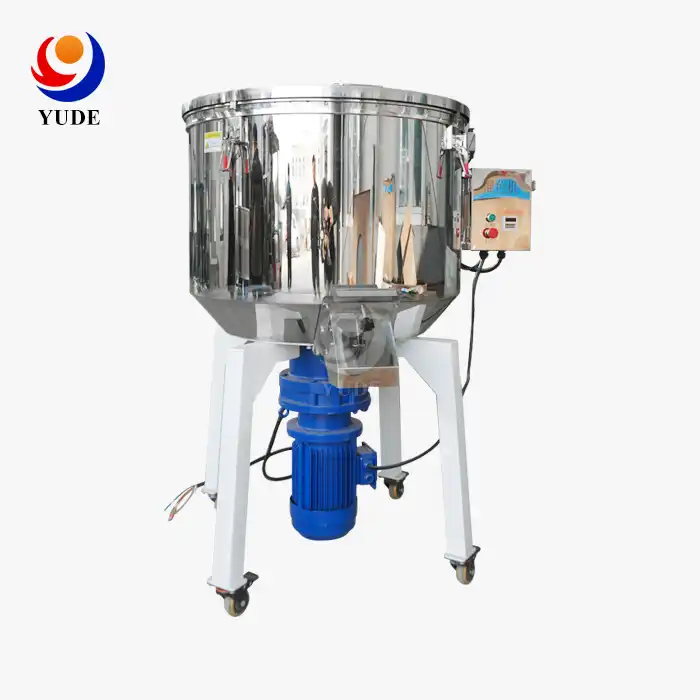
How Yude's High Speed Plastic Particle Powder Mixer Addresses These Problems
Spiral Structure and Higher Rotation Speed
If your checks point to the tools, you should look closely at how the stirring is made. Yude Plastic Machinery makes the high-speed plastic particle powder mixer. It has a spiral shape that is perfectly tuned and can stir very quickly. The speed of spin is 50% faster than on standard models, and it takes 40% less time to mix. There are fewer dead spots that cause streaks because the particles move faster through the whole barrel. The plan is to make the mixing at least 98% equal. The lines for granulation, injection molding, and film blowing don't have to wait as long between runs when the cycle speed is higher.
Motor Power and Protection
A stable drive lets you get the same results over and over. This high-speed plastic particle powder mixer has a motor that runs steady and quietly, using less energy. This makes the workshop easier for the people who work there. There are safety features that keep the motor safe when a batch runs heavy or the load goes up. That's related to the steps we just talked about to fix things. It's dangerous when the motor current goes up. While you look for the cause, the safety devices stop the damage. Giving steady power also helps keep the speed the same from one batch to the next.
Thickened Barrel and Wear-Resistant Blades
Worn-out blades often make mixing go badly, so it's important that the build is good. The High Speed Plastic Particle Powder Mixer's barrel is made of thickened carbon steel, and the blades that mix the powder are made to last a long time. Additives that are rough, such as calcium carbonate and talc, wear down the blade edges over time. This makes the gaps bigger and the mixing less effective. Blades that last a long time slow that change down. If you want to keep your blades in good shape, you should check them often and measure the space between them. Changing blades at the right time is cheaper than throwing away batches that don't meet standards.
Capacity Options and Application Fit
The high-speed plastic particle powder mixer's useful amount can be changed based on the type. This way, you can match the vessel to the real size of your batch instead of the brochure's biggest number. In this high-speed mixer machine, pieces of plastic like PE, PP, ABS, and PVC can be mixed together. It can be used with film blowing, granulation, and high-capacity lines that need to quickly mix a lot of particles. Yude has more than just plastic mixers to choose from. It also has vertical color mixers, small plastic particle mixers (300 kg to 500 kg), plastic mixers made of stainless steel, and vertical plastic mixers that can hold up to 10 tons.
Keep Blending Consistent Over the Long Term
Maintenance and Cleaning Routines
Any high-speed plastic particle powder mixer can keep mixing well if it is taken care of regularly. The gears, scrapers, sensors, bearings, joints, seals, blades, and shafts should all be checked regularly. Watch out for changes in the motor power, temperature, noise, vibration, or vibration. Things like this often happen right before something breaks. OSHA's 29 CFR 1910.147 lockout/tagout standard says that you must turn off and tag out all power sources before you clean or work on the blades. Extra blades, seals, bearings, and release parts should be kept on hand based on how likely it is that something will break down and how long it takes for suppliers to get them to you.
Verify Performance with Data
To decide how to mix, the judge should use numbers instead of eyes. Keep an eye on things like the ability to repeat batches, the consistency of the results, cycle time, temperature rise, motor load, energy use, and the amount of waste. Harnby, Edwards, and Nienow's book Mixing in the Process Industries goes into a lot of detail about sampling because mistakes in sampling can change how mixing turns out. So always get samples from the same places and use the same method. The recipe, the order of the loads, the speed profile, the mixing time, the temperature, and any warning should all be written down in each batch record for your high-speed mixer machine. Before you buy it, ask to try it out with your own raw materials.
Choose a Supplier You Can Trust for the Long Run
Not only look at price, but also how much they know about technology, how much experience they have with your application, how well they build, and how good their customer service is after the sale. When you are looking for a high-speed mixer machine, get a quote that includes the machine's working capacity, motor power, speed range, materials, accessories, shipping, warranty, and spare parts. People in the US should also look at the control standards, export packing, inspection papers, voltage, frequency (60 Hz is common in US companies), and frequency. Its goods are bought in more than 30 countries and regions by Yude Plastic Machinery. It has customizable, international user interfaces and can be changed to fit the needs of each local business. It also has customer service that is open seven days a week after the sale. It checks the quality of the raw materials that come in, the work that is being done, and one last time before the goods are sent out.
Conclusion
Finding out what's wrong is the first thing that needs to be done to fix inconsistent blending. This can be caused by a mix of process settings, the condition of the raw materials, and machine wear. To tell the difference between mechanical and process faults, you need to describe the issue, get samples from several locations, and check the speed, fill level, loading order, and blade clearances. A high-speed mixer machine does more than just go fast; it also cuts and moves things around in a controlled way. In other words, every formula needs its own speed profile and the right set-up. Each time the results are checked, they are always the same because they are locked out before service and logged in batches. If the changes don't help, the best things to compare are the spiral structure, rotation speed, motor protection, rugged blades, and vessel size. This can be seen in a high-speed plastic particle powder mixer. A process that has been written down and tried keeps the quality of the result high and cuts down on waste.
FAQ
Why does my high-speed mixer machine leave lumps?
Most lumps happen when too much powder or liquid is added too fast, when the raw materials are too wet, or when the level of filling is not high enough. Lessen the dose, let the stuff dry, and check the blade's condition before you do anything else.
Does higher speed always improve blending?
No. Speed makes shear and heat worse, which can break down a formula or make stuff pile up on the walls. Watch the motor's current and temperature and set the speed in steps.
How do I choose the right capacity for a high speed plastic particle powder mixer?
The working capacity, bulk density, fill ratio, and future output needs should all be taken into account, not just the vessel's overall size. Share your batch size and material data with the supplier.
When should I replace the blades on a high speed plastic particle powder mixer?
You should replace them when wear makes the gaps bigger or the level of uniformity drop. Do regular checks. How long you go between checks will depend on how rough your materials are and how many hours you run.
Request a High-Speed Mixer Machine Quote from Yude Plastic Machinery
Yude Plastic Machinery makes high-speed mixer machines for companies that work with plastic. Their machines can be changed to fit different needs, have user screens in multiple languages, and come with 7x24 customer help after the sale. It takes 40% less time and can mix things evenly 98% of the time or more with our high speed plastic particle powder mixer. Send your material type and batch size to sales@yudemachinery.com or visit yudemachinery.com to learn more.
References
- Handbook of Industrial Mixing: Science and Practice, 2004
- Mixing in the Process Industries, 1992
- Polymer Mixing: A Self-Study Guide, 1998
- Mixing and Compounding of Polymers: Theory and Practice, 2009
- Plastics Additives Handbook, 2009
- Control of Hazardous Energy (Lockout/Tagout), 29 CFR 1910.147, OSHA, 1989
Learn about our latest products and discounts through SMS or email