- English
- French
- German
- Portuguese
- Spanish
- Russian
- Japanese
- Korean
- Arabic
- Greek
- German
- Turkish
- Italian
- Danish
- Romanian
- Indonesian
- Czech
- Afrikaans
- Swedish
- Polish
- Basque
- Catalan
- Esperanto
- Hindi
- Lao
- Albanian
- Amharic
- Armenian
- Azerbaijani
- Belarusian
- Bengali
- Bosnian
- Bulgarian
- Cebuano
- Chichewa
- Corsican
- Croatian
- Dutch
- Estonian
- Filipino
- Finnish
- Frisian
- Galician
- Georgian
- Gujarati
- Haitian
- Hausa
- Hawaiian
- Hebrew
- Hmong
- Hungarian
- Icelandic
- Igbo
- Javanese
- Kannada
- Kazakh
- Khmer
- Kurdish
- Kyrgyz
- Latin
- Latvian
- Lithuanian
- Luxembou..
- Macedonian
- Malagasy
- Malay
- Malayalam
- Maltese
- Maori
- Marathi
- Mongolian
- Burmese
- Nepali
- Norwegian
- Pashto
- Persian
- Punjabi
- Serbian
- Sesotho
- Sinhala
- Slovak
- Slovenian
- Somali
- Samoan
- Scots Gaelic
- Shona
- Sindhi
- Sundanese
- Swahili
- Tajik
- Tamil
- Telugu
- Thai
- Ukrainian
- Urdu
- Uzbek
- Vietnamese
- Welsh
- Xhosa
- Yiddish
- Yoruba
- Zulu
How to choose between a 5-ton and a 3-ton vertical plastic drying mixer?
Plastics makers have to choose the right size vertical drying mixer to get the best production results, lowest costs, and best quality products. A 5 ton vertical plastic particle mixer with drying function is better than a 3 tonne model, but it relies on how much you make every day, how you need to handle batches, and the layout of your facility. The 5-ton model has better throughput and energy efficiency per kilogram for larger businesses that process 10 tonnes or more per day. On the other hand, the 3-ton units work well for mid-sized makers on a budget and in limited space. When you look at the types of materials you have (PE, PP, ABS, or PVC), your moisture removal goals, and the amount of floor space you have, you can make an informed purchasing decision that balances short-term capital costs with long-term operational savings.
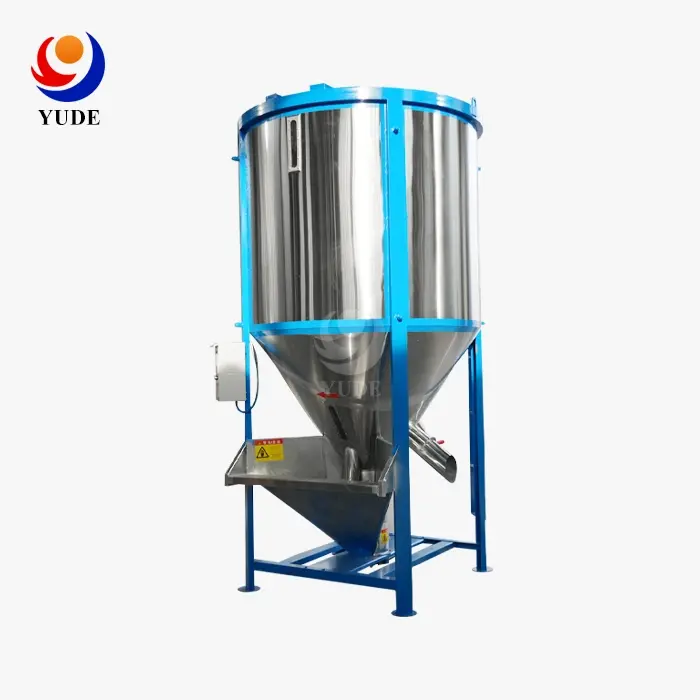
Core Differences Between 5-Ton and 3-Ton Vertical Plastic Drying Mixers
There is no need for separate drying equipment because vertical plastic drying mixers mix materials and remove wetness through heat in a single system. The vertical spiral upward circulation system picks up plastic bits from the bottom and spreads them out evenly. At the same time, hot air runs through the material bed, effectively removing any moisture. This two-in-one approach cuts down on production steps and manual labour, which is especially helpful in high-volume settings where the efficiency of the work flow directly affects profits.
Capacity and Production Scale Implications
Differences in capacity completely change how much production can go through. A 3-ton unit can only handle 3000 kg per cycle, but a 5 ton vertical plastic particle mixer with drying function can handle 5000 kg. When running at the same cycle time of 35 to 50 minutes, the larger mixer produces about 67% more per hour. This high flow is needed to keep downstream equipment running continuously in factories that make injection-molded auto parts or large-scale blown film operations.
On the other hand, job shops that work with different colour runs or speciality compounds benefit from the 3-ton mixer's versatility, which lets them switch materials more quickly and avoid waste from batches that aren't fully filled. The actual volume measurements show bigger differences in how things work. With a standard load of 0.6 to 0.8g/cm³, a 5-ton mixer needs about 7500 to 8000 litres of tank space. A 3-ton mixer, on the other hand, only needs about 4500 to 5000 litres. This relationship between volumes changes not only the mixing chamber's physical footprint but also how heat moves through it. For larger amounts, you need more complex temperature control systems to keep the temperature consistency you need to remove moisture evenly across the whole batch.
Energy Consumption and Cost Dynamics
Increases in capacity lead to huge increases in power needs. A normal 5 ton vertical plastic particle mixer with drying function has a motor that mixes plastic particles that uses 37 to 45kW and heating parts that use 80 to 100kW, for a total of 120 to 145kW when it is actively drying. About 22–30kW are used for mixing in a 3-ton unit, and 50–70kW are used for heating. This is about 60% of the energy needed by the bigger type. However, the bigger equipment usually has a lower energy cost per kilogram worked because the bigger tanks are more thermodynamically efficient and lose less heat through surface area-to-volume ratios.
To look at the working cost structure, you have to look at both how much power is used and how efficiently the cycle works. The 5-ton mixer can mix materials evenly enough to meet above 98% of the time and lower the moisture level to below 0.5% in 35 to 50 minutes, handling about 6 to 8 tonnes of material every hour. Based on how much energy is used, this comes out to about 14 to 24 kWh per tonne of dried material. Even though the 3-ton model uses less power overall, it usually needs 16–28kWh per tonne because it loses more heat and takes longer for the structure of the equipment to heat up. When processes run on multiple shifts for more than 5,000 hours a year, these differences in efficiency add up to a big problem.
The type of heating technology is another cost factor to think about. Electric heating tubes let you precisely control the temperature of the hot air, which can be adjusted from room temperature to 85℃. This is good for heat-sensitive materials that could break down if the temperature goes too high. Steam heating systems, which come in a variety of designs, are much cheaper to run in buildings that already have boilers. Compared to electric resistance heating, they could cut heating costs by 40 to 60 percent. When comparing the total cost of ownership of different capacity choices, procurement teams should look at the services that are already in place at their plant.
Key Criteria for Choosing the Right Vertical Plastic Drying Mixer Capacity
To choose the best capacity, you need to carefully look at the production factors, material properties, and operating limitations. Instead of relying only on advertised capacity numbers, these criteria make it possible to match the specs of equipment to the actual needs of manufacturing.
Evaluating Production Requirements and Workflow
The daily volume of material consumption is the main factor that determines capacity. Find out how much plastic particles your production lines use on average every day, taking into account times of high demand like when production goes up during certain times of the year. As a general rule, you should choose a mixer with enough capacity to handle your daily output in six to eight cycles. This will give you extra capacity for things like equipment repair, material changes, and sudden demand spikes without stopping production.
For manufacturing operations that need to process 25 to 40 tonnes of material every day, a 5-ton capacity is usually best. For sites that process 12 to 20 tonnes of material every day, a 3-ton capacity works better. The regularity of batch size has a big effect on how well a mixer works. Underfilling a 5-ton mixer to work with 2-ton batches loses energy by heating up extra metal structure and makes it hard for the materials to mix evenly during the cycle, which could affect the final result.
The vertical spiral mechanism works best when the effective volume is filled to 60–80% of its fullness. This makes sure that the material moves through the fountain-like circulation pattern properly. Businesses that often work with different batch amounts below 2500 kg should choose the 3-ton model, even if they could make more overall, which could support bigger equipment. In less clear ways, production frequency trends affect the choice of capacity. The 5-ton mixer's throughput benefits are at their best in continuous production settings that use the same material formulas for long periods of time. When spread out over several cycles, the time it takes to heat the larger thermal mass becomes almost nothing.
Technical Specifications: Drying Time, Temperature Control, and Moisture Removal
How well moisture is removed depends on how drying time, air temperature, material properties, and the strength of the mixing action work together. The 5 ton vertical plastic particle mixer with drying function has a barrel made of Q235 carbon steel that is insulated on all sides. This keeps the temperature inside the mixer fixed during the drying cycle and reduces the amount of heat that escapes to the environment. Compared to static drying methods, the thicker carbon steel mixing spiral creates turbulent flow patterns that keep the hot air stream on top of new material surfaces, evaporating a lot more moisture much faster.
For industrial plastics that are sensitive to water, precise temperature control is essential. PID-controlled heating systems keep hot air temperatures within ±2–3℃ of setpoint values. This keeps materials like ABS and PVC from breaking down due to heat, which can cause them to turn yellow or lose molecular weight. The temperature range can be changed from room temperature to 85℃ to accommodate different material needs. Polyolefins like PE and PP can handle higher drying temperatures for shorter cycles, while heat-sensitive compounds need to be treated more gently and for longer periods of time.
Different materials have very different abilities to remove moisture. For removing deep moisture below 0.02%, hygroscopic plastics like nylon or PET usually need desiccant-based dehumidifying dryers. However, the vertical mixer does a good job of removing surface moisture and pre-drying tasks, which makes it easier for downstream specialised equipment to do its job. Non-hygroscopic materials, like polyethylene and polypropylene, can be dried with hot air alone to meet moisture levels (usually between 0.3 and 0.5%). This means that these built-in mixer-dryers are all that is needed to fully prepare the material. Knowing the main types of materials you work with helps you choose the right capacity.
Comparing 5-Ton Vertical Mixers with Drying Function vs 3-Ton Models: Pros and Cons
When you do a fair analysis, you can see the pros and cons of each capacity level. This helps procurement teams choose equipment that fits with strategic manufacturing goals instead of just maximising capacity.
Advantages of 5-Ton Capacity for Large-Scale Operations
With bigger mixing tools, industrial-scale producers can save a lot of money. The 5 ton vertical plastic particle mixer with drying function moves materials at much lower costs per kilogram when it is used close to its full capacity. To keep material preparation from getting in the way of production, factories that supply injection moulding operations with multiple big presses or run blown film lines that use several tonnes of film every hour need this flow level. At first, the bigger thermal mass might seem like a bad thing, but it actually keeps temperature changes from being too big or too small during the mixing cycle. This makes the drying conditions more even across the batch.
This thermal stability is very helpful when working with heat-sensitive materials that need to be handled carefully to keep them from breaking down. Scalability is another strong benefit for businesses that want to grow. Companies that think their production will grow over the next three to five years should invest in bigger facilities so they can handle future volume increases without having to buy new equipment. Being able to handle bigger batches makes it easier to plan production, which cuts down on the number of material changes and the downtime that comes with them. Contract makers who work with a wide range of clients like being able to handle big orders quickly while also being able to work on smaller batches when needed, even if it means sacrificing some efficiency.
With bigger equipment, integrating material handling is easier. When they are used to connect to larger pieces of equipment, pneumatic conveying systems, automated loading mechanisms, and downstream process connections become more cost-effective because the infrastructure investment is spread out over a larger volume of material. Because of the higher everyday output, more complex automation is needed that wouldn't be worth it for setups with lower capacity. Most of the time, these systemic efficiencies make it more cost-effective to use bigger machines in manufacturing settings with many integrated process steps.
Benefits of 3-Ton Models for Budget-Conscious and Mid-Sized Producers
Many purchasing decisions are based on how much the purchase will cost, especially for mid-sized manufacturers or companies starting new product lines with unknown volume trends. A 3-ton vertical drying mixer usually costs 40–55% less than similar 5-ton equipment, which makes the original investment much easier to make. This lower cost keeps working capital for other business needs and speeds up the payback period; for similar tasks, the ROI is usually reached in 18 to 24 months instead of 30 to 40 months for bigger equipment.
This lower starting cost is very appealing to businesses that don't have a lot of money or are planning their finances carefully, especially if they have enough capacity to meet their current production needs. Space economy is useful in industrial settings with a lot of people. Because 3-ton mixers have a smaller footprint and need less height, they can be installed in places where floor room or roof height is limited. It is now possible to update current production areas without having to make expensive structure changes or build bigger facilities.
The lighter equipment also makes the foundation requirements simpler, which could mean that you don't need to use reinforced flooring or special structural support systems that are needed for heavier equipment. These easier installation steps cut down on project timelines and costs in ways that go beyond the cost of the tools. Operational freedom is especially helpful for companies that make a lot of different products or custom formulas. Because the batch size is smaller, materials can be switched over more often without creating too much waste from half amounts or taking too long to clean. Smaller pieces of equipment have faster thermal reaction, which means they can stabilise more quickly when drying temperatures are changed between materials that are sensitive to heat in different ways. This makes the total production schedule more flexible.
FAQ
How Do I Accurately Determine the Appropriate Mixer Capacity for My Operation?
Figure out how many plastic particles you use every day and aim to process this amount in 6 to 8 full drying cycles. This gives you extra capacity in case you need to do repairs or demand goes up without warning. Check to see if your production uses the same formulas all the time or if it needs to switch materials often. For ongoing operations, bigger equipment is better, but for different production, smaller, more adaptable equipment is better. Think about the amounts of the batches you usually make. For the best mixing results, make sure the mixer can handle 60–80% of its capacity.
What Quality Improvements Does the Integrated Drying Function Provide?
Getting the moisture level below 0.5% stops processing flaws like splay marks in injection moulding, bubbles in extrusion, and loss of mechanical qualities due to hydrolytic degradation during heat processing. The combined method makes sure that the material gets to the next step of processing at the right temperature and level of dryness at the same time. This eliminates the quality problems that come up when materials cool down and reabsorb moisture, which can happen when drying and mixing equipment are used separately. When mixing accuracy is above 98%, the colour and additives are spread out evenly throughout each batch.
What Maintenance Routines Do These Mixers Require?
Standard maintenance includes lubricating the bearings every 500 hours of use, changing the oil in the gearbox once a year, inspecting the heating elements every three months, and checking the condition of the thermal insulation every six months. To keep the hot air inside, the sealed feeding port gaskets need to be replaced every year. After 3000 hours of use, most makers say that the drive system alignment and mixing spiral wear should be checked by an expert. Following these steps will usually get you 8 to 12 years of solid service before you need to repair important parts.
Partner with Yude Plastic Machinery for Your Vertical Drying Mixer Needs
Picking the right 5 ton vertical plastic particle mixer with drying function provider affects not only the quality of the equipment, but also the long-term success of the business through professional support and service. Yude Plastic Machinery is a skilled maker that combines production and sales. They offer a wide range of capacities, from small 300 kg units to large 10-ton systems used in factories. Our tech team can make options that are just right for your material characteristics, production volumes, and facility constraints, ensuring optimal equipment specification rather than generic standard models.
We maintain rigorous quality control throughout production, implementing standardized processes from component machining through final assembly and pre-delivery testing. Our 24/7 after-sales service systems with professional customer support teams are available for troubleshooting assistance, though response effectiveness for international customers depends partly on communication planning and potentially engaging local service partners for complex issues requiring on-site intervention.
Contact email: sales@yudemachinery.com
References
- Shandong Yude Plastic Machinery Co., Ltd. - Specialized Manufacturer of Vertical Plastic Mixers and Drying Equipment.
- ISO 9001:2015 Quality Management Systems Requirements for Industrial Machinery Manufacturing.
- Thermodynamic Efficiency Analysis of Large-Scale Vertical Blending Systems in Polymer Processing.
- Technical Specifications for Carbon Steel and Stainless Steel Vertical Spiral Mixing Mechanisms.
- Operational Cost Comparison: Electric Resistance vs. Steam Heating for Industrial Drying Applications.
Learn about our latest products and discounts through SMS or email