- English
- French
- German
- Portuguese
- Spanish
- Russian
- Japanese
- Korean
- Arabic
- Greek
- German
- Turkish
- Italian
- Danish
- Romanian
- Indonesian
- Czech
- Afrikaans
- Swedish
- Polish
- Basque
- Catalan
- Esperanto
- Hindi
- Lao
- Albanian
- Amharic
- Armenian
- Azerbaijani
- Belarusian
- Bengali
- Bosnian
- Bulgarian
- Cebuano
- Chichewa
- Corsican
- Croatian
- Dutch
- Estonian
- Filipino
- Finnish
- Frisian
- Galician
- Georgian
- Gujarati
- Haitian
- Hausa
- Hawaiian
- Hebrew
- Hmong
- Hungarian
- Icelandic
- Igbo
- Javanese
- Kannada
- Kazakh
- Khmer
- Kurdish
- Kyrgyz
- Latin
- Latvian
- Lithuanian
- Luxembou..
- Macedonian
- Malagasy
- Malay
- Malayalam
- Maltese
- Maori
- Marathi
- Mongolian
- Burmese
- Nepali
- Norwegian
- Pashto
- Persian
- Punjabi
- Serbian
- Sesotho
- Sinhala
- Slovak
- Slovenian
- Somali
- Samoan
- Scots Gaelic
- Shona
- Sindhi
- Sundanese
- Swahili
- Tajik
- Tamil
- Telugu
- Thai
- Ukrainian
- Urdu
- Uzbek
- Vietnamese
- Welsh
- Xhosa
- Yiddish
- Yoruba
- Zulu
How Long Should You Mix Plastic Granules in a Vertical Mixer?
For most standard applications, vertical mixers for plastic granules https://www.yudemachinery.com/plastic-mixer/vertical-mixers-for-plastic-granulesrequire 8 to 20 minutes per batch to reach a mixing uniformity of ≥98%. The exact duration depends on granule type, batch size, screw speed, and additive ratio. Virgin PE or PP pellets with color masterbatch typically need 10–15 minutes. Larger batches or materials with significant density differences—such as glass-fiber-filled compounds—may need up to 20 minutes. Under-mixing causes color streaks and mechanical inconsistencies, while over-mixing wastes energy without improving blend quality.
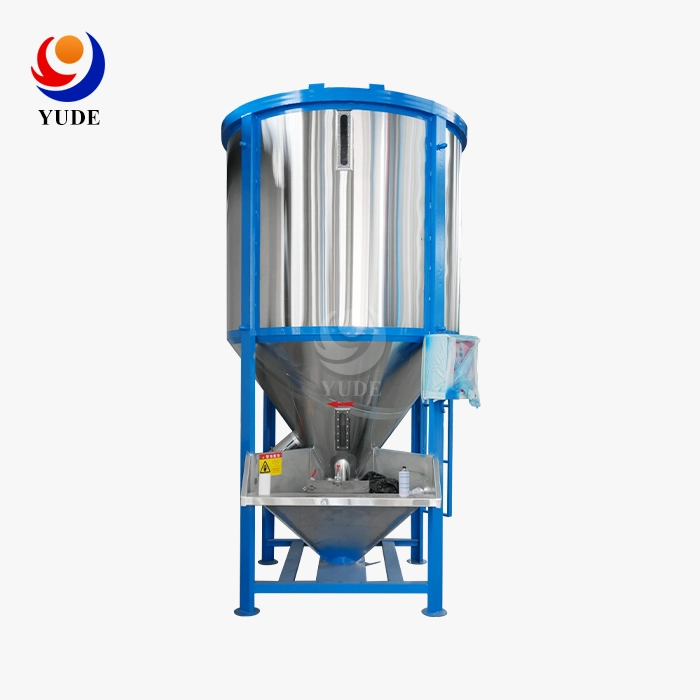
Understanding Vertical Mixers for Plastic Granules
How the Screw-Lift Mechanism Works?
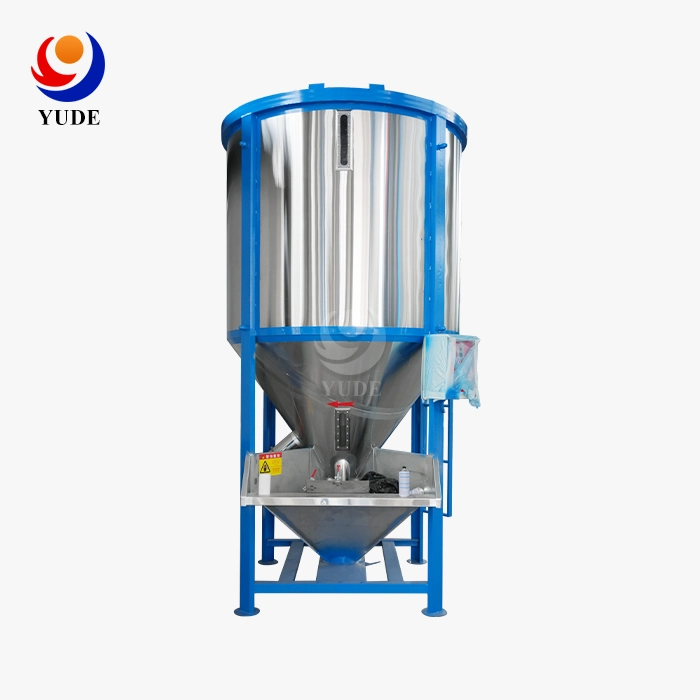
A vertical mixer moves stuff through a centrally located rotating screw that picks up granules at the bottom of the cone-shaped hopper and drops them at the top. The pellets fall back down along the wall of the tank because of gravity. This constant movement from top to bottom goes through all of the layers of the batch without shearing them too much. This keeps fragile or filled granules from getting damaged by the machine.
Standard vs. Custom Capacity Models
Units made by Yude Plastic Machinery range from 300 kg to 10 metric tons. Smaller models (300–500 kg) are better for R&D lines or short-run color trials. Bigger models (1–10 tons) are better for pre-mixing for high-volume injection molding or film extrusion. All of the types can handle PE, PP, ABS, and PVC pellets, and they are made from either Q235 carbon steel or 304 stainless steel, based on how clean the application needs to be.
Key Design Advantages Over Horizontal Mixers
A vertical ribbon blender with the same capacity takes up 40% less space than a horizontal ribbon blender with the same capacity. The screw in vertical mixers for plastic granules only touches the center column of material, so wear is focused on a part that can be replaced instead of a long ribbon flight. This lowers the cost of long-term upkeep. The sealed top cover keeps dust out, which is useful on open production floors.
How Mixing Time Affects the Quality of Plastic Granule Blending?
The Consequences of Under-Mixing
Color masterbatch tends to gather near the discharge port when a batch runs in a standard 500 kg unit for less than 8 minutes. Tracer-pellet deviation is more than 2% in the top, middle, and bottom parts of the hopper, as shown by statistical sampling. This means that finished parts have color differences that can be seen. When it comes to injection-molded device housings, this rate can hit 5–8% per shift, which is a direct cost that is covered by scrap and rework.
The Consequences of Over-Mixing
It doesn't make the mixture more homogeneous to blend it for more than 25 minutes with normal PE or PP. Data on motor current gathered during long runs shows that regularity stops changing after 15 minutes for most 500 kg batches. Keep running wastes electricity and slightly raises the bulk temperature for heat-sensitive compounds, which can change the gloss of thin-wall parts.
Practical Time Benchmarks by Material
Based on data from mid-size injection molding operations, these ranges are good places to start:
- Virgin PE/PP + color masterbatch (≤3% loading): 10–12 minutes at rated screw speed
- ABS + impact modifier or UV stabilizer: 12–15 minutes
- Glass-fiber-reinforced compounds (≤30% GF): 15–20 minutes at reduced speed to limit fiber attrition
- Regrind blended with virgin resin: 15–18 minutes to account for bulk-density differences
These numbers are for batch fills that are 80–90% of the maximum capacity. Overfilling above 90% stops the screw from turning and unexpectedly extends the time needed.
Comparing Vertical Mixers to Other Mixer Types
Vertical vs. Horizontal Ribbon Blenders
Horizontal ribbon blenders mix powders and small particles well, but their longer mixing area has dead spots on the walls at the ends. It can take 20 to 30 minutes for a ribbon blender to get ≥98% uniformity for pellets with a bulk density above 0.5 g/cm³. The vertical screw design hits the same goal in 10–15 minutes under the same conditions, which means that each batch uses a lot less energy.
Vertical vs. Conical Paddle Mixers
Because the paddles create low pressure, conical paddle mixers are good for mixing granules that are easily broken. But when working with mineral-filled or glass-reinforced products, they need to be inspected and replaced more often. The vertical screw in vertical mixers for plastic granules has a single replaceable part that makes it easier to service and costs less per maintenance cycle. This makes it better for production environments with three shifts that work nonstop.
Selecting Based on Production Volume
For tasks that don't produce more than 500 kg per batch, a small vertical unit is the best way to combine cost and floor space. For lines that handle more than 2 tons per batch, a bigger vertical mixer with a variable-frequency drive that lets the speed change during the cycle—slower at the beginning to spread the particles out evenly, then faster to finish the blend is usually best.
Best Practices and Maintenance Tips for Consistent Blending
Good equipment only pays for itself when workers stick to a plan. The following recommendations are what most high-output injection molding plants do.
Here are the main maintenance and operation steps that keep blend quality high:
- Load sequence: Add base resin first, then masterbatch or additives on top. This placement draws light additives into the circulating stream immediately, preventing surface stratification.
- Fill level: Keep the batch at 80–90% of rated volume. Below 70%, the screw draws air into the stream and mixing time lengthens.
- Speed adjustment: Reduce screw speed by 20–30% for glass-fiber-filled or brittle-additive compounds to limit particle breakage.
- Between-batch cleaning: Use compressed air or an industrial vacuum. Wet cleaning introduces moisture that damages hygroscopic resins such as nylon or PET in the next batch.
- Routine inspection schedule: Check screw alignment and gearbox oil every 500 operating hours; inspect the bottom bearing housing every 1,000 hours.
If you stick to this schedule, your annual unplanned downtime will be well below the three days that most production managers consider to be acceptable.
Buying Guide: Choosing the Right Vertical Mixer
Technical Specifications to Evaluate
Make sure the motor is a three-phase asynchronous type that protects against overloading and overheating. These safeguards keep workers from getting burned out during high-density runs, and they come standard on all Yude Plastic Machinery machines. Check the mixing uniformity certificate. A good supplier should give you a tracer test report that shows deviations of less than 2% at the top, middle, and bottom sample spots.
Customization and Delivery Timelines
Standard models weighing between 600 kg and 2 tons usually ship in 15 to 25 days. If your process needs a stainless steel interior for food-grade or pharmaceutical-adjacent uses or a multi-language control interface for facilities in other countries, make sure the seller knows about the change in wait time before you send the final purchase order. Distributors in Southeast Asia, the Middle East, and South America can use OEM labels and multilingual panels made by Yude Plastic Machinery.
After-Sales Support as a Procurement Criterion
How well equipment works after five or ten years rests just as much on how easy it is to get parts as on how well it was built in the first place. Check to see if the supplier has local service partners that can get someone to the site within 24 hours and that wear parts like the screw flight and bottom bearing are always in stock. A 7x24 service channel is a useful way to stand out, not just a marketing phrase.
Conclusion
In a vertical pellet blender, the mixing time is not a set number. It changes depending on the type of material, the batch size, the fill level, and the speed of the screw. For most pre-mixing for injection molding jobs, 10–15 minutes at 80–90% capacity gives ≥98% consistency without using too much energy. To keep that standard, you need the right equipment, strict rules for how to use it, and a seller who will stand behind the gear after it's delivered. When these three things come together, the rate of color rejection goes down, shift output goes up, and the return on investment for vertical mixers for plastic granules is well within the 12–18 month range that most production managers aim for.
FAQ
How long should I mix standard PE or PP pellets with color masterbatch?
A 500 kg batch that is 80–90% full takes 10–12 minutes at the rated screw speed to make a blend with a statistical error of 2%. To run a 2-ton batch, add 15 to 18 minutes to the time.
Can I reduce mixing time by increasing screw speed?
Higher speed cuts cycle time by a small amount, but it also causes more heat to build up and more particles to be lost. A 15–20% speed boost can save 2–3 minutes of work time on materials that don't wear down easily. To protect the length of the fibers, keep the speed of glass-fiber compounds at or below the rated setting.
Does mixer capacity affect the required mixing duration?
Yes, right away. The circulation path is shorter in a 300 kg unit than in a 5 ton unit running the same recipe, so it gets to homogeneity faster. If your batch size is bigger than 500 kg, add 1–2 minutes to the cycle time when you figure out how long it will take for a new batch.
How do I verify that my blend has reached ≥98% uniformity?
Add 1% colored pellets to white resin that hasn't been used before. Mix for the set amount of time, and then take samples from the top, middle, and bottom discharge points. The batch meets the homogeneity standard if the difference in tracer counts between the three samples stays below 2%.
What causes excessive vibration during start-up?
Usually, it's because the base isn't level or there is material crossing at the bottom of the hopper. Check to see that the unit is level on a concrete pad and that pellets haven't squished together around the lower screw bearing overnight.
Get a Customized Mixing Solution from Yude Plastic Machinery
The tools on your production line should be the right size and shape for the materials and batches you are making. As a reputable company that makes vertical mixers for plastic granules, Yude Plastic Machinery has units ranging from 300 kg to 10 tons, all of which are built to achieve ≥98% mixing uniformity and come with 7x24 hours of after-sales support. Please email our engineering team at sales@yudemachinery.com or check our website at https://yudemachinery.com/ to get a price that fits your needs for capacity, materials, and delivery time.
References
- Rosato, D. V., & Rosato, M. G. Injection Molding Handbook. Springer, 2000.
- Harper, C. A. Handbook of Plastics Technologies. McGraw-Hill, 2006.
- Mixing Technology Insight. Powder and Bulk Solids: Mixing Equipment Performance Review. Cahners Publishing, 2018.
- Tadmor, Z., & Gogos, C. G. Principles of Polymer Processing. Wiley-Interscience, 2006.
- PlasticsToday Editorial Staff. "Optimizing Color Masterbatch Dispersion in Injection Molding." PlasticsToday, 2022.
- Society of Plastics Engineers. Plastics Engineering Handbook of the Society of the Plastics Industry. Springer, 1991.
Learn about our latest products and discounts through SMS or email