- English
- French
- German
- Portuguese
- Spanish
- Russian
- Japanese
- Korean
- Arabic
- Greek
- German
- Turkish
- Italian
- Danish
- Romanian
- Indonesian
- Czech
- Afrikaans
- Swedish
- Polish
- Basque
- Catalan
- Esperanto
- Hindi
- Lao
- Albanian
- Amharic
- Armenian
- Azerbaijani
- Belarusian
- Bengali
- Bosnian
- Bulgarian
- Cebuano
- Chichewa
- Corsican
- Croatian
- Dutch
- Estonian
- Filipino
- Finnish
- Frisian
- Galician
- Georgian
- Gujarati
- Haitian
- Hausa
- Hawaiian
- Hebrew
- Hmong
- Hungarian
- Icelandic
- Igbo
- Javanese
- Kannada
- Kazakh
- Khmer
- Kurdish
- Kyrgyz
- Latin
- Latvian
- Lithuanian
- Luxembou..
- Macedonian
- Malagasy
- Malay
- Malayalam
- Maltese
- Maori
- Marathi
- Mongolian
- Burmese
- Nepali
- Norwegian
- Pashto
- Persian
- Punjabi
- Serbian
- Sesotho
- Sinhala
- Slovak
- Slovenian
- Somali
- Samoan
- Scots Gaelic
- Shona
- Sindhi
- Sundanese
- Swahili
- Tajik
- Tamil
- Telugu
- Thai
- Ukrainian
- Urdu
- Uzbek
- Vietnamese
- Welsh
- Xhosa
- Yiddish
- Yoruba
- Zulu
How do you mix masterbatch with plastic granules evenly?
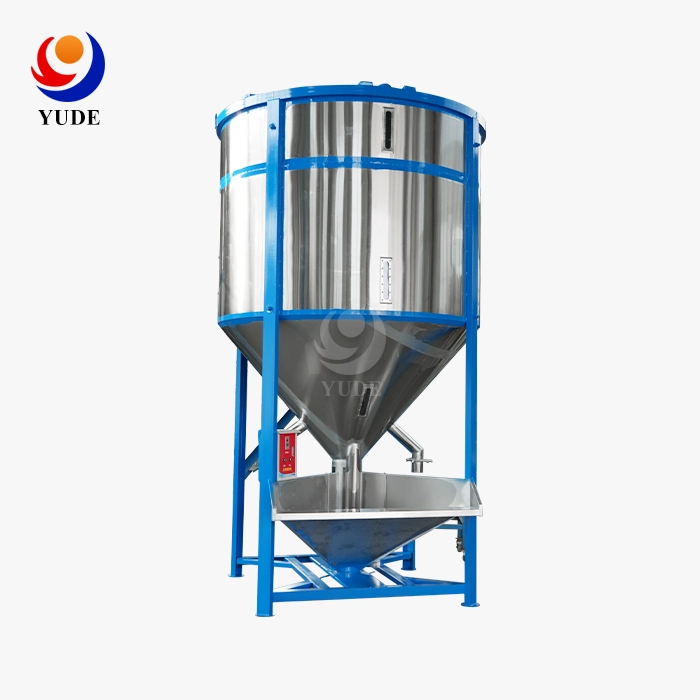
Achieving even masterbatch distribution in plastic granules comes down to three things: the right dosing ratio, consistent particle sizing, and proper equipment. A vertical plastic granule mixer lifts material from the bottom of the chamber and circulates it in a fountain-like pattern, coating each granule with colorant or additive uniformly. When the mixing uniformity reaches ≥98%, color streaking and mechanical defects drop significantly. Getting this process right from the start reduces scrap rates, cuts rework costs, and keeps your injection molding or extrusion line running on schedule.
Understanding the Challenge of Even Masterbatch Mixing
Uneven masterbatch blending is one of the most common root causes of color streaks, surface defects, and inconsistent mechanical properties in finished plastic parts. Before choosing any equipment, it helps to understand what makes this process difficult.
Density and Particle Size Differences
Masterbatch pellets and base resin granules often differ in bulk density. Heavier particles sink; lighter ones float. Without a mechanical system that continuously recirculates the blend, these differences cause stratification. Research published in Polymer Engineering & Science confirms that bulk density variance above 15% between components significantly increases the risk of segregation in static or low-shear mixing environments.
Equipment Mismatch
Using a drum tumbler or manual scooping for a 500 kg batch is a recipe for inconsistency. The mixing action must match the batch volume and the material properties. Oversized equipment wastes energy and time; undersized equipment fails to reach the ≥98% uniformity threshold that most quality control standards require for injection-molded consumer goods.
Human Error in Dosing
Manual weighing introduces variability. Even a 0.5% overdose of color masterbatch can shift the final product color outside acceptable Pantone or RAL tolerance bands. Automated or semi-automated dosing, paired with the right mixing unit, removes this variable almost entirely.
How Plastic Granule Mixers Work to Ensure Uniform Mixing?
It's pretty easy to understand how a vertical mixer works. Something that turns inside a cylinder or cone-shaped tower moves things from the bottom to the top. Then, the outside walls pull it back down, creating a loop that keeps going. With this fountain-flow pattern, you can mix things of different densities without turning them into dust.
Key Mixer Types Compared
There are four main types of mixing tools used in the plastics industry. You can mix a lot of stuff with a vertical screw plastic granule mixer that doesn't take up much room space. Mixtures that are heavy on powder work well with horizontal ribbon mixers. With a drum mixer, you can do jobs that need low volume and low pressure. A static mixer is used right at the throat of the injection machine. It is an inline device. When it comes to mixing things evenly and speed, vertical units are always better than drum and static types for tasks that come before injection molding or film blowing lines.
Material and Safety Features
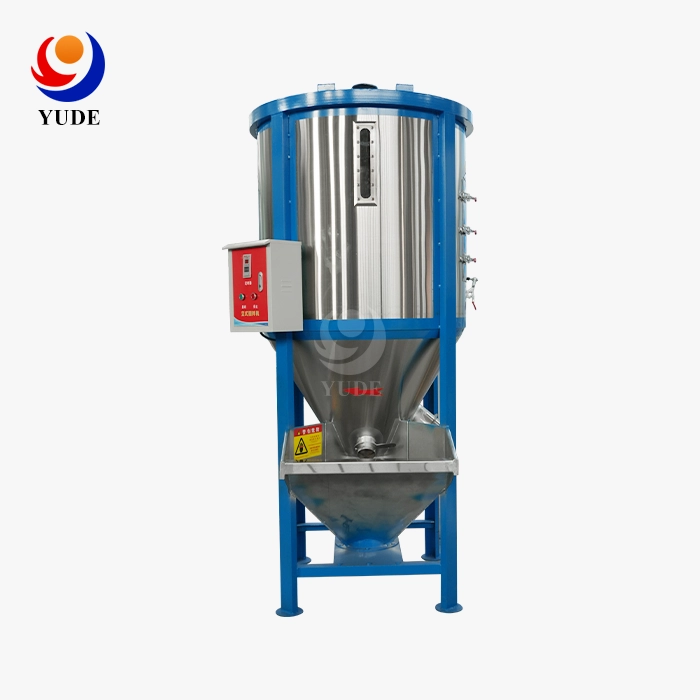
Contact surfaces made of 304 stainless steel don't rust, keep colors from getting dirty by accident, and are easier to clean. Most of the time, Q235 carbon steel works well when it's not necessary to meet food-grade standards. A three-phase asynchronous motor with temperature and overload sensors keeps the machine running smoothly even when it's fully loaded. This means that it doesn't have to stop for no reason as often.
Energy and Capacity Range
Because gravity helps the material flow back down, vertical mixers need less motor power per ton of material than horizontal systems that are driven by paddles. The machines can handle everything from small color tests to full-scale production runs. They range from 25 kg bench-top units to industrial bins that can hold over 20,000 kg.
Step-by-Step Guide to Mixing Masterbatch with Plastic Granules Evenly
It's important to be careful at every step of the way, from getting the ingredients ready to checking the quality after the mix is done.
Step 1 — Verify Dosing and Compatibility
Talk to the seller of the masterbatch to find out what rate of addition they recommend. Most of the time, this is between 1% and 5% by weight for color blends. In the masterbatch, make sure that the base polymer and the carrier resin can mix and work. When an LDPE-carrier masterbatch is mixed into a PVC base, for example, dispersion failure can happen, even if the mixing is done well by hand.
Step 2 — Select the Right Batch Size and Mixing Time
Fill the mixer up to about 80% of the way to the top. When you overfill, the flow of fluid slows down, and when you underfill, particles touch each other less often. A vertical screw mixer running at 200 to 400 RPM for 10 to 15 minutes will usually have a Coefficient of Variation below 5%. This means that the mixing is almost uniform (98% of the time).
Step 3 — Monitor Quality and Maintain the Equipment
After each batch, get a sample from the top, middle, and bottom of the overflow to make sure the color stays the same. You can do this with your eyes or a colorimeter. If you work with compounds that are full of minerals or glass fibers, you should grease the bearings and check the screw for wear every 500 hours. Contact areas that are worn down make it more likely for segregation to happen and get into the mix.
Evaluating and Choosing the Best Plastic Granule Mixer for Your Business
There is real money at stake when you decide what mixing tools to buy. A cheaper mixer that breaks down all the time will not pay for itself in five years. A more expensive one that works well for five years and then needs to be thrown away will.
Capacity and Material Compatibility
Match the expected ability to how much you can get done in an hour plus some extra. For 30 minutes of mixing, the hopper needs to be able to hold at least 100 kg if the injection machine needs 100 kg/hr. Make sure the mixer can handle the resins you want to use. It's true that PE, PP, ABS, and PVC all move in different ways.
Build Quality and Certifications
Factory environments that work with plastics often have a lot of dust and humidity, but that won't hurt a plastic granule mixer that was made according to CE machinery directives and has electrical enclosures that are rated IP. If your business changes colors often or works with things that come in contact with food, the extra cost of 304 stainless steel innards is well worth it.
Total Cost of Ownership
There's more to it than just the price you pay. Think about how much energy is used, how easy it is to get spare parts, and how long it takes for service to arrive. Find a source that keeps common wear parts in store and can get them to your site within 24 hours. This will cut down on the cost of yearly downtime by a lot. One example is Yude Plastic Machinery's vertical mixing equipment has built-in safety features that keep it from being overloaded or overheated, which directly lowers the frequency of maintenance.
Case Studies: Successful Masterbatch Mixing Solutions in B2B Environments
When you look at real production data, you can see what the right tools do in the real world.
Small Manufacturer — Reducing Color Defects
It used to be that they used a hand drum blender, but now they use a 300 kg vertical stainless steel mixer. It went from 4.2% to less than 0.8% in the first quarter for people to refuse to wear color. It took 35% less time to prepare batches, and one person could run two injection machines at the same time with the move.
Large OEM — Waste Reduction at Scale
A big company that makes car trim has switched to a 2,000 kg vertical screw mixing system. This system mixes ABS, PP, and talc. There was no more broken talc in the batch because of the fountain-flow movement, which kept the high-gravity talc mixed throughout the batch. During the first year, about 18% less material was lost on parts that were not used. This meant that the equipment paid for itself in less than 14 months.
Both of these examples show the same thing: quality and cost change quickly when you match the right mixer specs to the needs of your output.
Conclusion
To mix plastic granules and masterbatch evenly, you need the right tools, the right amount of each ingredient, and strict instructions on how to do it. More often than not, a vertical plastic granule mixer that moves materials in a steady fountain-flow pattern can mix resins like PE, PP, ABS, and PVC equally (98% of the time). For lower scrap rates, faster batch cycles, and uniform product quality, the first thing that needs to be done is to choose a unit with the right size, the right contact materials, and reliable safety systems. Most businesses can get their money back on the tools they buy within 12 to 18 months, as long as the tools are right for the job.
FAQ
Can a vertical mixer handle materials with different bulk densities?
Yes. The vertical screw is always pulling stuff up from the bottom. This keeps the heavier granules from falling below the lighter regrinds or additives. When you want to mix different kinds of stuff, this is better than drum tumblers.
How long does a mixing cycle typically take?
Most 200–400 RPM vertical screw mixers can make a full batch that is ≥98% uniform in 10–15 minutes. This number can change depending on the batch size, the qualities of the material, and the fill amount.
What is the correct cleaning procedure for color changes?
Get rid of everything, and then blow out anything that's left over with compressed air. This will make big changes from dark to light. Run a small batch of natural resin purge and then throw it away. If the inside is cleaned 304 stainless steel, this step doesn't have to be done as much.
Does the motor trip when starting under full load?
It's possible for this to happen because a fully loaded tank needs a lot of force to move. You can keep the mixer from tripping by starting it with nothing in it or a soft-start procedure. High-torque engine types can be used for tough jobs.
Are these mixers suitable for food-contact applications?
Yes, as long as the parts that you touch are made of 304 or 316 stainless steel and the insides are smooth as glass. Check with your provider to make sure they have the right licenses before you ask them to package food or make medical devices.
Get the Right Mixing Solution from Yude Plastic Machinery
Vertical plastic granule mixers made by Yude Plastic Machinery can hold up to 10 tons of plastic. They are made of carbon steel or 304 stainless steel, have systems that can be used in more than one language, and offer 24-hour local service. We are a well-known business that sends plastic granule grinders to more than 30 different countries. We have prices that come straight from the factory, OEM support, and full fitting help. Email sales@yudemachinery.com or go to https://yudemachinery.com/ right now to get a price quote that fits your needs.
References
- Todd, D. B. (Ed.). Plastics Compounding: Equipment and Processing. Hanser Publishers, 1998.
- Rauwendaal, C. Polymer Mixing: A Self-Study Guide. Hanser Gardner Publications, 1998.
- Tadmor, Z., & Gogos, C. G. Principles of Polymer Processing (2nd ed.). Wiley-Interscience, 2006.
- Gould, R. J. "Mixing and Blending of Colorants in Thermoplastics." Plastics Technology, Vol. 48, No. 3, 2002.
- Xanthos, M. (Ed.). Functional Fillers for Plastics (2nd ed.). Wiley-VCH, 2010.
- Rosato, D. V., & Rosato, M. G. Injection Molding Handbook (3rd ed.). Springer, 2000.
Learn about our latest products and discounts through SMS or email