- English
- French
- German
- Portuguese
- Spanish
- Russian
- Japanese
- Korean
- Arabic
- Greek
- German
- Turkish
- Italian
- Danish
- Romanian
- Indonesian
- Czech
- Afrikaans
- Swedish
- Polish
- Basque
- Catalan
- Esperanto
- Hindi
- Lao
- Albanian
- Amharic
- Armenian
- Azerbaijani
- Belarusian
- Bengali
- Bosnian
- Bulgarian
- Cebuano
- Chichewa
- Corsican
- Croatian
- Dutch
- Estonian
- Filipino
- Finnish
- Frisian
- Galician
- Georgian
- Gujarati
- Haitian
- Hausa
- Hawaiian
- Hebrew
- Hmong
- Hungarian
- Icelandic
- Igbo
- Javanese
- Kannada
- Kazakh
- Khmer
- Kurdish
- Kyrgyz
- Latin
- Latvian
- Lithuanian
- Luxembou..
- Macedonian
- Malagasy
- Malay
- Malayalam
- Maltese
- Maori
- Marathi
- Mongolian
- Burmese
- Nepali
- Norwegian
- Pashto
- Persian
- Punjabi
- Serbian
- Sesotho
- Sinhala
- Slovak
- Slovenian
- Somali
- Samoan
- Scots Gaelic
- Shona
- Sindhi
- Sundanese
- Swahili
- Tajik
- Tamil
- Telugu
- Thai
- Ukrainian
- Urdu
- Uzbek
- Vietnamese
- Welsh
- Xhosa
- Yiddish
- Yoruba
- Zulu
How is a granule mixer different from a plastic granulator or pelletizer?
Everyone who works with plastics has likely come across all three of these names, and perhaps even used them interchangeably once. There are three distinct machines that perform distinct functions on the assembly line: a pelletiser, a granulator, and a plastic granule mixer. In preparation for moulding or extrusion, a granule mixer homogenises the material composition by blending pre-existing plastic pellets or additives. A granulator is a machine that cuts bigger pieces of plastic into smaller ones. By use of extrusion and cutting, a pelletiser transforms molten polymer into homogeneous pellets. Your ability to make an informed choice about the purchase of equipment and the quality of your output are both impacted by this distinction.
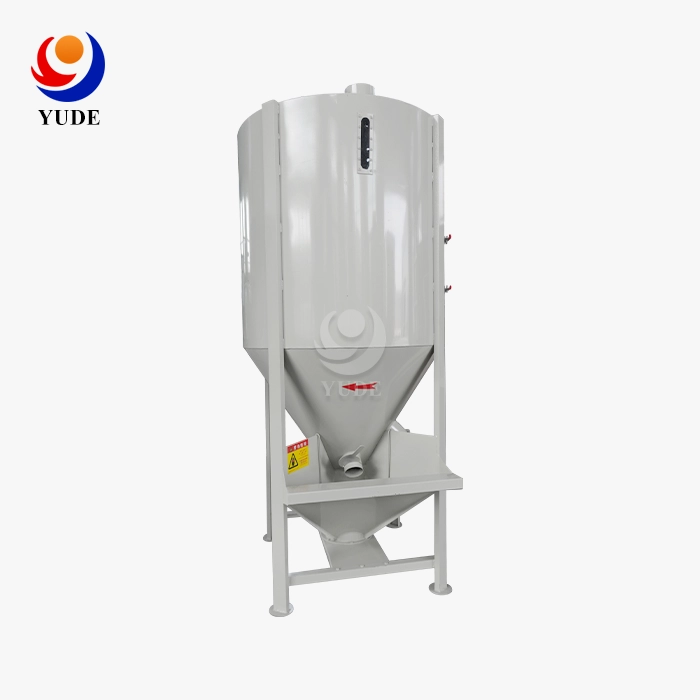
Understanding the Core Functions of Granule Mixers, Granulators, and Pelletizers
These three machines occupy distinct positions in a plastic processing workflow. Let me walk through each one clearly.
What a Granule Mixer Does?
Gratule mixers, whether horizontal or vertical, combine additive powders, colour masterbatches, and pre-formed plastic pellets. The material's physical form remains unchanged. The aim is to have a consistent composition. For example, vertical versions achieve a mixing consistency of 98% or more by lifting material from the bottom and circulating it in a fountain pattern using a revolving screw. Because of this, the likelihood of colour streaking and other defects in film blowing or injection moulding lines is significantly reduced.
What a Plastic Granulator Does?
A granulator is a size-reduction machine. It uses rotating and stationary blades inside a cutting chamber to chop sprues, runners, film trim, and rejected parts back into granules. The output particle size depends on screen selection. Granulators are common in recycling operations and closed-loop manufacturing systems where scrap material is re-introduced into the production feed. They add no blending function — their job is purely mechanical size reduction.
What a Pelletizer Does?
Pelletisers use extrusion and cutting (strand cutting, underwater cutting, or hot-face cutting) to reduce molten plastic compound to homogenous pellets. Following an extruder or compounding line is where you'll find the pelletisers. A uniform, freely flowing pellet that is suitable for storage, distribution, or further processing is their principal product. Instead of combining already solid grains, they recrystallise molten material.
Comparing Working Principles and Operational Mechanisms
When purchasing teams understand the technical parts of each machine, they can better match it to the needs of output.
Mixing Mechanism in a Vertical Plastic Pellet Mixer
A stainless steel cylinder or cone-shaped silo houses a helical screw agitator in vertical plastic pellet mixers. After transferring items from one level to another, it releases them at the top. Rotations per minute (RPM) ranges from 200 to 400 for the screw. This gravity-based return cycle is more efficient than horizontal mixers using paddles in terms of motor power consumption per tonne of material. A three-phase asynchronous motor with built-in overheat and overload protection is often found in equipment that has been CE-approved.
Cutting Mechanism in Granulators
Granulators cut against set bed knives on a rotor that has cutting blades on it. How even the particles are is determined by how far apart the rotor blades and bed knives are. The stuff goes through a screen when the particles are the right size. The main thing that affects maintenance for a plastic granule mixer is how the blades wear down. Wear rates are higher for harder materials, like glass-fiber-reinforced scrap, so they need to be checked more often.
Extrusion-Cutting Mechanism in Pelletizers
The pelletiser uses an extruder screw to melt and combine the resin before forcing it through a die plate. The strands are then trimmed to length by a spinning pair of blades or melt jets. Pelletisers that operate underwater simultaneously chill and cut, producing very uniformly shaped bits that may be blended with pinpoint accuracy. The energy required to melt, transport, and reassemble the material is much more than that of a mixed process, per unit of output.
Key Differences Between Granule Mixers, Granulators, and Pelletizers for B2B Procurement
To help purchasing managers compare machines from different sellers, here is a clear picture of all three types side by side in the areas that matter the most when deciding what to buy.
The main things that affect making a choice are these:
- Function: A granule mixer blends solid pellets and additives. A granulator reduces solid scrap into particles. A pelletizer re-forms molten resin into pellets.
- Input material state: Granule mixers handle solid, pre-formed pellets and powders. Granulators process solid scrap. Pelletizers process molten polymer from an extruder.
- Energy consumption: Granule mixers carry the lowest energy demand because they do not melt or cut material. Pelletizers carry the highest due to the extrusion process.
- Maintenance intensity: Granulators require blade and screen inspection on a regular schedule. Pelletizers require die plate and cutter maintenance. Vertical granule mixers have fewer wear components, contributing to lower annual downtime figures.
- Capital cost and ROI timeline: Granule mixers typically offer the shortest return on investment period among the three, often within 12–18 months for mid-scale injection molding operations.
Because of these differences, the total cost of ownership is different. An injection-molded part manager doesn't need a pelletizer if they want to make parts with less color difference. They can use a vertical batch mixer instead, which costs a lot less and mixes things evenly 98% of the time.
How to Choose the Right Equipment: Granule Mixer vs Granulator vs Pelletizer?
The selection process comes down to three questions: What is the material state at your input stage? What output are you trying to achieve? What is your production volume?
Match the Machine to Your Process Stage
If your line receives pre-compounded pellets and masterbatch that need blending before molding, a plastic granule mixer is the correct choice. If you generate scrap from sprues, rejected parts, or film trim and want to recover that material, a granulator fits your workflow. If you operate a compounding line that modifies resin formulations, a pelletizer sits at the end of that process.
Evaluate Capacity and Throughput Requirements
Our vertical granule mixers range from 25 kilogram small-batch units to silo versions capable of handling 20,000 kg or more. Injection moulding, film blowing, and extrusion pre-processing lines may all benefit from the vertical plastic pellet mixing equipment that Yude Plastic Machinery manufactures, which comes in capacities between 300 kg and 10 tonnes. To maintain a constant buffer supply and prevent production disruptions, match the batch size to your injection machine's hourly usage.
Factor in After-Sales Support and Customization
Lead time, spare parts availability, and technical support access matter as much as the specification sheet. Standard vertical mixer models from Yude carry delivery timelines of 15–25 days. Custom configurations — including 304 stainless steel contact surfaces, multilingual control interfaces, and voltage adaptations for overseas markets — are available with responsive turnaround times.
Practical Tips for Using and Maintaining Plastic Granule Mixers
Proper operation extends equipment service life and protects mixing quality batch after batch.
Set Correct Load Capacity and Mixing Time
Never fill a vertical mixer beyond its rated capacity. Overfilling restricts the screw circulation path and reduces blend uniformity. For most PE, PP, ABS, and PVC pellet applications, a 5–15 minute mixing cycle achieves a coefficient of variation below 5%. Always calculate your required holding capacity based on your injection line's hourly throughput plus a 20–30% buffer.
Follow a Routine Cleaning Protocol
Color change cleaning is one of the most time-sensitive maintenance tasks. After each color run, use compressed air to clear residual granules, then wipe interior surfaces with a lint-free cloth. Polished SUS304 stainless steel interiors — available on Yude vertical mixer models — reduce cleaning time significantly compared to carbon steel alternatives because pigment particles cannot penetrate the surface finish.
Monitor Motor and Drive Components
Check the motor temperature and gearbox oil level on a weekly schedule. If the motor trips during a full-load startup, the likely cause is static friction bridging from settled granules. Starting the mixer empty before adding material, or enabling a soft-start sequence, prevents this issue. Annual inspections of the screw agitator for wear are especially important when processing materials with mineral fillers.
Conclusion
Granule mixers, granulators, and pelletizers are all different kinds of tools that are made to do various tasks. They get mixed up, and you buy tools that don't help with the production problem. The best way to mix plastic pellets and chemicals before injection molding, blow molding, or extrusion is with a vertical plastic granule mixer. It mixes the pellets and chemicals evenly, doesn't use much energy, and doesn't take up much room. To make a buying choice that always pays off, you must first understand how each machine works and what it does during the production process.
FAQ
Can a granule mixer replace a pelletizer on a compounding line?
Not at all. A grain mixer can only mix powders and solids that have already been made. It is not possible to make pellets out of liquid glue. If you put a pelletizer after an extruder, you need a melt phase. You can't use one tool instead of the other because they are used for different things.
What plastic materials are compatible with a vertical granule mixer?
One type of plastic pellet mixer can mix PE, PP, ABS, PVC, and most other common thermoplastic granules. They also work with color masterbatch powders and chemical concentrates. If you use rough fillers like calcium carbonate or glass fiber, it will save you money on wear costs to choose a model with hardened or stainless steel touch areas.
How do I calculate the right mixer capacity for my injection line?
Find out how many pieces of material your machine uses each hour. To account for changes in the cycle, add a 20–30% break. For example, if your machine needs 200 kg per hour, a 250–300 kg batch mixer will give you that much without any delays.
What is a typical lead time for a standard vertical mixer order?
Most standard kinds of vertical mixers ship in fifteen to twenty-five days. It takes longer to make custom designs that use non-standard quantities, materials, or control systems. Make sure the service is clear when you ask them about this.
Does mixing uniformity affect injection molded part quality?
Yes. If the consistency of mixing is less than 95%, color streaks, changes in mechanical qualities, and more scrap are likely to show up. A consistency grade of 98% or more is the standard for parts made by injection molding and film blowing to be of the same quality every time.
Get the Right Mixing Equipment from Yude Plastic Machinery
Vertical plastic grain mixers from Yude Plastic Machinery can hold up to 10 tons and are made for lines that handle PE, PP, ABS, and PVC. We will get back to you within 24 hours whether you need a simple blending unit or one made of stainless steel that can be sent abroad. Email our team at sales@yudemachinery.com or visit yudemachinery.com to get prices and information from a reputable plastic granule mixer provider.
References
- Plastics Technology — Rosato, D.V. & Rosato, M.G. (2012). Injection Molding Handbook, 3rd ed. Springer.
- Polymer Engineering & Science — Todd, D.B. (1998). "Mixing of Polymers." Polymer Engineering & Science, Vol. 38.
- Plastics, Rubber and Composites — Covas, J.A. et al. (2004). "Monitoring Mixing Quality in Polymer Extrusion." Plastics, Rubber and Composites, Vol. 33.
- Journal of Applied Polymer Science — Manas-Zloczower, I. (2009). Mixing and Compounding of Polymers: Theory and Practice, 2nd ed. Hanser Publications.
- Polymer Processing Society Annual Meeting Proceedings — White, J.L. & Kim, E.K. (2008). "Developments in Twin-Screw Extrusion and Pelletizing Technology." PPS Conference Proceedings.
- Advances in Polymer Technology — Potente, H. & Bastian, M. (2001). "Material Throughput and Energy Consumption in Granulation and Pelletizing." Advances in Polymer Technology, Vol. 20.
Learn about our latest products and discounts through SMS or email