- English
- French
- German
- Portuguese
- Spanish
- Russian
- Japanese
- Korean
- Arabic
- Greek
- German
- Turkish
- Italian
- Danish
- Romanian
- Indonesian
- Czech
- Afrikaans
- Swedish
- Polish
- Basque
- Catalan
- Esperanto
- Hindi
- Lao
- Albanian
- Amharic
- Armenian
- Azerbaijani
- Belarusian
- Bengali
- Bosnian
- Bulgarian
- Cebuano
- Chichewa
- Corsican
- Croatian
- Dutch
- Estonian
- Filipino
- Finnish
- Frisian
- Galician
- Georgian
- Gujarati
- Haitian
- Hausa
- Hawaiian
- Hebrew
- Hmong
- Hungarian
- Icelandic
- Igbo
- Javanese
- Kannada
- Kazakh
- Khmer
- Kurdish
- Kyrgyz
- Latin
- Latvian
- Lithuanian
- Luxembou..
- Macedonian
- Malagasy
- Malay
- Malayalam
- Maltese
- Maori
- Marathi
- Mongolian
- Burmese
- Nepali
- Norwegian
- Pashto
- Persian
- Punjabi
- Serbian
- Sesotho
- Sinhala
- Slovak
- Slovenian
- Somali
- Samoan
- Scots Gaelic
- Shona
- Sindhi
- Sundanese
- Swahili
- Tajik
- Tamil
- Telugu
- Thai
- Ukrainian
- Urdu
- Uzbek
- Vietnamese
- Welsh
- Xhosa
- Yiddish
- Yoruba
- Zulu
Can stainless steel vertical mini mixer machine mix PVC powder?
A stainless steel vertical mini mixer machine can mix PVC powder effectively. PVC powder is a fine, free-flowing particulate with relatively low bulk density, and it responds well to the three-dimensional convective flow that a vertically mounted screw or paddle agitator generates. The 304 stainless steel construction resists chemical interaction with PVC resin and any stabilizer additives blended alongside it. When the stirring shaft operates between 30 and 60 r/min, the cascading fountain effect distributes particles evenly, achieving mixing uniformity ≥ 98% — the threshold most food-grade and medical-grade packaging lines require.
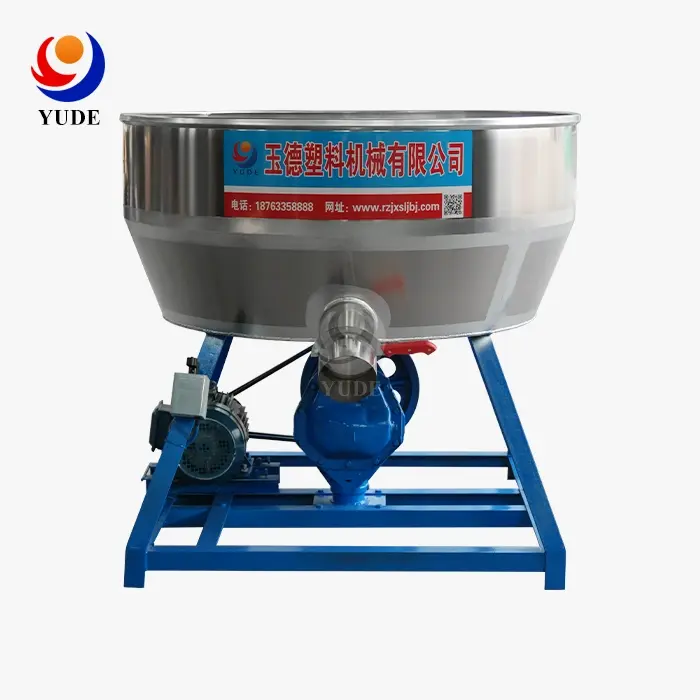
Understanding Stainless Steel Vertical Mini Mixer Machines and Their Suitability for PVC Powder
What Is a Vertical Mini Mixer?
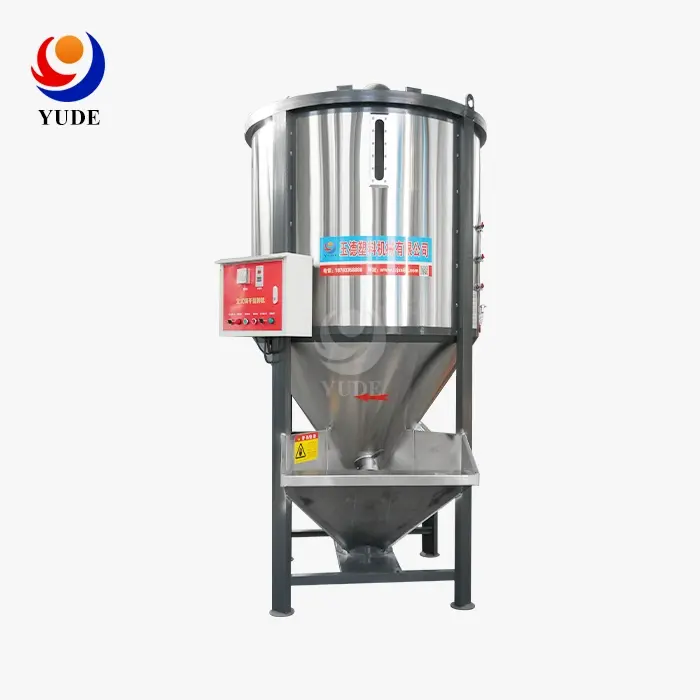
One compact device for combining materials is the vertical plastic pellet mixer. The central shaft repeatedly takes items from the bottom of the barrel and drops them back down. Due to its compact design—measuring less than 1 m² when upright—the machine finds use in cleanrooms, research and development laboratories, and minimal production cells.
Why PVC Powder Works Well in This Design?
Typically, PVC powder is found in 100 to 160 µm wide fragments. Thus, the grains are unrestricted in their mobility. Without altering their form, the vertical screw disassembles any pliable clumps and reassembles the parts. Because the active mixing zone does not have any horizontal dead zones, the whole batch passes through it in a matter of minutes.
Material Compatibility Between Steel and PVC
When it's not hot, austenitic stainless steel and raw PVC glue don't combine chemically. That's right, adding heat protection like organotin compounds or calcium-zinc compounds doesn't hurt the surface of 304 SS. It still works. When chemicals like chlorine plasticizers or high-salt flame retardants are mixed in a 316L barrel, the molybdenum makes it safer.
Technical Specifications and Operational Benefits for PVC Powder Mixing
Core Performance Parameters
Yude Plastic Machinery makes a small vertical pellet mixer that can hold up to 300 kg of weight and 80–500 L of filler. Thirty to sixty revolutions per minute for the shaft that stirs. This speed range keeps light PVC powder in the air long enough to mix without making too much dust.
Motor Configuration and Protection
The stainless steel vertical mini mixer machine runs smoothly and silently thanks to its three-phase asynchronous motor. Whenever dry PVC powder crosses at the discharge valve, it may cause torque spikes; however, the motor has built-in precautions against overload, overheating, and phase loss to prevent this. Even with this defence in place, unexpected shutdowns will be quite unusual.
- The mixing components and barrel are made of 304 stainless steel, which is used for food-grade and medical-grade plastic processing because it meets hygiene standards and leaves no metallic residue in the batch.
- The inside is mirror-polished with a roughness of no more than 0.8 µm. This smooth surface avoids powder sticking to different SKUs, which lessens the likelihood of colour contamination when formulating often.
- Standard coefficient-of-variation testing confirms that the mixing uniformity is at least 98%, which is sufficient to meet the demands of both GMP audits and downstream injection or extrusion consistency standards.
The most common problems with the quality of PVC dry-blend preparation are these: chemicals that aren't spread out evenly, color carry-over, and metal contamination from mild-steel surfaces that have rusted.
Comparing Stainless Steel Vertical Mini Mixers with Other Mixing Solutions
Vertical Mini Mixer vs. Horizontal Ribbon Blender
It takes up twice or three times as much floor space for a horizontal ribbon blender, and the ends have dead spots where PVC powder builds up without being mixed. With the numbers set up vertically, this math problem is already taken care of. You don't need to clear room along the long line of the machine to do repair because the lid lifts vertically.
Vertical Mini Mixer vs. Manual Drum Blending
The mixing coefficient of variation is only about 5–8% when you roll the drums by hand. This is a lot less than the 98% regularity that automatic vertical mixing gives you. Hand mixing is not only inconsistent, but it also exposes workers to PVC dust, which, according to OSHA standard 29 CFR 1910.1000, can hurt the lungs. Because it has a closed barrel, a small stainless steel mixer keeps dust where it starts.
Vertical Mini Mixer vs. V-Blender
V-blenders are great for mixing fragile granules gently, but they need to be fully loaded at once to work right. If they're only partly full, they can't do their job well. Between 20% and 100% of its maximum capacity can be put on the vertical screw mixer at once. This is very helpful in places like research and development where the PVC test batches are small and the raw materials are not cheap.
Maintenance and Best Practices for Optimal PVC Powder Mixing
Routine Cleaning Protocol
The inside of the 304 SS can be quickly cleaned with a dry cloth or a short burst of compressed air after each batch in a stainless steel vertical mini mixer machine. For full CIP procedures, the cone-shaped bottom moves any extra powder toward the butterfly valve, which lets it out without making any pockets that hold it in. It fits with the GMP cleaning certification records that inspectors need for IQ, OQ, and PQ checks.
Preventive Inspection Schedule
When the valve has been used for 500 hours, check the mechanical seal and the covers on it. Small pieces of PVC powder can get into worn-out seals and make small leaks that dirty the gears. Once every three months, check the fasteners on the agitator shaft. You should because the roughness of PVC can make vibrations that can slowly loosen them if you don't.
Managing Dust and Static Hazards
PVC powder may carry a small amount of static electricity as it is pushed into the tube by air. To get rid of this charge, connect the frame of the machine to a known earth point before each fill cycle. The powder won't stick to the inside of the lid this way. This also means that hygroscopic plasticizer chemicals are less likely to stick to the barrel wall if the humidity level in the work area stays below 60%.
Procurement Considerations for Stainless Steel Vertical Mini Mixer Machines
Matching Capacity to Your Batch Size
Before you ask for a price, you should know how long you want the cycle to last and how much each batch should weigh on average. Wet-blend PVC normally takes 8–12 minutes on a 100 kg unit that is 80% full. Up to six batches can be made in an hour. If you want to cut down on cycle count, make the barrel too big. If it's not full, it doesn't mix well, so pick a model that can hold 10–20% more than your normal batch.
Documentation Requirements for GMP and FDA Environments
Food packagers and drug companies that work with plastic often need a 304/316 SS material composition report from a third-party lab, a surface roughness certificate (Ra ≤ 0.8 µm), and a dossier that includes the IQ, OQ, and PQ stages of equipment validation. Make sure that the stainless steel vertical mixer provider you work with gives these papers to you for free and not as extras that you can buy separately.
Evaluating After-Sales Support
Help with setting up, training for workers, and a promise to provide spare parts for at least five years are all things that a reliable maker should offer. If you are buying from another country, find out if the seller has local service partners to help with time zones. They offer help after the sale seven days a week, twenty-four hours a day at Yude Plastic Machinery. They also work with service groups in Europe, South America, Southeast Asia, and the Middle East.
Conclusion
To mix PVC powder, a stainless steel vertical mini mixer machine is a good choice. When making a PVC dry-blend, the three most important things to think about are consistency, contamination, and user safety. These problems are solved by this machine's vertical convective mixing action, corrosion-resistant 304 SS construction, and closed barrel that keeps dust inside. Because it's small and doesn't need much maintenance, this type of mixer is useful whether you run a GMP-certified packaging line, an R&D lab that tests new recipes, or a regional distribution network that sends goods to processors in your area. This machine will work well for your PVC powder tasks as long as you match the rated capacity to the size of your batch and have the compliance papers on hand.
FAQ
Can the mixer handle PVC powder with liquid plasticizer already added?
A small amount of liquid plasticizer pre-coated onto PVC powder (up to roughly 5% by weight) remains processable in the vertical screw design. Higher liquid ratios cause sticking on the barrel wall; in those cases, a modified paddle agitator and higher-torque motor are the recommended configuration changes.
How often should I clean the barrel when switching PVC colors?
For color changes in food packaging or cosmetic packaging lines, a dry compressed-air purge followed by a short wipe-down of the mirror-polished interior is sufficient in most cases. If switching between light and dark colorant batches, a brief CIP rinse cycle using the optional spray nozzle attachment removes residual pigment more reliably.
Is 304 stainless steel sufficient, or do I need 316L for PVC applications?
Standard PVC resin with calcium-zinc stabilizers is compatible with 304 SS. If your formulation includes high-chloride flame retardants or acidic processing aids, 316L is the safer choice because its molybdenum content resists pitting corrosion in chloride-rich environments.
What mixing uniformity can I expect with a 50 kg PVC batch?
At fill levels as low as 20% of rated capacity, a vertical screw mixer maintains a mixing uniformity ≥ 98%, confirmed by coefficient-of-variation testing. This performance is consistent across batch sizes because the convective flow pattern scales with fill height rather than requiring a minimum mass threshold.
Request a Quote from Yude Plastic Machinery Today
There are tested stainless steel vertical mini mixer machines that you can buy from Yude Plastic Machinery. These machines are made to handle PVC powder as well as a lot of different kinds of plastic. Each unit has full material certificates and proof that it meets all the requirements. Talk to our expert team to get an idea of how much we can do, how much it will cost, and what OEM choices we have. If you have a question, you can email us at sales@yudemachinery.com or visit our website at https://yudemachinery.com/.
References
- Tadmor, Z., & Gogos, C. G. Principles of Polymer Processing. Wiley-Interscience, 2006.
- Wypych, G. PVC Degradation and Stabilization. ChemTec Publishing, 2015.
- Rosato, D. V., & Rosato, M. G. Plastics Technology Handbook. Springer, 2012.
- American Society for Testing and Materials. ASTM A276: Standard Specification for Stainless Steel Bars and Shapes. ASTM International, 2017.
- European Hygienic Engineering and Design Group (EHEDG). EHEDG Guideline Document 8: Hygienic Equipment Design Criteria. EHEDG, 2018.
- Occupational Safety and Health Administration (OSHA). Air Contaminants Standard 29 CFR 1910.1000. U.S. Department of Labor, 2019.
Learn about our latest products and discounts through SMS or email