- English
- French
- German
- Portuguese
- Spanish
- Russian
- Japanese
- Korean
- Arabic
- Greek
- German
- Turkish
- Italian
- Danish
- Romanian
- Indonesian
- Czech
- Afrikaans
- Swedish
- Polish
- Basque
- Catalan
- Esperanto
- Hindi
- Lao
- Albanian
- Amharic
- Armenian
- Azerbaijani
- Belarusian
- Bengali
- Bosnian
- Bulgarian
- Cebuano
- Chichewa
- Corsican
- Croatian
- Dutch
- Estonian
- Filipino
- Finnish
- Frisian
- Galician
- Georgian
- Gujarati
- Haitian
- Hausa
- Hawaiian
- Hebrew
- Hmong
- Hungarian
- Icelandic
- Igbo
- Javanese
- Kannada
- Kazakh
- Khmer
- Kurdish
- Kyrgyz
- Latin
- Latvian
- Lithuanian
- Luxembou..
- Macedonian
- Malagasy
- Malay
- Malayalam
- Maltese
- Maori
- Marathi
- Mongolian
- Burmese
- Nepali
- Norwegian
- Pashto
- Persian
- Punjabi
- Serbian
- Sesotho
- Sinhala
- Slovak
- Slovenian
- Somali
- Samoan
- Scots Gaelic
- Shona
- Sindhi
- Sundanese
- Swahili
- Tajik
- Tamil
- Telugu
- Thai
- Ukrainian
- Urdu
- Uzbek
- Vietnamese
- Welsh
- Xhosa
- Yiddish
- Yoruba
- Zulu
Can a plastic particle mixer handle recycled plastic or regrind?
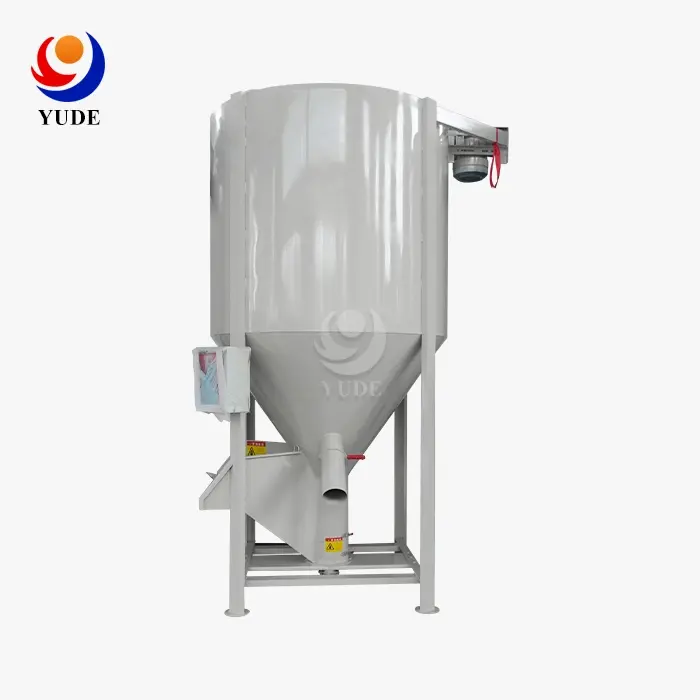
A blender for plastic particles can certainly regrind and process recycled plastic. That happens every day in lots of industrial plants. A good stainless steel plastic particle mixer works well for these materials. The corrosion-resistant barrel and mixing components can handle the variability of recycled feedstock. Particle size, moisture and surface contamination can vary in regrind and recycled pellets. The equipment, made from 304 or 316 stainless steel, can withstand these variables without breaking down or migrating contaminants into the batch. It is a practical choice for food-grade, medical and general plastic processing lines.
Challenges of Mixing Recycled Plastic and Regrind
Regrind and recycled plastic are not uniform in character. If you’ve ever worked with post-consumer or post-industrial regrind, you know the headaches involved. It is important to understand these material-specific challenges before choosing any mixing equipment.
Particle Size Variability and Clumping
The size of regrind particles varies from fine dust to irregular flakes depending on the source and the grinding method. This inconsistency causes an uneven distribution of the material during mixing and a higher risk of clumping. Standard mixers not made for heterogeneous batches can produce pockets of unmixed material, which directly impacts the quality of downstream processing.
Moisture and Static Buildup
Recycled plastics tend to absorb moisture from the air, especially hygroscopic resins like nylon or ABS. Additional moisture causes agglomeration of pellets and disruption of flow in the mixing chamber. Another problem with plastic particles is static electricity. Although stainless steel plastic particle mixer bodies with proper grounding naturally dissipate static charge, plastic-bodied equipment can accumulate charge and create handling hazards.
Contamination Risks in Recycled Feedstock
Trace contaminants, such as residual pigments, surface oils or processing additives from previous production cycles are common in post-consumer regrind. For food packaging and medical device supply chain manufacturers, cross-contamination is not just a quality issue, it’s a compliance issue. This makes the material of the internal surfaces of the mixer a non-negotiable factor in the specification.
How Stainless Steel Plastic Particle Mixers Work with Recycled Plastic
The design of a stainless steel plastic pellet blender directly impacts its performance with abrasive and recycled materials. Procurement teams need to understand how things work so that they get the right things from the start.
Mixing Mechanisms That Adapt to Irregular Shapes
Ribbon, paddle, and spiral auger actions are used to mix different types of materials. Spiral augers lift stuff off the bottom of the cone-shaped chamber, and drop them evenly, so they have a soft rolling motion in three dimensions. This low shear motion mixes the uneven regrind particles without further breaking them apart. This holds the pellet together for the entire cycle.
Adjustable Speed and Cycle Time Control
The rate of spin can be varied by the workers according to the material and its density with a mixing rod spinning at 30 to 60 r/min. Regrind in heavier mixes will take longer to reach the desired level of consistency. Parameters and systems that log data and are PID-controlled enable operators to get the same results from batch to batch. This is very important to ensure product quality when the feedstock properties change.
Safety Features That Protect Equipment and Product
Three phase induction motors run quietly and easily. They have built-in safety features to prevent overload, fire and phase failure. These safety steps are very important when doing mixed-density recycling batches because load mismatches can occur any time. This is because of air-purge or mechanical plugs in the shaft that keep lubricant out of the mixing room. Do this before you handle anything that will touch food or medicine being packaged.
Comparison: Stainless Steel Plastic Particle Mixers vs. Other Mixer Types
Not every mixer body material performs equally when processing recycled plastic. The choice between stainless steel, standard carbon steel, and plastic-bodied equipment has real implications for cost, cleanliness, and service life.
Here is a direct comparison across the key performance factors:
- Stainless Steel (304/316): Corrosion resistance to moist regrind and acidic residues. Mirror polished interior (Ra ≤ 0.4-0.8 µm), no material residues between batches. The stainless steel plastic particle mixer is the standard choice for regulated industries and supports GMP and FDA compliance documentation. Surfaces can be checked with a profilometer and chemical composition can be confirmed with an XRF spectrometer.
- Carbon Steel: Cheapest to buy, but will rust on the surface when handling hygroscopic or wet regrind. The batch is contaminated with rust particles, making the equipment unsuitable for any food grade or medical grade production environment. Maintenance costs build up over time.
- Plastic body mixers: Good for light duty dry blending of virgin pellets but not recommended for abrasive regrind, high temperature applications or production environments requiring contamination control. Static build up is an ongoing problem as well.
These differences translate directly into total cost of ownership. Stainless steel equipment commands a higher initial price, but its longer service life, lower contamination risk, and reduced cleaning time typically offset that gap within the first two years of operation in high-throughput environments.
How to Choose the Right Stainless Steel Plastic Particle Mixer for Recycled Plastic?
You need to know how much you want to make and what kind of recycled materials you will use before you can choose the right tools.
Match Capacity to Your Production Volume
The first thing to consider is how much use. Yude stainless steel plastic particle mixer is available in a wide range of models from 300 kg to 10 tons. This means they can be used both in small-scale laboratory work and large-scale production. If your facility has many SKUs and changes them often, then you should pick a size that will allow you to empty a batch completely without leaving any material behind.
Verify Material Certifications and Surface Specifications
Procurement teams should request surface roughness data and third-party material certification (mill test results for Cr and Ni content) prior to placing an order. The inside surface shall be finished to Ra ≤ 0.8 µm for ease of cleaning for people packing food and working in pharmacies. GMP compliant equipment should come with IQ-OQ-PQ paperwork to assist with facility checks.
Evaluate Customization and After-Sales Support
How often a business has to grind regrind varies. Harder materials are needed for blades and tanks must flush quickly for color-sensitive applications in glass fiber-filled compounds. A more useful supplier is one that can modify the shape of the spiral, the size of the vessel and the temperature control settings to suit your formulation, rather than one that just sells standard items. Support after the sale, such as having extra parts on hand and service technicians standing by to go to the site, has a direct effect on how much time you can spend making things.
Future Trends and Innovations in Plastic Particle Mixing for Recycled Materials
The market for recycled plastics is expanding very fast. The global recycled plastics market is estimated to reach over $66 billion by 2030, according to the Ellen MacArthur Foundation. Equipment makers are answering the call with designs that reflect this shift.
Automation and Smart Process Controls
Newer stainless steel plastic particle mixer systems integrate batch weight tracking, RPM logging and cycle time recording onto centralized control panels. These data outputs provide traceability requirements and help to mitigate operator error during high volume recycled material processing runs.
Energy-Efficient Motor and Drive Systems
The mix cycle includes low load periods where the energy draw can be reduced with VFDs . This is particularly applicable for recycled batches where the fill level varies. With energy prices rising and sustainability reporting becoming standard practice, the efficiency specifications of equipment are gaining greater importance in purchasing decisions.
Circular Economy Alignment
Equipment used by manufacturers processing post-consumer or post-industrial regrind is increasingly being required to be documented for its role in closed-loop production. Stainless steel pellet blending systems with full traceability documentation can be used with circular economy reporting frameworks to support internal ESG targets and client-facing sustainability claims.
Conclusion
The pieces aren’t always the same size, they absorb water, they’re static and there’s a chance they could get dirty. It’s hard working with recovered plastic and regrind. You need tools that always behave the same way everyplace. All these problems can be solved by the properly stainless steel plastic particle mixer. It is made of high-quality materials, has a clean inside, allows you to modify the working conditions, and shows proof of compliance . In food packaging, medical plastics and custom compounding, proper tools are important. That is because they are cleaner, turn around faster, and make audit trails easier to follow. The lower risk mixers come from companies that provide you with confirmed material approvals, papers on surface finish and good technical support when you buy.
FAQs
Can a plastic particle mixer handle both virgin and recycled pellets in the same batch?
Yes. It is common production practice to mix virgin pellets with regrind. The key is to make sure the mixer can handle the difference in density of the materials. Three-dimensional tumbling action spiral auger design mixes mixed-density batches to a uniformity rate of ≥ 98%, ensuring product quality consistency batch after batch.
How long does a typical mixing cycle take for regrind materials?
Standard pellet-to-pellet blending results in homogeneity in 10 to 15 minutes. Mixing regrind with additives or masterbatch usually requires cycle times of 15 to 20 minutes, depending on the shaft speed and the geometry of the mixing blades.
Does stainless steel construction prevent static buildup in plastic pellets?
A properly grounded metal chassis will naturally dissipate static charge that builds up in pellet movement. Stainless steel construction grounds out static cling and the spark hazards associated with plastic bodied equipment – a real safety plus in dry mixing applications.
What safety protections should a mixer include when processing recycled materials?
The motor must have standard overload, overheat and phase failure protection. Operational safeguards include lid interlock switches to prevent operation in the open chamber and emergency stop controls. Mechanical shaft seals prevent contamination of the batch with lubricant.
Is GMP documentation available for food-grade recycled plastic mixing applications?
Reputable manufacturers will also provide third party material test reports, surface roughness certification and IQ-OQ-PQ validation documents to support GMP and FDA compliance audits.
Ready to Process Recycled Plastic More Efficiently? Contact Yude Plastic Machinery
You can buy different types of stainless steel plastic powder mixers from Yude Plastic Machinery. The small ones can handle 300 kg, and the big ones can handle 10 tons. Each unit comes with full support after the sale, information about the finish on the surface, and a certificate that says it is made of verified 304 stainless steel. For the type of recycled material you have, our expert team can help you figure out the best way to set up the mixer. Go to yudemachinery.com or email sales@yudemachinery.com with the details of what you need made to get a price.
References
- Ellen MacArthur Foundation. The New Plastics Economy: Rethinking the Future of Plastics. 2016.
- Rosato, D. V., & Rosato, M. G. Injection Molding Handbook (3rd ed.). Springer. 2000.
- Harper, C. A. Handbook of Plastics Technologies. McGraw-Hill. 2006.
- International Organization for Standardization. ISO 1940-1: Mechanical Vibration — Balance Quality Requirements for Rotors in a Constant (Rigid) State. 2003.
- American Society for Testing and Materials. ASTM E1920: Standard Guide for Metallographic Preparation of Thermal Spray Coatings. 2014.
- Plastics Industry Association. 2023 Size and Impact Report of the U.S. Plastics Industry. 2023.
Learn about our latest products and discounts through SMS or email