- English
- French
- German
- Portuguese
- Spanish
- Russian
- Japanese
- Korean
- Arabic
- Greek
- German
- Turkish
- Italian
- Danish
- Romanian
- Indonesian
- Czech
- Afrikaans
- Swedish
- Polish
- Basque
- Catalan
- Esperanto
- Hindi
- Lao
- Albanian
- Amharic
- Armenian
- Azerbaijani
- Belarusian
- Bengali
- Bosnian
- Bulgarian
- Cebuano
- Chichewa
- Corsican
- Croatian
- Dutch
- Estonian
- Filipino
- Finnish
- Frisian
- Galician
- Georgian
- Gujarati
- Haitian
- Hausa
- Hawaiian
- Hebrew
- Hmong
- Hungarian
- Icelandic
- Igbo
- Javanese
- Kannada
- Kazakh
- Khmer
- Kurdish
- Kyrgyz
- Latin
- Latvian
- Lithuanian
- Luxembou..
- Macedonian
- Malagasy
- Malay
- Malayalam
- Maltese
- Maori
- Marathi
- Mongolian
- Burmese
- Nepali
- Norwegian
- Pashto
- Persian
- Punjabi
- Serbian
- Sesotho
- Sinhala
- Slovak
- Slovenian
- Somali
- Samoan
- Scots Gaelic
- Shona
- Sindhi
- Sundanese
- Swahili
- Tajik
- Tamil
- Telugu
- Thai
- Ukrainian
- Urdu
- Uzbek
- Vietnamese
- Welsh
- Xhosa
- Yiddish
- Yoruba
- Zulu
Best Plastic Mixer Machine for Raw Material Blending
The best plastic mixer machine for raw material blending is the one that fits your resin, additives, and batch size while keeping every pellet clean. For food, medical, and daily chemical packaging, a stainless steel plastic particle mixer https://www.yudemachinery.com/plastic-mixer/stainless-steel-plastic-particle-mixermakes sense because 304 stainless steel resists corrosion, wipes clean, and leaves no material residue between batches. At Yude Plastic Machinery, we build this type of mixer with mixing uniformity of 98% or higher and a shaft speed of 30 to 60 r/min. In this guide, I explain how these machines work, how to choose one, and how to compare suppliers before you buy.
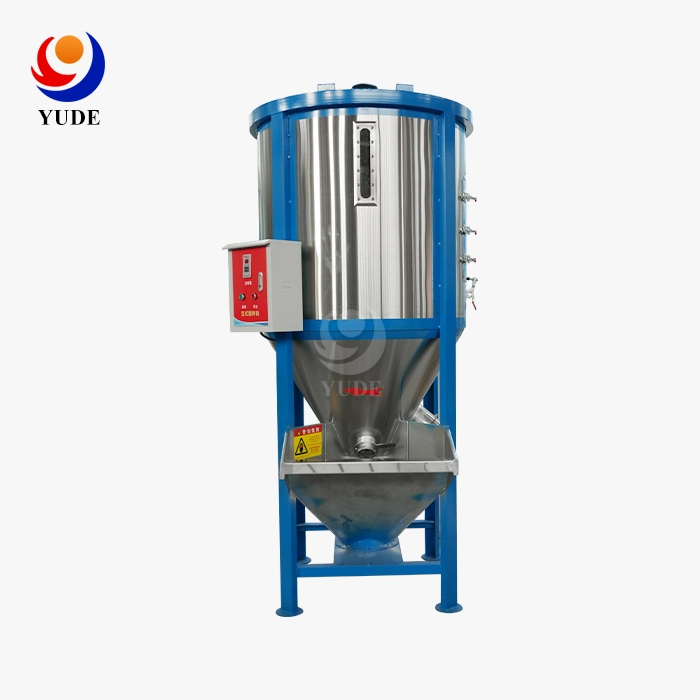
What Is a Stainless Steel Plastic Particle Mixer?
How the Mixing Process Works
This kind of mixer can mix bits and pieces of plastic, powders, masterbatch, and additives without melting the polymer. Things that need to be mixed are put into the barrel, and the shaft is turned on. The blades that are moving pick up the material and fold it until all the pieces are spread out evenly. The helper then opens the hole that lets the material out. Some of the things that can change the result are the speed of the shaft, the amount of fill, the size of the particles, the mass of the material, and the time it takes to mix. It takes longer to mix if the barrel is too full because the materials can't move around as much. Also, the final mix may be different. Fill level should always be seen as a process setting, not something that is added after the fact.
Core Components and Yude Product Features
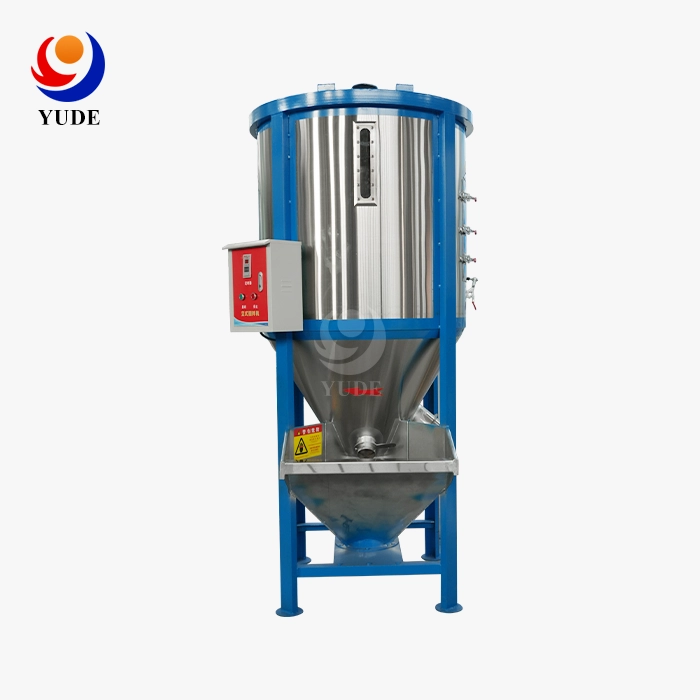
The cover is on top. The motor, the controls, the release valve, the mixing shaft, and the blades make up the other parts. The barrel and other parts of our stainless steel plastic particle mixer that can be used for many things are made of 304 stainless steel. Because this stuff doesn't rust and is simple to clean, it doesn't leave any marks and meets the standards for cleanliness needed to work with food- and medical-grade plastics. Each model has a different effective volume that can be changed. The mixing is even at 98% or higher, and the shaft spins at 30 to 60 r/min. A three-phase asynchronous motor moves the shaft. It is stable and quiet. It keeps the circuit from overheating, burning, and losing its power.
Why 304 Stainless Steel Matters
These values from ASTM A240 say that Type 304 stainless steel has 18% to 20% chromium and 8% to 10.5% nickel. It's good for production lines that can't handle getting dirty because of this. The chromium makes a thin oxide layer on top, which keeps it from rusting. For that reason, I recommend getting a material report from each supplier. A lower-nickel grade, like 201, is more likely to rust over time in damp places or with hygroscopic resins. Parts that are clear or light-colored can get black spots from rust or metal dust, which wastes materials and makes customers unhappy. Because dust can't hide on a smooth steel surface as well, it takes less time to clean when the color or grade changes.
How to Choose the Best Plastic Mixer Machine for Raw Material Blending?
Match the Mixer to Your Material Formula
Start with the stuff, not the machine. Before you go shopping for a stainless steel plastic particle mixer, you should write down the formula's pellet size, bulk density, moisture, flowability, and powder amount. New resin, recovered pellets, masterbatch, and fillers are some of the materials that react in different ways. What works well for one meal might not work well for another. If there are big differences between the densities of the parts, they are more likely to separate after being mixed. Powders that are very fine may stick to pellets because of the electric charge. Give all of your suppliers this short piece of paper with the specs on it. The seller will ask you more about your recipe if they are good. This quote is likely based on guesses if none of them do.
Size the Machine by Working Volume
A lot of buyers aren't sure what capacity means. That's the official size of the barrel. On the other hand, the working amount is how much you can mix well in one batch. Bulk density changes the amount of empty space in a barrel into weight, which means that heavy pellets can't fit as much thick material as they can. Take into account the time it takes to load, mix, and discharge when comparing the batch size to the hourly output. The useful volume of our stainless steel plastic particle mixer can be changed from one model to the next. We have small plastic particle mixers that range in size from 300 kg to 500 kg. We also have plastic mixers that go from 600 kg to 10 tons. Pick a size that lets your batch grow.
Verify Uniformity With a Trial
A catalog number doesn't prove that your method worked. Read up on the stuff and get samples from the top, middle, and bottom of the batch that was dumped. Check the color, additives, or weight ratio of the samples against each other. Then, test the first batch again to make sure it can be done again. The goal of our mixer is to make the mixture at least 98% uniform. A test run will let you know how your own materials react. The last batch took how long, how fast, and how full? Write it down so that your workers can do it again. You should also ask for a material report if the steel is going to be used to package food or medicine. If the cleaners you use are too harsh, look into 316 and write down the answer just to be sure.
Types and Applications of Plastic Particle Mixers
Horizontal, Vertical, and Shaft Designs
People who work in industry can buy ribbon blenders, high-speed mixers, horizontal or vertical mixers with one or two shafts, and mixers with one or two shafts. It's easy to check on most horizontal boxes because they empty quickly. To make vertical units that can hold between 600 kg and 10 tons, Yude Plastic Machinery has to cut down on floor space. These units can also be added by gravity. Double-shaft systems can help when the parts have very different densities. Ribbon blenders and high-speed mixers work better than pellet-to-pellet blenders for making powders or spreading things out quickly. Before you decide, look at the size, how well it discharges, how easy it is to keep up, and how much power it uses. After that, do a material trial to be sure you picked the right thing.
Applications in Food, Medical, and Daily Chemical Packaging
A stainless steel plastic particle mixer is good for keeping things clean and can be used for pellets that are used to package food, make medical plastics, or pack high-end chemicals every day. The new batch is less likely to get rust or old stuff if the barrel is smooth and doesn't rust. The line doesn't have to be scrubbed for hours at a time, which is helpful when there are a lot of grade or color changes. For items that come into contact with food in the US, 21 CFR Part 177 tells the FDA what rules they need to follow. In this case, a mixer shouldn't add anything to a resin that is already up to code. Clean the parts that touch things to keep that agreement safe.
Masterbatch, Recycled Pellets, and Fine Powders
These machines do more than just put things in boxes. They also mix the master batch and the colors, make new and used pellets, and mix fillers or additives. CaCO3, flame retardants, and stabilizers are all fine powders that make dust. Make sure you ask sources about covers that close and ways to get rid of the dust. Dusts stick to pellets and the walls of the barrel because they have an electric charge. If you ground the steel body properly, it helps drain the charge. You should talk to the seller about friction before you buy. Blades break down more quickly when they are filled with glass fiber and other hard materials. Smooth stainless steel surfaces work best for changing colors, like going from black to white.
Features and Supplier Comparison
Features That Affect Daily Performance
When you mix pellets faster, more heat is made, which can hurt soft pellets. Make sure the speed range works with the size of your pellets. Our shaft goes 30 to 60 r/min. The powder stays in the barrel and the people who work with it are safe thanks to good seals, dust-proof covers, and viewing holes. This opening should let your hopper, conveyor, or extruder link to it, and it should not waste much. Also, safety is key. This three-phase asynchronous motor we sell doesn't make a lot of noise and is safe from overload, burning, and phase failure. You might be able to use vacuum filling, load cells, or automatic doses, depending on how much you make. Talk to each one and find out what their best options are for your project and how much they cost.
Comparing Quotations Line by Line
When getting quotes for a stainless steel plastic particle mixer, you should look at the specs first, then the main price. To find out more about the machine, you can ask about its working range, batch size, motor power, speed range, mixing time, steel grade, size, dimensions, voltage, warranty, and spare parts. Then, do some research to find out what each price includes: moving boxes, dust collection, shipping, setup, packing, and shipping. Watch how the machine is packed when you order from another country, and ask how it will be kept safe during sea freight. Find out about the materials, see pictures of the welds, and keep test records. You could also get a plant check or video review. Everyone saves time with a clear quote, and costs don't come up after the deposit.
Common Buying Mistakes
There are three mistakes that keep happening. First, buyers choose based on the largest barrel volume, not the working volume. Second, the real formula is not used in the test. Third, they choose the cheapest price, but it costs them in the long run in hours of downtime, extra work to clean up, or contamination. Also, think about how easy it is to clean, how long the material stays in place, how often the joints and seals need to be fixed, and how long it takes to switch. It is important that the written design includes safety features like stops for overheating, cover interlocks, and accident stops. If these things are left out, you can't really compare prices that are very low. The machine might cost more after it's up and running too.
Selection Process and Customization
A Five-Step Process for Global Buyers
There is less risk when you buy a stainless steel plastic particle mixer from another country if you follow a clear process. The first thing you need to do is write down the formula, batch size, output, working hours, and floor space for the polymer, pellet, or powder. Step 2: Write down the technical and business needs, like the building's size, utilities, shipping, warranty, papers, and Incoterms. Step 3: Check to see if the mixers are set up the way you need them for production. Step 4: Ask for a sample of the material and a full quote. Step 5: Before you pay, make sure you have extra parts, training for the user, help, and tests. I believe you should give the seller the plant plans early on so that they can check the electrical needs and heights.
When Customization Makes Sense
For each recipe or factory, there isn't a single plan that works. We at Yude Plastic Machinery can make a stainless steel plastic particle mixer in sizes that don't fit the norm to fit your needs. Things that are often changed are the hopper's size, the blades' form, the speed range, the release valve, the loading height, and the seal. We offer operation interfaces in multiple languages and equipment changes that meet the standards of the industry in the destination country for orders that are going overseas. People in more than 30 places already buy our goods. If the mixer is going to feed an extruder or injection molding line, check the heights, signs, and links right away. Distributors and OEM clients should make it clear in the contract who is in charge of paperwork, shipping, and customer service.
Final Checklist and After-Sales Support
Before you buy a stainless steel plastic particle mixer, take a quick look at this short list. Look over the formula, the batch size that works, the output that you need, and the layout. You can choose a single or double stick that is positioned either horizontally or vertically. Pick the type of steel that will best protect you from rust and clean up. Read over the safety rules, how to control the dust, and how to release again. See what the tests showed, how much it costs to own, the warranty, and the spare parts. It's also important to have support after the delivery. You can get help from Yude Plastic Machinery after the sale, and they're open seven days a week. They also keep repair records and customer files with information about the tools. When we're outside of the US, we work with service teams there. There is a full quality check on every machine from the time the raw materials come in until they are delivered.
Conclusion
If you want to find the best plastic mixer machine for mixing raw materials, don't look at price. Instead, look at the recipe to find out what you need. A stainless steel plastic particle mixer made of 304 stainless steel won't rust and is simple to clean. This makes it ideal for storing food, medicine, and common chemicals. More about what's really going on is shown by the working volume and tests on samples than by the largest barrel size or claims in a catalog. Different floor plans, numbers, and release needs can be met by designs with one, two, or three shafts. Protection against dust, speed range, and motor damage all have an impact on daily use. Instead of making the same mistakes, you should compare quotes based on specifications and follow a structured buying process. This will make it less likely that you will get a bad match. You can also get help and customization after the sale.
FAQ
Can a stainless steel plastic particle mixer blend recycled pellets?
Most of the time, yes. You should try a small amount of the material first because recovered pellets aren't always the same size or level of wetness. Write down how long it took to mix and how much filling there was. Then, take a sample of the batch to make sure you got it right.
Is 304 stainless steel enough for food and medical packaging resins?
Of course, most of the time. The base of our mixer and the parts that mix things are made of 304 stainless steel, which is clean enough to be used to make plastics for food and medicine. If the smell or recipe for your cleaners is too strong, ask about higher grades like 316 and write down the answer.
How long does mixing usually take?
In fifteen to twenty minutes, pellets can be turned into powder. In ten to fifteen minutes, pellets can be turned into other pellets. You should try these numbers out to be sure because they can change based on speed and blade form.
Does a stainless steel plastic particle mixer include motor protection?
Our model has an asynchronous three-phase motor that keeps it safe from overload, fire, and phase failure. It keeps going and doesn't make a lot of noise.
Request a Quotation for Your Plastic Mixing Project
There is a stainless steel plastic particle mixer made by Yude Plastic Machinery. It has a 304 stainless steel bowl and parts for mixing. At least 98% of the mixing is even, and the amount can be changed. We make stainless steel plastic particle mixers and have been in business for a long time. We can handle orders from all over the world, offer language interfaces, and provide after-sales service 24 hours a day, seven days a week. Tell sales@yudemachinery.com about the material, the size of the batch, and where it needs to go. You can find out more at yudemachinery.com as well. We'll make suggestions on how to set it up right and give you a full quote.
References
- Callister, W. D., & Rethwisch, D. G. Materials Science and Engineering: An Introduction. Wiley, 2018.
- ASTM International. ASTM A240/A240M, Standard Specification for Chromium and Chromium-Nickel Stainless Steel Plate, Sheet, and Strip. 2023.
- U.S. Food and Drug Administration. Code of Federal Regulations, Title 21, Part 177: Indirect Food Additives, Polymers. 2023.
- Manas-Zloczower, I. (Ed.). Mixing and Compounding of Polymers: Theory and Practice. Hanser Publishers, 2009.
- Zweifel, H., Maier, R. D., & Schiller, M. (Eds.). Plastics Additives Handbook. Hanser Publishers, 2009.
- ASM International. ASM Handbook, Volume 1: Properties and Selection: Irons, Steels, and High-Performance Alloys. 1990.
Learn about our latest products and discounts through SMS or email