- English
- French
- German
- Portuguese
- Spanish
- Russian
- Japanese
- Korean
- Arabic
- Greek
- German
- Turkish
- Italian
- Danish
- Romanian
- Indonesian
- Czech
- Afrikaans
- Swedish
- Polish
- Basque
- Catalan
- Esperanto
- Hindi
- Lao
- Albanian
- Amharic
- Armenian
- Azerbaijani
- Belarusian
- Bengali
- Bosnian
- Bulgarian
- Cebuano
- Chichewa
- Corsican
- Croatian
- Dutch
- Estonian
- Filipino
- Finnish
- Frisian
- Galician
- Georgian
- Gujarati
- Haitian
- Hausa
- Hawaiian
- Hebrew
- Hmong
- Hungarian
- Icelandic
- Igbo
- Javanese
- Kannada
- Kazakh
- Khmer
- Kurdish
- Kyrgyz
- Latin
- Latvian
- Lithuanian
- Luxembou..
- Macedonian
- Malagasy
- Malay
- Malayalam
- Maltese
- Maori
- Marathi
- Mongolian
- Burmese
- Nepali
- Norwegian
- Pashto
- Persian
- Punjabi
- Serbian
- Sesotho
- Sinhala
- Slovak
- Slovenian
- Somali
- Samoan
- Scots Gaelic
- Shona
- Sindhi
- Sundanese
- Swahili
- Tajik
- Tamil
- Telugu
- Thai
- Ukrainian
- Urdu
- Uzbek
- Vietnamese
- Welsh
- Xhosa
- Yiddish
- Yoruba
- Zulu
10 Reasons Every Factory Needs a Vertical Plastic Particle Mixer
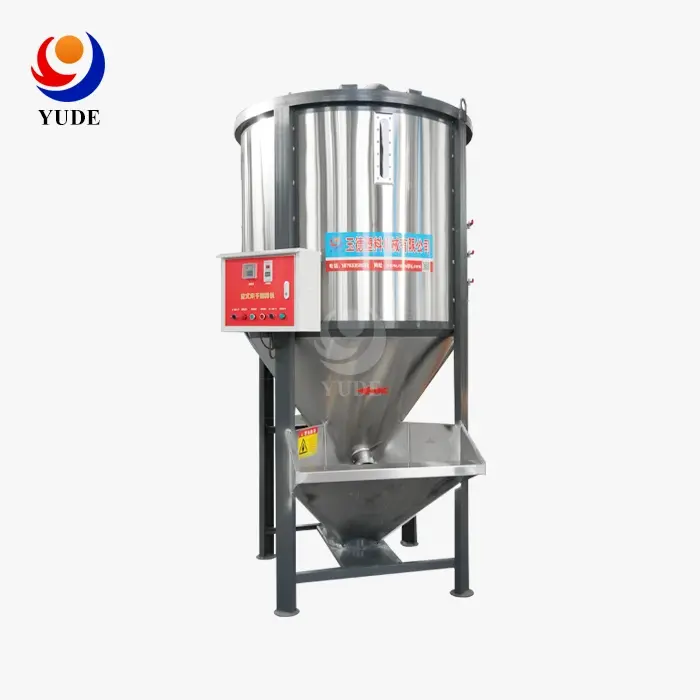
Every factory needs a plastic recycling machine for ten practical reasons: lower resin costs, better blend quality, moisture control, a simpler workflow, larger batches, lower energy and labor use, wider applications, custom configuration, compliance support, and a dependable supplier. A 1000kg vertical plastic particle mixer with drying function https://www.yudemachinery.com/vertical-plastic-particle-mixer-with-drying-function/1000kg-vertical-plastic-particle-mixer-with-drying-functioncovers the preparation side of that list. It blends recycled pellets, virgin resin, masterbatch, and additives, then dries them in the same vessel. It does not shred or pelletize scrap, so I treat it as the step that turns recycled material into a consistent feed for extrusion or injection molding.
The need is easy to measure. The U.S. Environmental Protection Agency reported about 35.7 million tons of plastics in municipal solid waste in 2018, with only about 8.7 percent recycled. A 2017 study in Science Advances found that about 9 percent of the plastic waste generated through 2015 had been recycled. Reusing your own scrap is one place a plant can start.
Reasons 1–3: Lower Costs, Better Blends, and Drier Material
The first three reasons come straight from the material you feed into the process.
Reason 1—A Plastic Recycling Machine Reduces Raw Material Costs
Resin costs a lot of money at most plastics plants, so every pound of scrap that can be safely used again brings down the cost per part. A plastic recycling machine can carefully mix recovered PP, PE, ABS, or PVC pellets with new resin. A 1000kg vertical plastic particle mixer with drying function is used to make these blends in large batches. This cuts down on the time needed to move the particles from the trash can to the machine's hopper. When someone wants to buy something, they shouldn't just look at the price tag. They should also compare how much it costs for additives, energy, labor, upkeep, waste, and new resin. Because the stuff that is collected is different from one lot to the next, it is also important to have set recipes and batch records.
Reason 2—The Vertical Plastic Particle Mixer Improves Material Uniformity
Weak spots, color streaks, and parts that were not used show up when the blend is not even. In a 1000kg vertical plastic particle mixer with drying function, a helical screw pulls pellets from the bottom of the tank and lets them fall down the wall. By going through that loop over and over, the masterbatch, stabilizers, recovered pellets, and new resin are spread out over the whole batch. Yude Plastic Machinery says that at least 98 percent of the time, the mixing is even. They still depend on the pellets' size, the amount of additives used, and how long the machine is run. Some books on mixing, like Mixing in the Process Industries, say that the best way to judge a blend is to take a typical sample of it. So, during a test, I think you should get samples from the top, middle, and outlet point and then look at the color and density of the finished parts.
Reason 3—The Drying Function Helps Control Moisture Before Processing
Pellets get wet when they are washed, put away, or in sticky air. Wet resin can cause bubbles, silver lines, gaps, and hydrolysis when it is pushed out or inserted. A 1000kg vertical plastic particle mixer with drying function heats the material and uses a screw to keep it moving. This lets the same amount of surface moisture leave. When working normally, the amount of wetness should be 0.5 percent or less after drying. The time it takes to mix and dry something depends on how wet the material was to begin with. PET, PC, and nylon are said to be sensitive to water in the Injection Molding Handbook and other injection molding resources. Perhaps they will need a separate desiccant dryer after this step.
Reasons 4–6: A Simpler, Faster, and Leaner Production Line
The next three reasons focus on how the machine fits into daily production.
Reason 4—One Integrated Machine Simplifies the Production Process
Combining both steps into a single 1000kg vertical plastic particle mixer with drying function cuts down on the number of moves and human handling needed, as well as the chance that dust or other foreign material will enter the batch. It also saves floor space, which is useful when a press or a machine takes up the whole thing. This setup works well for factories that make lots of batches and want a central place to store recycled pellets and additives. But because it doesn't dry things as precisely as a separate dehumidifying dryer, a mixer-dryer isn't the best choice. Please compare the two plans' prices, sizes, the number of batches they can handle, and how well they dry. Most of the time, one machine can do both tasks if the resin doesn't mind water too much.
Reason 5—A 1000kg Batch Mixer Supports Large-Scale Production
Based on the fact that the bulk density of plastic particles is between 0.6 and 0.8 g/cm³, the rated load capacity is 1000kg, and the effective volume is between 1500 and 1600 liters. A 1000kg vertical plastic particle mixer with drying function can feed an extrusion line or several injection machines without having to be refilled all the time. About 13 to 24 batches can be mixed and dried in an eight-hour shift with a 20 to 35 minute cycle. Because it takes time to load, empty, and clean, the real output will be less. Based on the resin, filling ratio, and mass density, ask the provider to figure out the cycle time.
Reason 6—The Machine Improves Energy and Labor Efficiency
Check out how much power is used during the whole cycle, not just the motor. The heaters, the hot air fan, the main motor, and the exhaust all use power. In your case, ask for kWh per ton or kWh per batch. It depends on the glue, the temperature, and the insulation, so I can't say for sure how much money you'll save. It is easier to see how much work has been cut out. You don't have to mix the bags by hand next to the press; instead, you can load a 1000kg vertical plastic particle mixer with drying function, set the timer and temperature, and then move on. Yude says that its products are safe because they protect against overheating, have a lid safety switch, and shut down automatically.
Reasons 7–9: Flexible Use, Custom Options, and Compliance Support
These reasons matter most when your product mix or customer requirements change.
Reason 7—A Vertical Mixer Serves Multiple Production Applications
One 1000kg vertical plastic particle mixer with drying function can be used for many different things. Washed regrind stays wet on top in recycling plants. The flakes don't stick together as they dry and mix with new glue and stabilizers because they are stirred all the time. They both use the same method to make sure that the pigment pellets are spread out evenly through the carrier resin. This makes sure that the color stays the same over time. The mixer can be used by injection molders who make PC or ABS housings to dry and mix materials for more than one press at the same time. PVC needs to be carefully kept at a certain temperature, and industrial plastics that get wet easily might need extra tools to get rid of the water. After each recipe, you should always clean the pot.
Reason 8—Customization for Different Factory Requirements
The setup is important because different plants use different resins and layouts. The vertical mixers that Yude Plastic Machinery sells come in sizes from 600kg to 10 tons, and they can also be custom made to fit your needs. When purchasing a 1000kg vertical plastic particle mixer with drying function, talk about the chamber size, motor power, heating method, temperature control, feeding and output, dust collection, and voltage. Stainless steel is better for dry flakes than wet or acidic ones. Carbon steel is better for dry flakes. Yude can give you an English screen and electrical requirements for the United States. They can also make multilingual operation interfaces and changes for local standards just for you. Make sure you remember each choice by writing it down.
Reason 9—Sustainability and Compliance Goals
Start-up scrap, off-spec pellets, sprues, runners, and edge trim are the things you already paid for. Getting them ready for controlled recycling means that less trash ends up in landfills and more materials are made. Quality is always the most important thing. It was written by Hopewell and others in 2009 in Philosophical Transactions of the Royal Society B that contamination and mixed polymers were two of the main things that made recycled plastic less good. Separate the polymers first, then mix them to get the best results. People can ask for records of batches, comments about recycled material, and recipes for additives. For compliance to happen, there needs to be a paper trail of written recipes, moisture checks, and source confirmations. A mixer alone won't do it. Also, this kind of machinery usually has to follow OSHA's rules for machine safety, so make sure you check the guards and interlocks.
Reason 10 and Buying Guide: Supplier, Design, Checklist, and Cost
The last reason is the supplier, and this section shows how to judge one.
Reason 10—The Right Supplier Provides Long-Term Value
Check out more than just prices from the source. Ask each manufacturer of a 1000kg vertical plastic particle mixer with drying function for technical drawings, specifications, material testing, references, information on spare parts, and warranty terms. More than 30 countries and areas have bought goods from Yude Plastic Machinery. They have served thousands of people in China and around the world. The things that come in, the work that is being done, and every finished machine that is sent out are all checked by a quality system. After the sale, you can get help 24 hours a day, seven days a week. People from outside the US have their needs met by skilled service teams in those places. You might spend more on the cheapest price in the long run if the job takes longer or parts are hard to find. Price is important, but so is how easy it is to get service and spare parts.
How to Compare a 1000kg Vertical Plastic Mixer with Other Solutions
There is no rule that says a horizontal mixer is better than a vertical one. This is because vertical designs take up less room space and move grains around better when you work with them in groups. You can use a horizontal ribbon mixer for some tough or quick jobs. Also, speed is key. If you mix things faster, it might help the spread, but it might also add heat, dust, or pellet wear. It takes longer to mix things slowly, but it is gentler. Yude's plan has a vertical screw that lifts and lets fall the pellets so they can be mixed without hurting them. Before you make a choice, you should think about how the design, capacity, speed range, ease of cleaning, heat integration, and upkeep requirements will meet your needs.
Purchasing Checklist for a 1000kg Vertical Plastic Particle Mixer with Drying Function
Before you ask for a price, you should know the type of plastic, the pellet shape, the percentage of recovered material, the batch size, the daily output, the starting moisture, the goal temperature, the amount of additives, and the floor space. Then you should find out how well the machine works, how long it takes to cycle, how much energy it uses, and how big the contact areas are. Make sure that the price covers setting up, commissioning, and training for the user. Find out how the design deals with noise and dust as well. Before you ship something to the U.S., you should know about the 60 Hz voltage and phase, guarding and emergency stops, Incoterms, export packing, wait time, warranty, and payment terms. Find out how many extra parts are on hand and how long it takes to get them to you. Something small can become a long-term problem while you wait for parts.
Installation, Operation, and Maintenance Considerations
Plan the base, power source, exhaust path, and for loading the machine before it goes. Then, do a commissioning test with your own stuff. Before each batch, make sure the chamber, screw, sensors, discharge gate, and safety interlocks are all in good shape. You should keep an eye on the cycle time, temperature, power, and sound. A problem is generally shown by a new sound or a rise in current. Every so often, check the wires, bearings, seals, heating elements, and fans, and always have spare parts on hand in case you need them. The vessel should be cleaned all the way through when the material or color changes. To keep repair records and other information about each machine easy to find, Yude keeps a customer file for each one.
How to Evaluate the Business Case Before Purchase
There are more costs than just the price of the machine that need to be thought about. There are many things to think about, like shipping costs, tariffs, assembly, energy use, labor, maintenance, spare parts, and downtime. If you use less new resin, pay less to get rid of old materials, hire someone else to dry or blend your parts, and reject fewer parts, you can save money. To figure out how much money can be saved by recycling, multiply the amount of new resin that needs to be replaced each month by the price difference between new and recycled material. Then, take away the extra work and energy that needs to be done. When you figure out the numbers for each batch, month, and year, don't give too many. You can do a material trial before you approve the order to make sure of the uniformity, the amount of moisture lost, the cycle time, and the amount of energy used.
Conclusion
To turn recycled materials into a steady supply for production, factories need a 1000kg vertical plastic particle mixer with drying function. Some of these ten reasons are spending less on resin, getting more even blends, better controlling moisture, a simpler one-vessel workflow, bigger batches, better keeping track of energy and labor, more uses, custom configuration, better recycling practices, and getting help from suppliers. In normal conditions, the machine can handle no more than 0.5% moisture and a maximum weight of 1000kg. Its working space is 1500 to 1600 liters and its run time is 20 to 35 minutes. And resins that don't like water, like PET, PC, and nylon, might need their own dryer. It doesn't shred scrap. Because the result relies on the resin, the bulk density, and the mix, the best ways to make a choice are to test the materials and figure out how much they will cost.
FAQ
What is a 1000kg vertical plastic particle mixer with drying function?
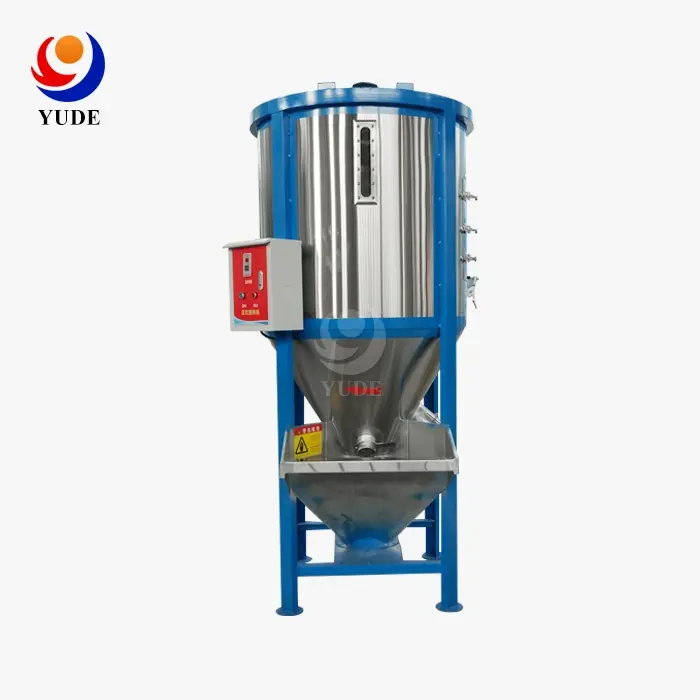
One container is used to mix and dry the plastic granules in this batch machine. A vertical screw moves the pellets around. It can hold up to 1000kg of material with a bulk density of 0.6 to 0.8 g/cm³.
How long does one cycle take, and how dry is the material?
This process can take anywhere from 20 to 35 minutes, depending on how wet the cloth is to begin with. When the material is dried, it should have no more than 0.5% wetness left in it under regular working conditions.
Can it replace a dedicated dryer for PET or PC?
Not all the time. You might still need a desiccant dryer even though these resins don't need 0.5 percent water. The mixer works well with PP, PE, and regrind that has water on top.
Can Yude Plastic Machinery customize the machine for U.S. plants?
Yes. Yude has sizes that aren't standard, unique ways to mix materials, user interfaces that can be used in more than one language, and changes that are made to fit local standards. The team will look at your options after you tell them about your resin, batch size, and voltage needs.
CTA: Request a Customized Plastic Particle Mixer Solution from Yude Plastic Machinery
Yude Plastic Machinery in Shandong sells a 1000kg vertical plastic particle mixer with drying function. They offer help after the sale, full-process quality inspection, and customization 24 hours a day, seven days a week. When it is made in big quantities, the cost performance stays high. Send an email to sales@yudemachinery.com with the voltage, type of resin, batch size, and starting moisture. We'll get back to you with a full plan and price quote. You can also visit https://yudemachinery.com/ to see our goods.
References
- Advancing Sustainable Materials Management: 2018 Fact Sheet, U.S. Environmental Protection Agency, 2020
- Production, Use, and Fate of All Plastics Ever Made, Science Advances, 2017
- Plastics Recycling: Challenges and Opportunities, Philosophical Transactions of the Royal Society B, 2009
- Injection Molding Handbook, Kluwer Academic Publishers, 2000
- Safeguarding Equipment and Protecting Employees from Amputations, Occupational Safety and Health Administration, 2007
- Mixing in the Process Industries, Butterworth-Heinemann, 1992
Learn about our latest products and discounts through SMS or email