- English
- French
- German
- Portuguese
- Spanish
- Russian
- Japanese
- Korean
- Arabic
- Greek
- German
- Turkish
- Italian
- Danish
- Romanian
- Indonesian
- Czech
- Afrikaans
- Swedish
- Polish
- Basque
- Catalan
- Esperanto
- Hindi
- Lao
- Albanian
- Amharic
- Armenian
- Azerbaijani
- Belarusian
- Bengali
- Bosnian
- Bulgarian
- Cebuano
- Chichewa
- Corsican
- Croatian
- Dutch
- Estonian
- Filipino
- Finnish
- Frisian
- Galician
- Georgian
- Gujarati
- Haitian
- Hausa
- Hawaiian
- Hebrew
- Hmong
- Hungarian
- Icelandic
- Igbo
- Javanese
- Kannada
- Kazakh
- Khmer
- Kurdish
- Kyrgyz
- Latin
- Latvian
- Lithuanian
- Luxembou..
- Macedonian
- Malagasy
- Malay
- Malayalam
- Maltese
- Maori
- Marathi
- Mongolian
- Burmese
- Nepali
- Norwegian
- Pashto
- Persian
- Punjabi
- Serbian
- Sesotho
- Sinhala
- Slovak
- Slovenian
- Somali
- Samoan
- Scots Gaelic
- Shona
- Sindhi
- Sundanese
- Swahili
- Tajik
- Tamil
- Telugu
- Thai
- Ukrainian
- Urdu
- Uzbek
- Vietnamese
- Welsh
- Xhosa
- Yiddish
- Yoruba
- Zulu
What are the 5 methods of processing plastic?
Modern plastic production depends on certain processing methods that turn raw materials into parts that work. There are five main methods: extrusion, blow molding, thermoforming, injection molding, and mixing systems, which are used for the important material preparation step. Each method is designed to meet a different set of manufacturing needs, such as making precise auto parts or a lot of wrapping materials. Before going into production lines, a plastic particle vertical mixer dryer makes sure that pellets have the right amount of wetness and are mixed evenly. This has a direct effect on the quality of the finished product and how efficiently it is made across all processing methods.
Injection Molding – Versatile and Precise Plastic Processing
Injection molding is a flexible and accurate way to work with plastic. Precision production is mostly done with injection molding in the electronics, consumer goods, and car industries. Melting polymer resins and pouring them under high pressure into machined steel molds is how the process works. This makes parts with very tight specs for size.
Why Injection Molding Demands Superior Material Preparation?
Materials that are hygroscopic, like Nylon PA66, ABS, and polycarbonate, take in water from the air and turn it into steam when they are heated. This wetness makes splay marks, silver streaks, and structural flaws in parts that have been formed. To keep chemical chains from breaking down, engineering-grade resins need dew points below -40°C before they can be processed. This problem is solved by modern drying and mixing systems that use both heat and motor movement in a single vertical room.
Technical Advantages for High-Volume Production
When procurement engineers look at injection molding operations, they should look at machines that can handle batches of 300 to 5,000 kg and keep the temperature accurate to within ±1.5°C. PID-controlled heating systems keep the temperature stable during drying processes, and the insides are made of mirror-polished stainless steel (Ra ≤ 0.8 μm) to keep contaminants out. The central auger mixing system makes sure that UV stabilizers and color masterbatches are spread out evenly throughout the raw resin. This stops chromatic aberration in the final goods. When compared to running separate tumble mixers and hopper dryers, this combination saves money on capital costs.
Vertical layouts that use less floor space are good for manufacturing sites that need to handle large amounts of material. The 304/316 stainless steel design doesn't rust in a variety of polymer chemicals, so it lasts longer in harsh production settings. Digital timer controls or PLC + HMI interfaces give both human and automatic production lines a lot of practical freedom.
Extrusion – Continuous and Efficient Plastic Formation
Extrusion is very different from batch molding in the way it makes continuous shapes, such as pipes, films, window frames, and weather stripping. Plastic pellets are fed into a hot barrel with spinning screws that create shear heat. This melts the material and forces it through shaped dies.
Critical Material Consistency Requirements
It is especially important for film extrusion that pellets are very uniform so that "fish eyes" don't show up. These are flaws that are obvious and are caused by sticky resin groups or pockets of moisture. For processing HDPE and LDPE to make clear packaging sheets, the melt flow indices must be the same for all groups of material. Temperature ranges of 60°C to 180°C (with an extra 220°C choice) can be used to meet the thermal needs of various types of polymers, such as industrial thermoplastics and polyolefins.
Operational Benefits for Continuous Production
Vertical mixing and drying equipment improves the efficiency of extrusion by getting rid of process pauses caused by wetness. When quick increases in humidity happen in the material that goes through LDPE film lines, flaws happen that need to be fixed by stopping production to clean the dies and purge the material. Integrated preparation systems keep the pellets' moisture content below vital levels so that these kinds of problems don't happen.
The slow spinning of the plastic particle vertical mixer dryer center auger reduces frictional heat and pellet wear, protecting the material's integrity for formulas that are sensitive to shear. This gentle treatment is especially helpful when working with regrind materials that have different amounts of fresh resin mixed with them. Purchasing teams that are in charge of recycling operations should know that proper mixing stops stratification, which makes extrudate measurements vary.
Energy efficiency has a direct effect on how much it costs to run high-throughput extrusion plants. Traditional hot air dryers are less thermally efficient than electric heating systems that can give desiccant air as an option. The vertical chamber design naturally encourages convective airflow through the material beds, which lowers the energy needs of the fan while still removing all the wetness completely.
Blow Molding – For Hollow Plastic Products
Blow molding is best for making solid objects like water bottles, gas tanks for cars, industrial drums, and medical cases. The process starts with turning plastic into a parison (a hollow tube) or preform. Compressed air is then used to fill the mold hole after it has cooled.
Material Quality Impact on Structural Integrity
Consistent material viscosity during parison creation is very important for wall thickness consistency and burst strength. When making PET bottles, very strict rules must be followed when preparing the materials. If there is more than 50 parts per million of wetness in the material, it breaks down during heated stretching, leaving containers that are less clear and less resistant to impact. The food and drug businesses have strict quality standards that come from the way raw materials are treated.
It is safe to work with hygroscopic resins like PET when you use vertical mixing equipment that has overheat protection, lid locking mechanisms, and emergency stop features. The temperature accuracy of ±1.5°C stops thermal degradation and allows for deep drying, which is needed for structure uses. The CE-ready design and extra ATEX approval meet the safety standards for buildings that work with volatile substances or in explosive atmospheres.
Procurement Considerations for Blow Molding Operations
When looking for tools for blow molding, buyers should look at capacity numbers that match the size of the production. Batch sizes starting at 300 kg are good for making prototypes and small runs of production, while 5,000 kg capacities allow for continuous production of car parts. The mirror-polished finish on the inside makes it easy to change colors quickly, which is very important for contract makers who have to meet the needs of many clients with different product requirements.
Material tracking is becoming more important in food-contact and vehicle uses. Modern control systems keep track of each batch's time-temperature profile, making quality records that meet ISO checks and customer quality agreements. This ability to record adds value to the main functions of drying and mixing.
Plastic Particle Vertical Mixer Dryer – Integrated Drying and Mixing Solution
Specialized technology for preparing materials is an important part of the working process itself, not just an extra tool that helps other methods work better. The plastic particle vertical mixer dryer merges two important preprocessing tasks—removal of wetness and homogenization of composition—into a single, energy-efficient unit.
Operational Mechanism and Engineering Design
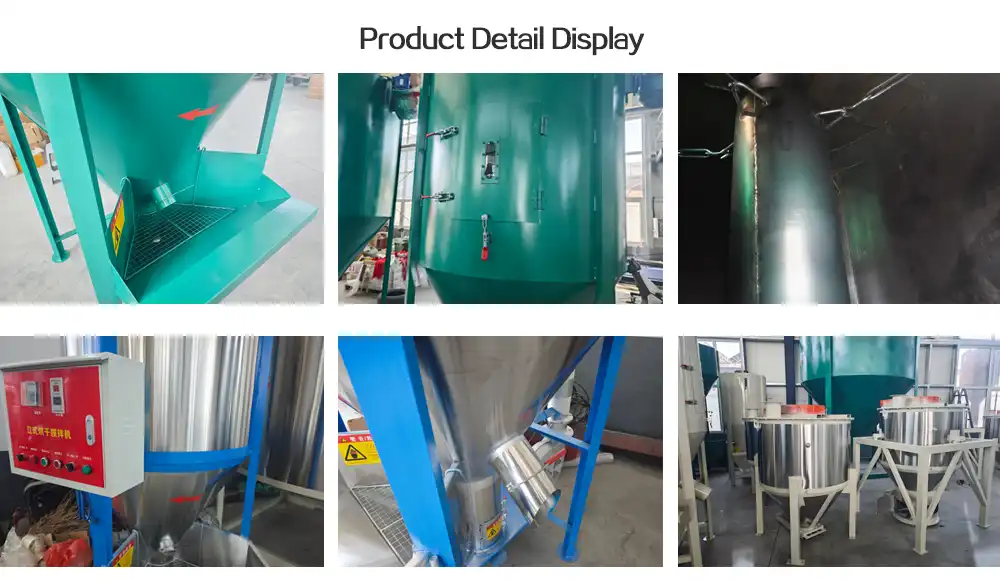
The machine works through an upright conical cylinder made of 304 or 316 stainless steel. Hygroscopic pellets enter the chamber, and a central auger repeatedly moves material from the bottom edge to the top, making a flow that looks like a waterfall. Electric elements or alternative desiccant systems heat the air that flows through the moving material bed. This heat transfer removes wetness from the surface and the spaces between the materials.
This two-step process solves one of the most important problems in polymer processing: making sure that the whole amount of the material is completely dry while also making sure that additives like slip agents, antioxidants, and color concentrates are spread out evenly. The slow movement keeps the pellets from breaking up, which would otherwise send fines and dirt into the feed lines.
Comparative Advantages Over Alternative Technologies
For the same amount of output, traditional spinning drum dryers need longer residence times and take up a lot of floor room. Fluid bed dryers can lose pellets and dry materials unevenly if the particles are different sizes. The vertical design turns over all the material in 15 to 30 minutes, based on the goal moisture level and bulk density.
Compared to horizontal ribbon mixers with many shaft seals and bearing systems, this type of mixer requires a lot less maintenance. The external bearing seat design keeps mechanical parts away from rough polymer dust, which makes service times longer. Strategic clean-out doors at the base of the chamber make it easy to switch materials quickly without taking apart the drive parts.
Capacity flexibility works for everything from small R&D labs to large production plants. Custom compounders working on unique formulas use the 300 kg minimum capacity, and big injection molding cells with multiple presses running at the same time use the 5,000 kg maximum capacity. Modular design principles make it possible to add new features after the fact, such as nitrogen purge systems for plastics that are sensitive to air or automatic material transfer interfaces.
Safety and Compliance Standards
Equipment used in industrial processing has to follow strict safety rules. Overheat safety stops thermal runaway situations that could damage temperature-sensitive plastics or make fires more likely. Lid interlock devices turn off the heater and mixer while the chamber is being opened. This keeps people from touching hot surfaces or moving parts. Emergency stop settings let you shut down the system right away and can be accessed from a number of workstation places.
The CE-ready design makes it easier to use the equipment in all European factories, and the optional ATEX approval lets it be installed in areas that are listed for explosive dust atmospheres. These compliance features are especially useful for makers who work with fine powders or chemicals that need low minimum ignition energy levels.
Conclusion
Knowing about these five ways to process plastic gives procurement workers the power to make smart decisions about what tools to buy. Injection molding, extrusion, blow molding, and thermoforming are all different ways to make things, but they all depend on properly preparing the material for the best results. The plastic particle vertical mixer dryer is both a processing method that can be used on its own and an important part of other techniques that improve quality. By combining mechanical homogenization with heat conditioning, these systems get rid of flaws caused by wetness, make sure that additives are spread out evenly, and use less energy than separate processing steps. When choosing equipment that meets working needs and quality standards, procurement engineers should look at things like capacity needs, material fit, and compliance certifications.
FAQ
How do vertical mixer dryers improve production efficiency compared to separate mixing and drying equipment?
Putting two preparation steps into one system cuts down on the work needed to move the materials, gets rid of the risk of contamination during transfer, and shortens the total processing time. The constant flow pattern ensures faster temperature equilibration than static hopper dryers, and mixing at the same time stops the compositional layering that happens when mixing happens before drying. When dedicated mixers and dryers are installed together, the total amount of floor room needed drops by about 40%.
What material types benefit most from vertical mixing and drying systems?
Because they break down easily when they come in contact with water, hygroscopic industrial resins like nylon PA6/PA66, PET, polycarbonate, PBT, and ABS are the best choice. The equipment also helps recycling operations a lot because it evens out the different melt flow indices and moisture levels in mixed material streams. When color concentrate masterbatches are processed or slip additives are added, even materials like HDPE and PP get better quality.
How should buyers evaluate return on investment for material preparation equipment?
Figure out how much the decrease in defects costs in terms of scrap materials and repair labor. When comparing vertical drying systems to other drying methods, keep in mind that they use 20 to 30 percent less electricity per kilogram of dried material. Think about how much more output time you'll have when you stop process pauses caused by moisture. Most facilities get their money back within 18 to 24 months by improving quality and making operations more efficient.
Partner with Yude Plastic Machinery for Advanced Material Processing Solutions
The vertical mixing and drying systems that Yude Plastic Machinery makes are designed to meet the needs of difficult plastic processing uses. Our equipment ranges from 300 kg lab-scale units to 10 tons industrial systems. All of them are made of mirror-polished 304/316 stainless steel and have PID temperature control that ensures accuracy within 1.5°C. As a maker with a lot of experience making plastic particle vertical mixer dryers, we know exactly what is needed for injection molding, extrusion, and blow molding in the packaging, automobile, and industry sectors.
Our engineering team creates special solutions to solve specific material problems, like when you need to work with hygroscopic engineering resins, mix large amounts of regrind, or get ATEX certification to make sure your equipment is safe for use in dangerous environments. Through our full 7x24 support system, we help clients choose the right technology, set it up, and make sure it works right. We also offer ongoing expert support. Get in touch with our expert sales team at sales@yudemachinery.com to talk about how you need to prepare your materials and get detailed equipment specs that are made to fit your production setting. Here, we'll show you how the right preparation tools can turn the quality of your raw materials into a competitive manufacturing edge.
References
1. Rosato, D. V., & Rosato, M. G. (2012). Plastics Processing Data Handbook. Springer Science & Business Media.
2. Crawford, R. J., & Throne, J. L. (2002). Rotational Molding Technology. William Andrew Publishing.
3. Tadmor, Z., & Gogos, C. G. (2006). Principles of Polymer Processing. John Wiley & Sons.
4. Rauwendaal, C. (2014). Polymer Extrusion (5th Edition). Hanser Publications.
5. Strong, A. B. (2006). Plastics: Materials and Processing (3rd Edition). Pearson Prentice Hall.
6. Goodship, V. (2004). Practical Guide to Injection Moulding. Smithers Rapra Technology.
Learn about our latest products and discounts through SMS or email