- English
- French
- German
- Portuguese
- Spanish
- Russian
- Japanese
- Korean
- Arabic
- Greek
- German
- Turkish
- Italian
- Danish
- Romanian
- Indonesian
- Czech
- Afrikaans
- Swedish
- Polish
- Basque
- Catalan
- Esperanto
- Hindi
- Lao
- Albanian
- Amharic
- Armenian
- Azerbaijani
- Belarusian
- Bengali
- Bosnian
- Bulgarian
- Cebuano
- Chichewa
- Corsican
- Croatian
- Dutch
- Estonian
- Filipino
- Finnish
- Frisian
- Galician
- Georgian
- Gujarati
- Haitian
- Hausa
- Hawaiian
- Hebrew
- Hmong
- Hungarian
- Icelandic
- Igbo
- Javanese
- Kannada
- Kazakh
- Khmer
- Kurdish
- Kyrgyz
- Latin
- Latvian
- Lithuanian
- Luxembou..
- Macedonian
- Malagasy
- Malay
- Malayalam
- Maltese
- Maori
- Marathi
- Mongolian
- Burmese
- Nepali
- Norwegian
- Pashto
- Persian
- Punjabi
- Serbian
- Sesotho
- Sinhala
- Slovak
- Slovenian
- Somali
- Samoan
- Scots Gaelic
- Shona
- Sindhi
- Sundanese
- Swahili
- Tajik
- Tamil
- Telugu
- Thai
- Ukrainian
- Urdu
- Uzbek
- Vietnamese
- Welsh
- Xhosa
- Yiddish
- Yoruba
- Zulu
Plastic Crusher Machine vs Granulator: What’s the Difference
A plastic crusher machine breaks bulky, thick, or irregular plastic into coarse pieces. A plastic granulator cuts manageable scrap into smaller, more uniform flakes through a sizing screen. Both machines reduce size, and neither one blends material. Blending comes next, and a large capacity plastic mixer https://www.yudemachinery.com/plastic-mixer/large-capacity-plastic-mixer handles that job once the material reaches the right particle size. We wrote this guide for purchasing managers, process engineers, recyclers, and compounders who need to match equipment to feedstock, output size, and throughput. Below, we compare the two machines, show how to choose between them, and explain where industrial mixing equipment fits in a large-scale line.
What Each Machine Does in a Plastic Processing Line
What Is a Plastic Crusher Machine?
A plastic crusher is the first machine that cuts down on size. Things that are heavy, thick, or awkward can use it, like pipe scraps, profiles, molded parts, containers, production lumps, and purge material. The stuff is put into a bin, and a machine with knives cuts it against blades that stay in place. Hits or cuts break up the pieces until they can pass through a screen or valve opening. Big pieces can go through again. Most of it is made up of the rotor, knives, fixed blades, screen, motor, and releases. When strong feeds and high torque are more important than even grain size, a crusher is the best choice.
What Is a Plastic Granulator?
To get a better handle on the powder size, use a plastic granulator. The material stays in the cutting room until the pieces are small enough to leave behind. The moving knives then went through the knives that were not moving. Flakes or granules that are mostly the same size are what you get in the end. Things like runners, sprues, bottles, sheets, films, and fair amounts of production waste are often put into the machine. People who want to buy a machine should check the knife clearance, rotor speed, screen opening size, noise, heat buildup, and energy use. Cutting resins can make them soft because of the friction. When the scrap already fits the feed hole and needs to be the same size, a granulator can be used to wash, dry, move, or extrude it.
Granulating, Pelletizing, and Mixing Are Different Steps
This means that the catalog name doesn't always tell you what the machine does. Some suppliers use the words "crusher," "shredder," "grinder," and "granulator" in the same way. With granulation, you cut things to make flakes. Most of the time, pelletizing makes pieces that are all the same size after melt extrusion. Mixed also doesn't work. It works with these tools and never needs to be replaced because a large capacity plastic mixer doesn't change the size of the particles. Look at the real process, from the feed form to the output size. Then you won't buy a machine that doesn't do the job. That's the main difference between them.
Plastic Crusher Machine vs Granulator: Key Differences
Side-by-Side Comparison
Start by comparing the information to what you already know.
| Factor | Crusher | Granulator |
|---|---|---|
| Main role | Primary, coarse size reduction | Controlled size reduction |
| Typical feed | Bulky, thick, irregular parts | Handleable scrap, runners, bottles, films |
| Output | Coarse, less uniform pieces | More uniform flakes or granules |
| Drive and cutting | High torque | Higher rotor speed, screen-controlled output |
| Maintenance focus | Knives, rotor wear, hopper | Knife clearance, screen condition |
Both are used in a lot of lines. First, the crusher gets rid of the big pieces. Next, the granulator evens out the size of the powder.
Why Rated Throughput Can Mislead
A number that tells you the estimated throughput only works for test files. What the end result is can be changed by the feed size, the bulk form, the screen size, the motor power, and the density. The granulator may not work as well with thick, dense regrind if it was made for thin-wall scrap. When you compare prices, find out what a screen is made of, what size it is, and how dense the bulk is. Every step that comes after the cutting room is also affected by the size of the particles. This is because coarse chips and small flakes pack and flow differently, which means they change the way plastic is washed, dried, moved, blended, extruded, and mixed in large batches by a large capacity plastic mixer.
Operating Cost per Kilogram
List price and put-in motor power only show a small part of how much something costs. The amount you pay over time is based on the motor load, the cutting resistance, the wear parts, the dust control, and the energy used per kilogram. Things that are sticky or shiny damage swords more quickly, and knives that are dull use more power and heat. You can use the same reasoning when mixing. We compare the motor power, gearbox type, and cycle time when evaluating the price of a large capacity plastic mixer. Then we find out how much power is needed to mix a ton of plastic. Need a list of wear parts, spare knife sets, and repair intervals? Ask each provider to write it down.
Crusher or Granulator? Selection by Material and Application
Bulky Rigid Parts and Pipe Scrap
Lots of big things need a breaker or a stage before they can be broken up. Large pieces of pipe, thick profiles, molded parts, and purge lumps are often bigger than the feed opening of a granulator. When you try to push them in, you damage the knives and build bridges and overloads. PP, PE, and PVC pipe and profile plants have a lot of this happen because waste and scraps from starting up pile up. Scale tells you why it's important. EU Plastics said that in 2022, the world made 400.3 million tons of plastic. The US Environmental Protection Agency (EPA) said that in 2018, the US made 35.7 million tons of plastic. Of that, 8.7 percent was recycled. Before you buy a knife, find out what the blade is made of. Hard or full advanced plastics wear knives out faster.
Films, Sheets, Runners, and Sprues
A granulator can take scrap that is easy to handle right away. Running boards, sprues, bottles, and sheet trim are all in this group. Extra care needs to be taken with films because light materials can wrap around the rotor or feed unevenly. Check how the film is fed and how the rotor is set up. It's also important to think about static electricity, smog, and how sensitive something is to heat. Static electricity can stop the feed if the films stick together, and dirt on the knives can make them wear out faster. When heat-sensitive plastics are cut, they can soften. Tell the seller about these conditions right away so that they can make sure that your resin will work with the rotor design, screen holes, and cooling.
Pellets and Powders Need Blending, Not Cutting
You don't have to shrink the pellets, flakes, or powders if they are already the right size. They need to be mixed. What makes a granulator different from a large capacity plastic mixer is that the two do different things. Resin, additives, color, and regrind are distributed evenly throughout the batch by a large capacity plastic mixer. PVC powder blends and PE or PP pellet blends are two examples. If you don't mix the additives well enough, they may not spread evenly and leave a color streak on the final part. Due to their different thicknesses, powder and pellets need different amounts of time to mix. This means that the batch size and stirring design should be right for the material.
How a Large Capacity Plastic Mixer Fits into the Processing System
Where Mixing Sits After Size Reduction
The steps generally go like this: reducing the size, moving it, mixing it, and then extruding or shaping it. You use a large capacity plastic mixer after the material is ready for recycling, extrusion, compounding, masterbatch, and making plastic. The capacity is not just shown by the nameplate number; it is also based on the mass density, filling ratio, and useful working space. Units between 1,000 kg and 2,000 kg can be used in many workshops, but big granulation plants need much bigger ones. It includes adding, stirring, heating or cooling (if needed), and taking out. We make sure that the layout matches how the materials act because items move in different ways when they are laid out vertically and horizontally.
Yude Large Vertical Plastic Pellet Mixer Specifications
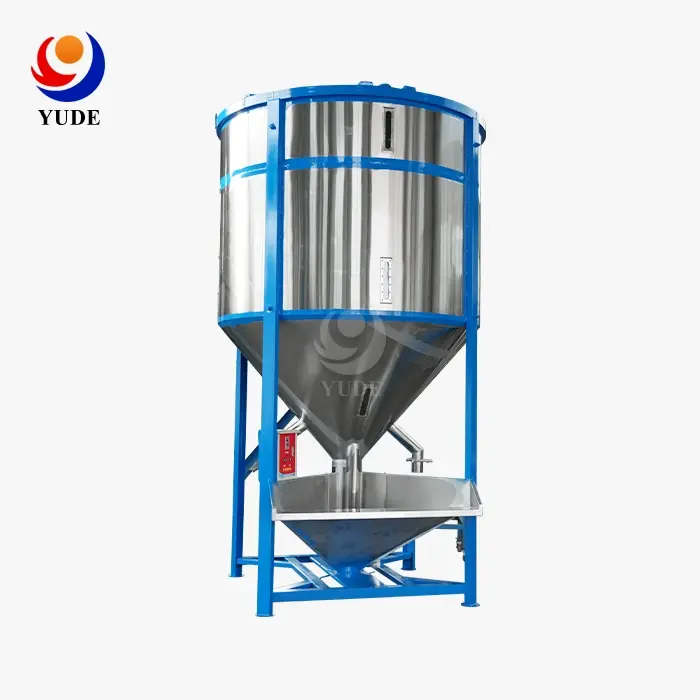
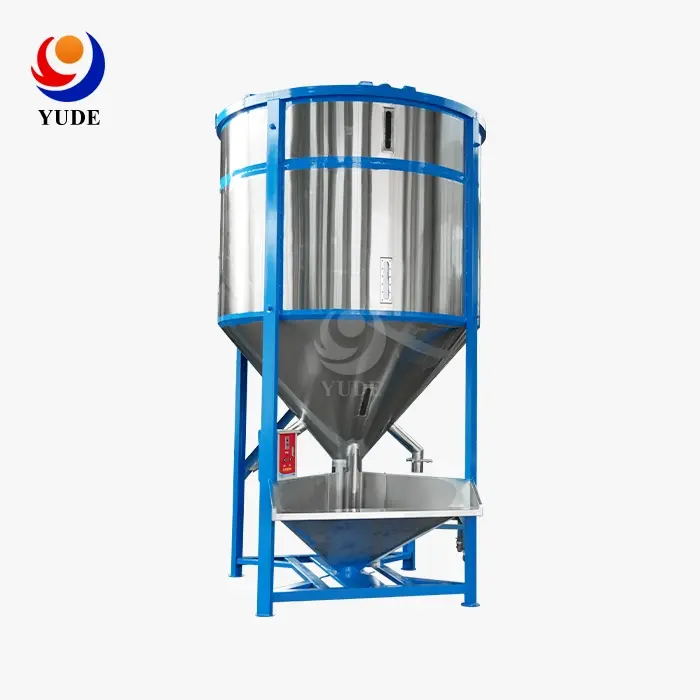
For people with big pellet plants, we sell a Large Vertical Plastic Pellet Mixer. There are two or more screws on the frame that mix the material so that it spreads evenly. 10 to 30 tons of weight can fit inside, and 15 to 48 m³ is a good amount of space. It takes between 20 and 50 minutes for each run, and at least 98% of the mixing is even. Two motors with outputs between 75 and 315 kW power the unit. The hard tooth surface gear reducer is extra-heavy-duty and was made to hold big loads for a long time. More dense Q235 carbon steel is used to make the barrel. Its walls are at least 30 mm thick. It doesn't shake because the base is stronger. Because of these features, this large capacity plastic mixer is perfect for continuously mixing pellets in large batches.
Where the Large Vertical Mixer Works Best
This design is made for large plants that grind up plastic and for shops that work with petrochemical companies to process plastic. At these places, a lot of pellets need to be mixed all the time. It's hard on the drive and frame to run heavy loads for long periods of time. That stress is taken care of right away by the thick barrel wall and heavy-duty gear reducer. Before you pick a size, divide the daily pellet output by the batch weight and cycle time. The large capacity plastic mixer can then keep up with the runs that come before and after it in this manner. Our range of vertical mixers comes in a lot of different sizes. They can hold anywhere from 600 kg to 10 tons at most.
How to Choose Equipment and Avoid Common Buying Mistakes?
Define Material and Throughput First
Start with the things instead of the machine. Write down the type of resin, its shape, the feed's size, its moisture, any contamination, its bulk density, and the size you want the output to be. It is then important to set reasonable goals for daily production, hourly output, batch capacity, and useful working volume. We can use these numbers to make a simple rule: use a crusher for large feed, a granulator for small scrap that needs to be turned into even flakes, and a large capacity plastic mixer for stuff that is already the right size but needs to be mixed. First, look at the specifics of the building. These include the blades' material, the rotor's design, the bearings, the wear protection, the overload protection, the dust collection, the metal detection, the emergency stops, and the PLC control.
Test with Real Material
Throughput and catalog ability don't always match up, so use your own content to try as often as you can. Too much trash in a granulator can cause it to overheat, bridge, damage the knives, and feed unevenly. The second mistake hurts too. In order to make flakes that are all the same size, you can use a crusher. This machine will wash, dry, blend, and extrude bits that aren't all the same size, making each step harder. Ask the supplier how they ensure the uniformity of a large capacity plastic mixer, such as the 98% minimum stated for our large vertical pellet mixer, and how they confirm cycle time for mixing.
Compare Total Cost and Supplier Support
The price is on the first line of the total cost. You need to add up how much it costs to run, clean, work, have parts wear out, and get help from experts. After that, check the source once more. A good maker makes it clear how much it can hold, gives you technical documents and extra parts, and helps you set it up in other countries. Vertical mixers that can hold up to 10 tons of plastic are made and sold by Yude Plastic Machinery. Small mixers that can hold up to 300 kg to 500 kg of plastic are also made and sold by Yude Plastic Machinery. We ship things to over 30 different countries and areas, make control panels that can be used in more than one language, and adapt our tools to fit the needs of each area. When you need a size or type of material that isn't available in stores, a direct manufacturer is the best way to go. Our after-sales service is available 7 days a week, 24 hours a day.
Conclusion
There is more than one measure that is used to choose the right machine. A plastic crusher machine cuts large, thick, or irregular pieces of plastic down to a smaller size at first. A granulator uses a sizing screen to make flakes that are easier to handle out of easy-to-handle scrap. As long as the grain size stays the same, a large capacity plastic mixer can mix pellets, powders, regrind, and additives. Instead of replacing size reduction, it comes after it. It depends on the density, the moisture level, the feed size, and the choice of screen. It depends on how much energy is used per kilogram, how often parts wear out, and how much time is lost. By testing with real material, you can avoid overload and output that doesn't match up. The 10 to 30 ton vertical design shows that pellet plants that make batches of tens of tons need mixers that can handle that much.
FAQ
Can a crusher replace a granulator?
Not very often, no. It can take big, thick, or uneven feed and make big pieces. A granulator needs less feed and makes flakes that are more even. In many recycling lines, both are running at the same time so that each machine can do its job.
Can a granulator process pellets or powders?
Not at all. It's already very hard to cut powders and pellets because it makes fines and hurts the pellets. To mix them, you need a large capacity plastic mixer, which is the best tool for the job. It makes sure that the chemicals, color, and resin are spread out evenly in the batch.
How do I choose the right mixer size?
To begin, you need to find the working amount, mass density, batch weight, and filling ratio. Then, every hour, try to match the cycle time to the line's demand. Before you choose a layout, send information about your material. This is because vertical and horizontal patterns will move it in different ways.
What should I send for a quotation?
Here are some things you need to send: the type of resin, the form of the material, the goal output, the particle size, the batch size, the heating or cooling needs, the automation needs, the plant voltage, and the equipment that comes next. With this information, our engineers can give you a good quote and advice on how to set things up.
Request a Large Capacity Plastic Mixer Recommendation from Yude Plastic Machinery
Yude Plastic Machinery makes plastic mixers and sells them directly to people in over 30 different countries and regions. After the sale, they offer help 24 hours a day, seven days a week, and platforms that can be used in more than one language. Are you not sure whether to buy a plastic crusher, granulator, or large capacity plastic mixer? Send sales@yudemachinery.com the plant voltage, the type of plastic, the shape of the material, the rate you want to reach, and the group capacity. As a large capacity plastic mixer manufacturer, we will look at your process and give you a suggestion and a quote. Visit yudemachinery.com to learn more.
References
- Plastics Europe, Plastics – the Facts 2023, 2023.
- U.S. Environmental Protection Agency, Advancing Sustainable Materials Management: 2018 Fact Sheet, 2020.
- Hopewell, Dvorak, and Kosior, "Plastics recycling: challenges and opportunities," Philosophical Transactions of the Royal Society B, 2009.
- Todd, D. B., Plastics Compounding: Equipment and Processing, Hanser Publishers, 1998.
- Manas-Zloczower, I., Mixing and Compounding of Polymers: Theory and Practice, Hanser Publishers, 2009.
- Kutz, M., Applied Plastics Engineering Handbook: Processing, Materials, and Applications, Elsevier, 2017.
Learn about our latest products and discounts through SMS or email