- English
- French
- German
- Portuguese
- Spanish
- Russian
- Japanese
- Korean
- Arabic
- Greek
- German
- Turkish
- Italian
- Danish
- Romanian
- Indonesian
- Czech
- Afrikaans
- Swedish
- Polish
- Basque
- Catalan
- Esperanto
- Hindi
- Lao
- Albanian
- Amharic
- Armenian
- Azerbaijani
- Belarusian
- Bengali
- Bosnian
- Bulgarian
- Cebuano
- Chichewa
- Corsican
- Croatian
- Dutch
- Estonian
- Filipino
- Finnish
- Frisian
- Galician
- Georgian
- Gujarati
- Haitian
- Hausa
- Hawaiian
- Hebrew
- Hmong
- Hungarian
- Icelandic
- Igbo
- Javanese
- Kannada
- Kazakh
- Khmer
- Kurdish
- Kyrgyz
- Latin
- Latvian
- Lithuanian
- Luxembou..
- Macedonian
- Malagasy
- Malay
- Malayalam
- Maltese
- Maori
- Marathi
- Mongolian
- Burmese
- Nepali
- Norwegian
- Pashto
- Persian
- Punjabi
- Serbian
- Sesotho
- Sinhala
- Slovak
- Slovenian
- Somali
- Samoan
- Scots Gaelic
- Shona
- Sindhi
- Sundanese
- Swahili
- Tajik
- Tamil
- Telugu
- Thai
- Ukrainian
- Urdu
- Uzbek
- Vietnamese
- Welsh
- Xhosa
- Yiddish
- Yoruba
- Zulu
How a Plastic Scrap Cutter Machine Revolutionizes Plastic Waste Management
A plastic scrap cutter machine improves plastic waste management by turning bulky, irregular scrap into small, even pieces that are easy to convey, weigh, and recycle. Smaller feedstock moves through the plant faster, wastes less material, and loads cleanly into the next machine. Cutting is only the first step, though. A large capacity plastic mixer https://www.yudemachinery.com/plastic-mixer/large-capacity-plastic-mixer then blends the cut material with virgin resin, pigments, fillers, and additives so every batch performs the same way. Together, these machines raise recycling output, reduce manual handling, and keep reusable plastic out of landfills. In this guide, we explain how both machines work and how to choose them.
How a Plastic Scrap Cutter Machine Works in Plastic Waste Management
What a Plastic Scrap Cutter Machine Does
A machine that breaks down used plastic into bits or small pieces has blades that stay in place and knives that move back and forth. Scrap is brought into the cutting area by a chute. It comes out of a screen when it's the right size. Running and trimmings that have been used a lot can be used in granulators. Heavy-duty routers and shears can cut through big, thick pipes, sheets, and parts. How fast the blades spin, how wide the screen is, and how fast the chips are fed determine what is made. Cut pieces that are all the same size so that the next machine can load more easily. This means that the line stops for overloads less often.
Why Size Reduction Alone Is Not Enough
The numbers show that there is still work to be done. As per the OECD's Global Plastics Outlook 2022, 353 million tons of plastic garbage were made around the world in 2019, but only 9% of that was recovered. The EPA's 2018 information sheet for the US shows that only 8.7% of the 35.7 million tons of plastic that are found in trash from cities and towns are recycled. Even though it's easy to cut, each cut flake still has its own color, amount of water, and type of polymer. Once recyclable stuff is mixed wrong, every batch might be different from the last, which makes people not trust it. Recycling centers need to figure out how to make a steady flow of different things that come in.
How the Cutter and Mixer Work Together
Sort by color, surface area, moisture, and contamination before you can make a good line. The metal in the scrap needs to be taken out, cleaned, and dried. The cutter then cuts the material into small pieces that are easy to move. After that, new resin, stabilizers, colors, fillers, or processing aids are added to the prepared feedstock using a large capacity plastic mixer. The method always works the same even though the time and speed can be changed. This makes it easy to move the mix to a bin for storage, an extruder, a pelletizer, or a machine for shaping. The cutter should be able to cut the same amount of wood in an hour as the mixer. If they don't match, one machine will do nothing while the other falls behind.
Why a Large Capacity Plastic Mixer Completes the Recycling Process
How a Large Capacity Plastic Mixer Blends Recycled Material
This is what the machine does. Recycled flakes, pellets, powders, new polymers, pigments, and fillers are mixed in a high-volume mixer until they form a single, uniform formula. Things move inside the car on screws, wheels, or blades that turn. There is controlled heating in some systems to help dry, soften, or spread out plasticizers. There is also cooling to make sure that things don't break down too quickly. There are various types of mixers, such as horizontal, vertical, high-speed, and hot-and-cool. The process and the material will determine which type is best. It is possible to connect the mixer to bins, conveyors, or extruders so that it can fill, weigh, and empty the bins itself. You can save time and work this way. If you have pipes and profiles that are sensitive to color, even small changes in color can cause parts to be kicked out. This is why it's so important to blend often.
Why This Integrated Approach Improves Plastic Waste Management
When you cut and mix at the same time, recycling works better and the end result is more even. It's easier to feed, measure, and blend scrap that is small and even. This means that teams lose less stuff and spend less time getting ready by hand. It spreads out the stabilizers, fillers, pigments, and plasticizers so that they are all mixed in the same way. This makes it less likely that batches will be different and things will be sent back. The main issues with properly reusing plastic, according to Hopewell, Dvorak, and Kosior (2009), are that it gets dirty and the different types of plastic get mixed up. Plan ahead to sort, cut, and mix things. This will help with both. Masterbatch, pipes, profiles, sheets, and PVC mixtures can all be put on the same machine. A lot of plastic doesn't have to be burned or thrown away when it is used again.
Mixer Types and Application Comparison
You will choose a mixer based on what you need to control during the process, the size of the batch, and the type of material. Horizontal mixers work well if your line has a belt that moves a lot of things. This is how our big units are set up so they take up less floor space and mix powder and pellets well. It's important to be careful with plastics that don't like heat because high-speed mixers spread out chemicals quickly but also heat them up. You can also put a mixer in front of a twin-screw auger. They are mixed by the mixer before they go through the extruder, which melts and combines them all the time. The machine is loaded in different ways for PVC, masterbatch, filler, and pellet jobs. Make sure the power, temperature range, blade style, and wear protection are all appropriate for the material you'll be mixing when you're looking at different large capacity plastic mixer designs.
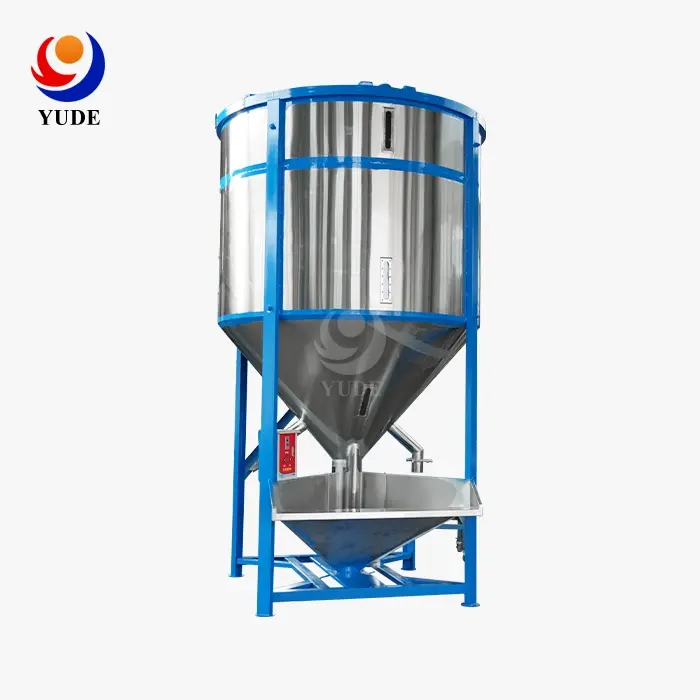
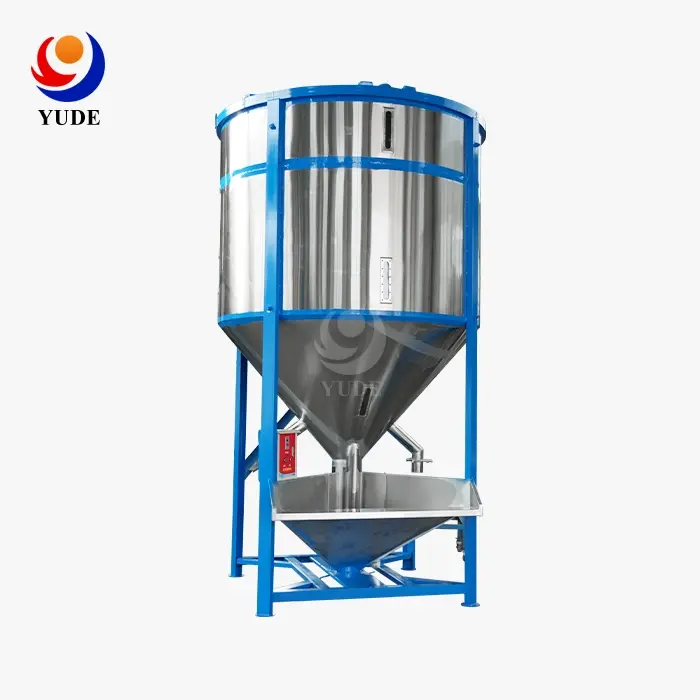
Yude Large Vertical Plastic Pellet Mixer for Large-Scale Pellet Blending
Core Parameters of the Large Vertical Plastic Pellet Mixer
For plants that mix pellets by the ton, we designed this large capacity plastic mixer. In short, these are the most important things about it:
- Capacity and volume: It can hold 10 to 30 tons of weight and has 15 to 48 m³ of useful room. A plant that feeds more than one granulation or extrusion line from the same batch can use this range. This speeds up the shift changes and lowers the number of small tasks that workers have to do each shift.
- Mixing performance: Because it has two or more screws, the vertical mixer mixes things in a way that is at least 98% even. Depending on the item and the recipe, one mixing run can last anywhere from 20 to 50 minutes. While making pipes and profiles, people need mixes that are all the same color. This is because different colors can slow down the pass rate.
- Power and drive: One motor in the mixer is 75 kW, and the other is 315 kW. An extra-heavy-duty hard tooth surface gear reducer holds it all together. When you put heavy loads on this drive, they last a long time. This is important for plants that do a lot of work at once. The motor power is different for each type.
Lots of the time, big plants have trouble with batches that are too small, uneven, or hard on the drive. These rules are meant to make things better.
Construction Built for Heavy Loads
More dense Q235 carbon steel makes up the wall of the barrel, which is at least 30 mm thick. The vessel can hold tens of tons of pellets while the screws turn because it is very thick. The stronger base keeps the machine from shaking while it works. This makes sure that the gear reducer, bearings, and joints don't have to deal with extra stress. You should think about the base, the power source, and how to lift this kind of unit ahead of time because it is big and heavy. They can talk to your project team about these things before you sign off on the layout. Putting the machine in place won't come as a surprise this way.
Application Scenarios for Continuous Large-Batch Pellet Mixing
Large plastic milling plants and oil company shops that work with plastic can use it well. Big groups of pellets need to be mixed all the time on both sets so that lines further down the line never have to wait for material. For example, a granulation plant can take pellets from different production runs and mix them into a single, uniform batch. This batch is then pressed or pressed into shape. Yude Plastic Machinery makes vertical plastic mixers that weigh between 600 kg and 10 tons, as well as small pellet mixers that weigh between 300 kg and 500 kg. These are made for rubbish collectors who don't need more than 10 tons. You can combine output and cut down on the number of runs your staff has to monitor every day if you plan a high-volume line with a large capacity plastic mixer.
How to Select, Run, and Maintain Cutting and Mixing Equipment
Selecting the Right Mixer Size and Specification
Start with the numbers: how much the batch needs to weigh, how much can be made in an hour, how dense the mass is, how long it takes to mix, and how fast the next line moves. How big the chamber is not as important as how much space it can hold. Take the volume and multiply it by the mass density and the amount of filled space to free space. This will give you the useful batch weight. Then, look at the stuff itself. Look at the type of polymer, the size of the particles, the amount of water, any dirt or other impurities, and how rough it is. Find out how strong the motor is, how to clean it, how fast it can turn, and if it gets too hot, is it safe? Write them down if you want safety locks, an automatic scale, or a place to keep recipes. You will have a better time using a large capacity plastic mixer if your recipe and extrusion rate work with it. This is because the motor will be more powerful.
Energy Use, Safety, and Maintenance
It is important to load and mix the equipment correctly and make sure that it can handle the same amount of work as the rest of the line. When they are built in, variable-frequency drives, insulated rooms, and energy tracking can all help cut down on power waste. The blades need to be cleaned, the hub and bearings need to be checked, and the screen needs to be looked at. The screws or paddles, liners, seals, bearings, and drive parts of a large capacity plastic mixer need to be inspected often. Keep in mind OSHA's lockout/tagout rule (29 CFR 1910.147) and make sure there are guards, enough space for dust, and clear emergency-stop training in place before you clean or fix something. When you keep extra parts for important parts on hand, the machine is down for less time when a part that wears out.
Common Mistakes When Buying Cutting and Mixing Equipment
The most common mistake people make when shopping for a large capacity plastic mixer is deciding solely on price or chamber volume. How much it costs to own a machine depends on how much work it does, how much energy it uses, how big the amount is that can be used, and how long it is down. Tools that don't work together is another mistake. The extruder's rate, the cutter's output, the mixer's cycle, and the discharge's speed all need to work together as a single line. If you don't heat or cool it at the right time for the process, it can stick, change color, or break. Germs can spread more easily inside, where it's harder to get to and where color changes take longer to happen. Before you sign, make sure you know what the warranty covers, how to get replacement parts, the electrical standards, the export paperwork, the installation help, the operator training, and the technical help that you can get from other places.
How to Compare Suppliers and Plan Your Installation?
What to Ask a Large Capacity Plastic Mixer Manufacturer
When choosing a supplier, you should not only look at their price, but also their engineering skills, production control, knowledge with certain uses, and customer service after the sale. There are things you need to ask for, such as technical models, process plans, material certificates, and inspection records. How does it work with your cutter or extruder? You should ask the maker if they can change the size, the output, and the wear protection. For a full price list, there should be separate lines for the main machine, its parts, controls, installation, freight, and any other services. If possible, ask for a test on a sample of the material or a test on the whole plant. This lets you check the feed rate, the evenness of the mixing, the energy use, and the discharge before loading. Your technical committee can also see the work for themselves when they go to the plant.
A Step-by-Step Plan From Plastic Scrap to Reusable Compound
First, write down how much scrap was there, what kinds of polymers were used, how much water was used, how much contamination there was, how big the particles were, and any problems that are happening right now. Next, choose how much automation you want, the recipe, the batch time, the cutter output, and the way much it can mix. Test how well different types of materials cut, mix, charge, and use energy. Before you start the job, make sure you know the plan, the weather, the utilities, how to clean up the dust, the safety rules, and the requirements for electricity. People should be taught how to load, unload, clean, and shut down the machine in case something goes wrong while it is being set up. Watch the throughput, the amount of energy used per batch, the rate of rejects, the downtime, the blade wear, and the amount of recycled materials used once it's up and running. Every day, keep the machine in good shape, and every three months, check the numbers to make sure that small problems don't get worse and cause the machine to shut down.
Why Work With Yude Plastic Machinery
Shandong Yude Plastic Machinery Co., Ltd. manufactures and sells plastic mixers. There are other units besides the big one we just talked about. We also have vertical color mixers, small pellet mixers that can hold 300 to 500 kg, and vertical plastic mixers that can hold 1 to 10 tons. Before the machine is sent out, our team checks it over in every way. The raw ingredients that are brought in and the finished machine are both part of this. We send things to more than 30 countries and regions, and we can change how equipment works and how it is used to meet the standards of that area. You can reach our customer service team 24 hours a day, seven days a week. They keep customer files with a list of all the machines that have been serviced and when they were serviced. People who are not in China hire service providers in their own countries. Our research and development team also comes up with creative ways to deal with sizes and materials that aren't standard. This is effective for a project requiring a large capacity plastic mixer.
Conclusion
It is easier to move, weigh, and work with small pieces of trash that have been cut up by a plastic scrap cutter. Recycling rates are still low around the world, so this step is important. Cutting the flakes doesn't change the type of polymer, their color, or how wet they are. A large capacity plastic mixer is useful in situations like these. It makes a uniform mixture of old resin, new resin, fillers, colors, and additives. The type of material, how much it can hold, the strength of the drive, and the way it is built all play a role. The Large Vertical Plastic Pellet Mixer can evenly mix between 10 and 30 tons of pellets. What keeps the line going and the output steady is safe maintenance, making sure the gear is in good shape, and a close look at the source.
FAQ
What separates a plastic scrap cutter from a plastic mixer?
An edger cuts and evens out scrap metal. Then, resin, pigments, fillers, and additives are mixed in to make sure that each batch is the same. That's why most places that recycle need these two things.
How do I calculate the usable capacity of a mixer?
What you need to do is add the whole amount of your material to the filling ratio. Then, compare the answer to the amount of water your pelletizer or extruder needs every hour. Your math is wrong because flakes, pellets, and powders all have different mass densities. You need to use the real thing to figure it out.
Can a mixer process both recycled flakes and pellets?
It is possible for a mixer to mix new things with used flakes or pellets this way. You need the right tank, screw, and drive for the type of screw or paddle, the size, and how rough the material is. Show the supplier a piece of the material or a picture of it so the team can be sure it will fit.
What should a professional quotation include?
In your quote, you should include information about the main machine, its power, the building materials, the parts, the controls, the installation, the freight, the delivery time, the warranty, and the support after the sale. If you ask, Yude Plastic Machinery can also give you prices on plans that work with different sizes and languages.
Request a Large Capacity Plastic Mixer Quote From Yude Plastic Machinery
There are heavy-duty vertical pellet mixers made by Yude Plastic Machinery that can always mix a lot of stuff. Send us the type of material, daily amount, batch goal, and plant layout you want to compare if you want to find a large capacity plastic mixer maker for your recycling or granulation line. To learn more about a product, send an email to sales@yudemachinery.com or go to yudemachinery.com. People can get help from us 24 hours a day, seven days a week. We also send things to more than 30 different countries. We'll look over what you need and get back to you with a clear quote that lists everything you need.
References
- OECD, Global Plastics Outlook: Economic Drivers, Environmental Impacts and Policy Options, 2022
- U.S. Environmental Protection Agency, Advancing Sustainable Materials Management: 2018 Fact Sheet, 2020
- Geyer, Jambeck, and Law, Production, Use, and Fate of All Plastics Ever Made, Science Advances, 2017
- Hopewell, Dvorak, and Kosior, Plastics Recycling: Challenges and Opportunities, Philosophical Transactions of the Royal Society B, 2009
- Al-Salem, Lettieri, and Baeyens, Recycling and Recovery Routes of Plastic Solid Waste (PSW): A Review, Waste Management, 2009
- Occupational Safety and Health Administration, Control of Hazardous Energy (Lockout/Tagout), 29 CFR 1910.147, 1989
Learn about our latest products and discounts through SMS or email