- English
- French
- German
- Portuguese
- Spanish
- Russian
- Japanese
- Korean
- Arabic
- Greek
- German
- Turkish
- Italian
- Danish
- Romanian
- Indonesian
- Czech
- Afrikaans
- Swedish
- Polish
- Basque
- Catalan
- Esperanto
- Hindi
- Lao
- Albanian
- Amharic
- Armenian
- Azerbaijani
- Belarusian
- Bengali
- Bosnian
- Bulgarian
- Cebuano
- Chichewa
- Corsican
- Croatian
- Dutch
- Estonian
- Filipino
- Finnish
- Frisian
- Galician
- Georgian
- Gujarati
- Haitian
- Hausa
- Hawaiian
- Hebrew
- Hmong
- Hungarian
- Icelandic
- Igbo
- Javanese
- Kannada
- Kazakh
- Khmer
- Kurdish
- Kyrgyz
- Latin
- Latvian
- Lithuanian
- Luxembou..
- Macedonian
- Malagasy
- Malay
- Malayalam
- Maltese
- Maori
- Marathi
- Mongolian
- Burmese
- Nepali
- Norwegian
- Pashto
- Persian
- Punjabi
- Serbian
- Sesotho
- Sinhala
- Slovak
- Slovenian
- Somali
- Samoan
- Scots Gaelic
- Shona
- Sindhi
- Sundanese
- Swahili
- Tajik
- Tamil
- Telugu
- Thai
- Ukrainian
- Urdu
- Uzbek
- Vietnamese
- Welsh
- Xhosa
- Yiddish
- Yoruba
- Zulu
Large capacity plastic mixers with easy maintenance features
When industrial operations demand high-volume material blending with minimal disruption, investing in a large capacity plastic mixer designed for straightforward maintenance becomes a strategic priority. These robust machines efficiently homogenize substantial batches of polymer resins, additives, and masterbatches while featuring intelligent design elements that simplify routine servicing. Modern industrial mixers integrate modular component access, wear-resistant construction, and automated lubrication systems to reduce downtime and extend operational life, delivering measurable value for procurement teams managing continuous production environments.
Understanding Large Capacity Plastic Mixers and Their Maintenance Needs
For industrial plastic processing to work, it needs effective mixing tools that can handle batches of several hundred kilograms to several tons. In facilities that handle fresh resins alongside recycled materials, pigments, and performance additives, a large capacity plastic mixer acts as the main mixing station. Unlike smaller lab or pilot-scale units, these industrial workhorses have to be able to run for a long time under heavy loads and keep mixing evenly over thousands of production cycles.
What Defines a Large Capacity Plastic Mixer?
Instead of just looking at the size, the ranking is based on volumetric capacity and output. This group includes machines that can handle batches bigger than 500 kilograms, and includes specialty machines that can handle 10 to 30 tons per cycle. The Yude Large Vertical Plastic Pellet Mixer is a great example of this type of machine. It has twin-screw or multi-screw mixing structures that make the mixture more than 98 percent equal. These machines can handle ongoing mixing needs in petrochemical plants and big granulation facilities. They have effective sizes ranging from 15 to 48 cubic meters and rated loading capacities from 10 to 30 tons.
Core Mixing Technologies and Their Operational Impact
The high-capacity section is dominated by vertical conical forms, which have great uniformity and gravity-assisted discharge properties. The vertical arrangement allows for fountain-flow mixing patterns, in which materials move up the outside wall and down through the middle zone, making several blending lines at the same time. When working with high-density mixtures or materials that need strong shear action, horizontal ribbon mixers are better, but they usually need more complicated cleaning processes. When procurement engineers understand these operational principles, they can better match the design of tools to the properties of materials and the way they are made.
Maintenance as a Core Performance Factor
In industrial mixing processes, planned repair intervals have a direct effect on the total cost of ownership. When equipment has to be taken apart for repairs or new parts, production loses often outweigh the direct cost of upkeep. Maintenance-friendly features built into mixers cut down on mean time to repair (MTTR) by letting techs get to key wear parts without having to take the whole thing apart. This way of thinking about design turns regular service from something that stops production into something that can be planned and done. This keeps operations running smoothly and keeps delivery promises.
Key Features of Large Capacity Plastic Mixers That Facilitate Easy Maintenance
When choosing equipment, repair accessibility is becoming more and more important, and performance measures are being mixed in. Modern industrial mixers have technical features that make it easier to check, repair, and clean parts without affecting the structure's strength or the mixing process' effectiveness. These built-in maintenance features work together to cut down on both planned and unplanned downtime for large capacity plastic mixers, leading to measurable gains in overall equipment efficiency (OEE) measures that procurement teams are keeping an eye on as key performance indicators.
The most effective maintenance-friendly designs share several common characteristics that collectively minimize servicing complexity and duration:
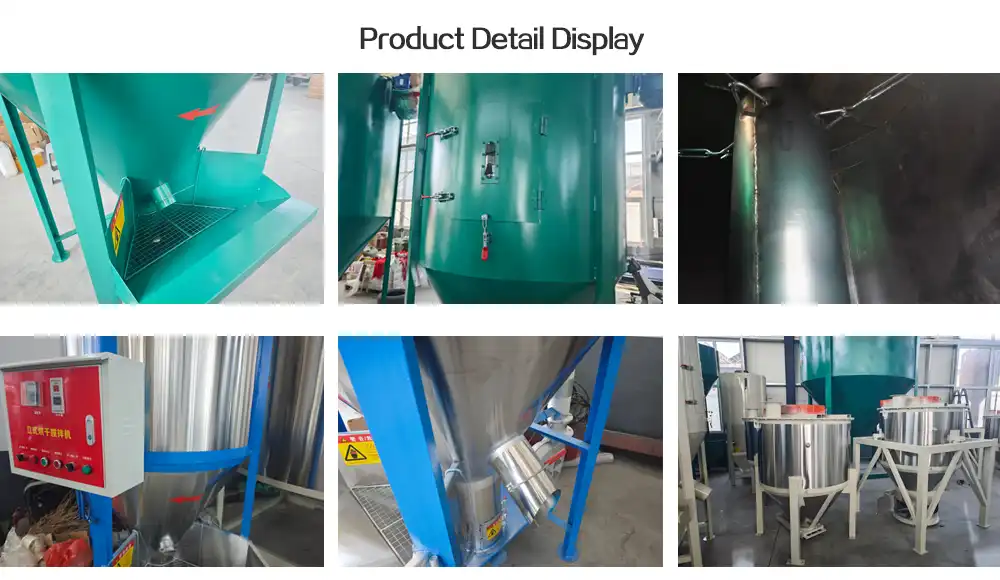
Modular Construction Architecture: Modern mixing designs use bolted-together parts instead of fully welded casings for important entry points. With this method, repair workers can take off inspection panels, agitator assemblies, or discharge mechanisms using normal tools, without having to cut anything or use special tools. Yude's vertical mixers have lid parts that can be taken off and locked in place with electromagnetic fields. This makes it easy to get to the mixing chamber for eye inspection or cleaning by hand between batches of product.
Wear-Resistant Material Selection: Heavy-duty construction starts with Q235 carbon steel barrels that have walls that are thicker than 30 millimeters. This gives the barrels longer life when they are constantly under mechanical stress. The smooth finishes on the inside of the surfaces keep things from building up and make cleaning easier. Mixing blades and shaft parts are made of hardened metals or have surface processes that protect them from wear caused by mineral fillers and glass-reinforced materials. This means that they don't need to be replaced as often.
Automated Lubrication Systems: Greasing bearing housings by hand can lead to poor upkeep and contamination. Modern mixers have centralized automatic lubrication systems that, on predetermined times, send the right amount of oil to key bearing points. This machinery makes sure that the lubrication is always the same, even during long production runs, and it also keeps maintenance logs for quality system paperwork.
Self-Cleaning Mechanisms: Vertical conical shapes naturally encourage full release through gravity-assisted material flow, reducing the amount of leftover material that could infect later runs. Some designs have air cleaning systems that clean the shaft seals and release valves. This keeps powder from building up in important seal areas, which could lower performance or cause cross-contamination risks.
Standardized Component Specifications: Using bearings, seals, and drive parts that are standard in the industry makes it easier to get extra parts and lowers the cost of keeping supplies. Instead of needing unique replacement parts that are only available from the original maker, standardized designs let buyers get parts from a number of approved providers. This makes the supply chain more flexible and lowers the cost of emergency repairs.
How to Choose a Large Capacity Plastic Mixer with Easy Maintenance Features?
Strategically choosing tools strikes a balance between short-term output needs and long-term operating viability. A structured evaluation framework guides buying teams through technical specs and seller offers so they can find solutions that are the best in terms of both performance and ease of maintenance for a large capacity plastic mixer.
Defining Your Production Volume and Mixing Requirements
To start planning for capacity, you need to have a good idea of how much flow is needed now and how it will grow in the future. Figure out how much material you use every hour across all of your processing lines, and then choose batch sizes that are the best balance between how efficiently you mix the materials and how easily you can store them. Facilities that process 5 to 10 tons of material every hour usually ask for mixers that can handle batches of 1,500 to 3,000 kilograms. This gives the mixers 15 to 20 minutes of mixing time, plus time for loading and unloading. With a huge capacity and a single mixing cycle that lasts 20 to 50 minutes, the Yude Large Vertical Plastic Pellet Mixer is perfect for petrochemical and milling operations that need to process big batches all the time.
Establishing Maintenance-Centric Selection Criteria
In addition to uniformity and cycle time, you should also look at options based on certain factors for maintenance. During site trips or in-depth technical studies, check to see how easy it is to get to wear parts like agitator blades, shaft seals, and drive connections. Ask for dimensional sketches that show where the entry panels are and how much space is needed to remove the components. Make sure the drive system uses standard motors and gear reducers instead of custom designs. This way, parts will still be available in the future even if the company that made the equipment goes out of business.
Energy efficiency should be thought about not only because it lowers running costs but also because it affects upkeep. The Yude mixer has two motors, each with 75 to 315 kilowatts of power and extra-heavy-duty hard tooth surface gear reducers. These give the machine the strong power transfer it needs for long-term heavy-load operation while spreading mechanical stress across multiple drive trains. This backup can keep things running at a lower rate if one of the drive systems needs repair, so production doesn't have to stop completely.
Evaluating Manufacturer Support and Service Capabilities
How reliable equipment is depends a lot on how good and quick the manufacturer's expert help is. Yude Plastic Machinery has a full after-sales service system with customer service available 24 hours a day, seven days a week, and local service shops that can respond to customer calls 24 hours a day. This help is available for installations around the world thanks to their foreign service network, which was set up through relationships with local technical teams. Ask current customers who have used the vendor before for examples and check the terms of the guarantee, the availability of spare parts, and the technical training that the vendor offers.
 Conclusion
When choosing industrial mixing equipment, you need to think carefully about both how well it works and how much it will cost to maintain over time. When you build large capacity plastic mixers with features that make them easy to maintain, you get measured benefits like less downtime, easier maintenance, and longer component life. These traits become more important from a strategy point of view as production levels rise, since even short machine breakdowns have a big effect on profits. Along with standard performance requirements, procurement professionals should put modular building, materials that don't wear down easily, and the ability to get help from the manufacturer at the top of their lists. This thorough evaluation method finds equipment options that have the lowest total cost of ownership while still meeting the high operating reliability standards needed by competitive manufacturing businesses.
FAQ
What maintenance features should I prioritize when selecting a large capacity plastic mixer?
Focus on modular construction that lets you get to parts without taking the whole thing apart, standard parts that can be used by multiple sources, and automated systems that require less human work. Make sure that common tools and standard methods can be used to repair worn parts like agitator blades and shaft seals for your large capacity plastic mixer. Check the quality of the manufacturer's expert help and the availability of spare parts, especially if you are working in a country that is far from the supplier's main service network.
How frequently should large capacity mixers undergo maintenance procedures?
While daily checks make sure everything is working normally and point out any clear problems, weekly processes check for wear signs and the integrity of the seals, and monthly servicing includes a full evaluation of all the parts and a check of the lubrication system. For thorough cleaning and accurate measurements of key clearances, maintenance that is done every three months usually includes taking some parts apart. Actual times rely on how abrasive the material is, how often it is used, and the surroundings. Materials that are more abrasive or that are used continuously need more frequent attention.
Do easy maintenance features reduce total ownership costs significantly?
Maintenance-optimized designs cut costs in a number of ways that can be measured. Simplified processes cut down on the number of hours needed for regular maintenance, and easier access to parts cuts down on the average time it takes to fix problems that happen when they're not supposed to. Spare parts are used less often because parts last longer because they are better lubricated and built to fight wear. Most importantly, higher uptime keeps production income that would have been lost during long equipment downtimes. This creates returns that are much higher than the extra cost of the equipment.
Partner with Yude Plastic Machinery for Reliable High-Capacity Mixing Solutions
The wide range of products offered by Yude Plastic Machinery will help procurement engineers and sourcing managers who are looking for reliable industrial mixing tools. The engineers who worked on our Large Vertical Plastic Pellet Mixer spent decades making it more reliable and easier to maintain. We offer full expert support throughout the entire lifecycle of the equipment, from initial specification advice through installation, commissioning, and continued service, as a reputable large capacity plastic mixer maker.
In high-volume production settings, our team knows how important it is for tools to be up and running all the time. We offer unique solutions that take into account the properties of your materials, the amount you need to produce, and the space limitations of your building. Get in touch with our technical experts at sales@yudemachinery.com to talk about your mixing needs and set up in-depth equipment demos. Bulk pricing and customizable choices make sure that businesses of any size get the best value. Find out why thousands of customers around the world trust Yude Plastic Machinery with their most important material handling equipment needs.
References
- Rauwendaal, Chris. Polymer Mixing: A Self-Study Guide. Hanser Publications, 2020.
- Tadmor, Zehev and Costas G. Gogos. Principles of Polymer Processing. Second Edition. Wiley-Interscience, 2013.
- White, James L. Twin Screw Extrusion: Technology and Principles. Hanser Publications, 2019.
- Manas-Zloczower, Ica. Mixing and Compounding of Polymers: Theory and Practice. Third Edition. Hanser Publications, 2021.
- Cheng, Jennifer J. and Iwao Manas-Zloczower. "Analysis of Mixing Performance in a VCM Mixer." Polymer Engineering and Science, vol. 58, no. 6, 2018, pp. 961-970.
- American Society of Mechanical Engineers. Maintenance Engineering Handbook. Eighth Edition. McGraw-Hill Education, 2018.
Learn about our latest products and discounts through SMS or email