- English
- French
- German
- Portuguese
- Spanish
- Russian
- Japanese
- Korean
- Arabic
- Greek
- German
- Turkish
- Italian
- Danish
- Romanian
- Indonesian
- Czech
- Afrikaans
- Swedish
- Polish
- Basque
- Catalan
- Esperanto
- Hindi
- Lao
- Albanian
- Amharic
- Armenian
- Azerbaijani
- Belarusian
- Bengali
- Bosnian
- Bulgarian
- Cebuano
- Chichewa
- Corsican
- Croatian
- Dutch
- Estonian
- Filipino
- Finnish
- Frisian
- Galician
- Georgian
- Gujarati
- Haitian
- Hausa
- Hawaiian
- Hebrew
- Hmong
- Hungarian
- Icelandic
- Igbo
- Javanese
- Kannada
- Kazakh
- Khmer
- Kurdish
- Kyrgyz
- Latin
- Latvian
- Lithuanian
- Luxembou..
- Macedonian
- Malagasy
- Malay
- Malayalam
- Maltese
- Maori
- Marathi
- Mongolian
- Burmese
- Nepali
- Norwegian
- Pashto
- Persian
- Punjabi
- Serbian
- Sesotho
- Sinhala
- Slovak
- Slovenian
- Somali
- Samoan
- Scots Gaelic
- Shona
- Sindhi
- Sundanese
- Swahili
- Tajik
- Tamil
- Telugu
- Thai
- Ukrainian
- Urdu
- Uzbek
- Vietnamese
- Welsh
- Xhosa
- Yiddish
- Yoruba
- Zulu
How does a vertical color mixer work with plastic pellets?
A pellets vertical color mixer works with the help of a vertical spiral lifting circulation system inside a cylinder-shaped or conical chamber. The spiral screw in the middle spins slowly, pulling plastic pellets and color masterbatch from the bottom to the top. Gravity then pulls them down the smooth inner walls. By gently moving the pellets, a fountain-like flow pattern is made that mixes the colors evenly (≥99%) in 15 to 40 minutes without damaging the pellets or making them dusty. The vertical form takes up as little floor room as possible while making blending more efficient by letting the materials run naturally.
Fundamentals of Vertical Color Mixers
What Makes Vertical Color Mixers Essential for Plastic Processing
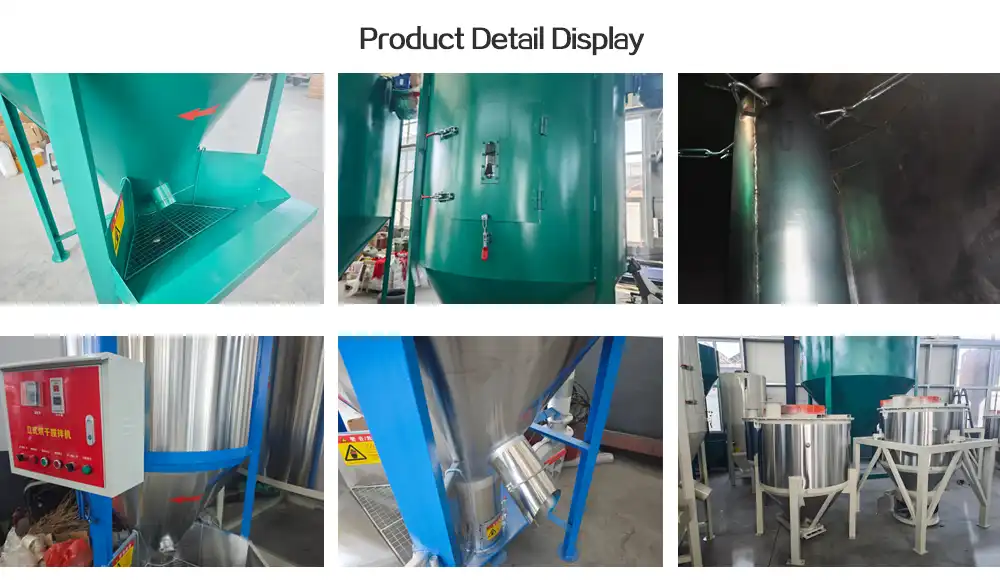
In current plastics production, it is still very hard to make sure that the colors of thousands of parts are all the same. This need is met by a pellets vertical color mixer, which combines mechanical accuracy with material flow based on physics. The machine has a main mixing room, a spiral screw agitator, a motor drive system with overload safety, and an electric control cabinet that is centrally located. These parts work together to make regular blends that get rid of color streaking and areas with a lot of pigment, which are problems that cause makers to reject thousands of parts every year.
There are clear benefits to mixing in a vertical way over standard ways. When the screw is placed vertically, the mixer uses gravity to help move the materials around, which uses about 20–30% less energy than horizontal devices. The polished carbon steel or stainless steel inside keeps materials from sticking, which is especially helpful when moving between different color formulas during production shifts.
The Working Principle Behind Vertical Spiral Circulation
The idea behind how vertical spiral circulation works depends on lifting and falling all the time. The spiral screw moves the pellets up and away from the base of the hopper at 8 to 25 rpm. When the materials reach the top, they spread out in all directions and fall along the room walls, making several mixing layers at the same time. This low-shear method keeps the structure of the pellets, which is very important when working with brittle resins like polystyrene or delicate modified engineering plastics.
Material scientists have found that this pattern of movement makes more touch points between the masterbatch and base plastic than systems that tumble or paddle. During a normal 20-minute cycle, hundreds of surface contacts happen on each pellet, which theoretically guarantees a complete coating of color. The main control screen lets workers change the cycle time and spinning speed based on the type of material, from thin PP pellets to thick PVC compounds.
Key Performance Benefits for Industrial Applications
When manufacturers use vertical mixing technology, they say that their production measures get better in a number of ways. Mixing uniformity of more than 99% directly leads to stable part look, which is a must for car interior parts and consumer electronics housings. The sealed room design reduces the amount of dust that is made, which makes the workplace safer and cuts down on material waste caused by pigment loss in the air.
The ability to save energy is another important benefit. When you combine gravity-assisted flow with the right size motor, you can get 500 kg capacity units that use as little as 3 to 5 kW of power. These savings add up over the course of a year's worth of production, especially in places that work more than one shift. Motor overload and burning protections make equipment last longer and keep it from needing expensive emergency fixes during busy production times.
Vertical Color Mixer vs. Other Mixing Technologies
Comparative Analysis of Blending Equipment
When procurement engineers look at mixing options, they have to compare different methods and make sure they meet operational needs. Ribbon blenders have horizontal U-shaped pits with spiraling ribbons that move stuff from side to side. These methods work well for mixing powders, but they have trouble with pellet stratification because fresh resin and masterbatch have different bulk densities. The horizontal shape also takes up a lot of floor room, which is hard to come by in many factories.
Horizontal color mixers have the same room limitations as vertical ones, but they can mix bigger batches, sometimes up to 20 tons or more. The horizontal screw design, on the other hand, causes more mechanical strain, which can break pellets or damage temperature-sensitive additives. High-speed mixers are the opposite; they can finish cycles in three to five minutes, but they create contact heat and pellet surface roughness that lowers the quality of the next step in the process.
In terms of practicality, pellets vertical color mixers are in the middle. When compared to horizontal units of the same size, their small vertical footprint saves 40–60% of floor room. The low-speed, high-torque process keeps the shape of the pellets while spreading them out evenly. Moving materials from one color batch to another only takes 5–10 minutes of cleaning with compressed air or ATEX-rated vacuum systems. This is a lot faster than taking apart horizontal mixer paddles and cleaning them by hand.
Application Suitability Across Production Scales
Vertical mixers are useful for small businesses that handle batches of 300 to 500 kg because they can switch between tasks quickly. Just-in-time production methods can be used with a single unit that can handle different color formulas every day without cross-contamination. Larger factories with continuous extrusion or injection molding lines use 1-2 tonne vertical mixers as holding bins to make the flow of materials to later equipment smoother and more consistent.
Large original equipment manufacturers (OEMs) in the product or car industries use 5–10-ton vertical mixers to prepare materials in one place. These systems feed several processing machines at the same time, making the color quality the same along the whole production line. The interior design without paddles gets rid of the wear parts that are common in ribbon blenders. This cuts down on maintenance costs and unexpected downtime that can mess up contract manufacturing plans.
Practical Applications and Case Studies in Plastic Pellet Processing
Industry-Specific Implementation Examples
Injection casting operations that make parts for cars are a good example of pellets vertical color mixer value propositions. A company in the Midwest of the United States that makes panel parts from ABS and PC blends added a 2,000 kg vertical mixer to their system for moving materials. Color differences between casting processes were fixed, which was a problem that was causing 3-5% of rejections before. Consistently mixing pellets cut machine cleaning time by 40% during color changes, which returned about 15 production hours per month.
Vertical mixers can mix recycled resin with new resin, which is useful for film production plants. A company that makes container film put in a 1,500 kg stainless steel unit to mix 30% post-industrial regrind with new LDPE and color concentrate. The vertical circulation pattern stopped density-based stratification, which would have made the finished film's width vary. Quality control tests showed that the uniformity of the film gauge went from ±8% to ±3%, which cut down on customer complaints and the waste of materials caused by production that wasn't up to standard.
Vertical mixers are used as continuous-feed buffer bins in pipe production lines that work with PVC and PPR compounds. A company in Europe set up a 5,000-kilogram mixer that feeds three extrusion lines at the same time. The centralized blending method made sure that all production lines used the same mix of materials. This got rid of the color differences that happened with line-side blending. Monitoring energy use showed that mixing-related electricity use was 22% lower than with the old horizontal blender setup.
Emerging Technology Trends
Process integration and digital tracking are two new ideas that have come out recently. Smart mixer controls now have load cell systems built in that measure the weight of materials in real time and change the cycle settings automatically based on the make-up of the batch. This closed-loop control takes away the operator's need to guess and makes sure that the same results are achieved during each shift. Energy management features keep track of how much power is used per cycle, which shows when efficiency is dropping and lets you know that you need to do repair before the equipment breaks down.
With remote tracking, you can keep an eye on various mixers across facility networks from one place. Maintenance teams are automatically notified when working parameters go beyond what has been set as normal. This could be because of high motor power, longer cycle finish times, or strange vibration signs. Predictive maintenance programs look at past performance data to figure out when to replace parts. This means that instead of fixing problems as they happen, fixes are planned ahead of time so that production is interrupted as little as possible.
Material tracking systems now combine records of how the mixing was used with information about how the materials were received upstream and processed downstream. This digital chain of custody meets the stricter quality paperwork needs of controlled industries such as making medical devices and packaging for food contact. Blockchain-based traceability tools that are still being developed will keep permanent records of where things came from and how they were processed. This will help with product liability defense and sustainability reports.
Conclusion
Pellets vertical color mixers are a tried-and-true way to color pellets consistently in tough plastic working settings. When you combine low-shear mixing, vertical spiral circulation, and gravity-assisted material flow, you get regularity of more than 99% while keeping the pellet's shape. When compared to other technologies, vertical mixers make the best use of floor space, use less energy, and are easier to maintain. To choose the right equipment, you need to weigh your production needs and quality standards against the equipment's ability, building materials, and supplier's abilities. Regular repair and following best practices for operations make tools last longer and work reliably in a wide range of handling tasks.
FAQ
What capacity range do vertical color mixers typically offer?
Vertical mixers can handle anywhere from 300 kg for small-batch and lab work to 10 tons or more for large-scale commercial setups. Most injection molding and extrusion plants use units in the 1,000-2,000 kg range. To keep production going, choose a size that is 1.5 to 2 times the amount of materials you use every hour for the pellets vertical color mixer.
Do vertical mixers damage pellet structure during blending?
The low speed (8–25 rpm) and paddle-free design keep the pellets from being stressed mechanically. When vertical mixers are used correctly, they produce less than 2% fines from pellet grinding, which is a lot less than high-speed or high-shear mixing technologies. This careful handling keeps qualities of the material that are important for later processing.
How quickly can colors be changed between production runs?
Using compressed air or an industrial vacuum device, stainless steel units usually need 5 to 10 minutes to be completely cleaned. Because of the different textures on the surface, carbon steel models may need a little longer. Do not clean with water because it adds moisture to later batches.
What leads times should procurement teams expect?
Standard setup units are sent out three to five weeks after the order is confirmed. Lead times are extended to 6 to 8 weeks for custom specs such as non-standard sizes, special materials for building, or changed electrical systems. Depending on the location, international shipping and clearing customs can take an extra two to four weeks.
Partner with Yude Plastic Machinery for Superior Mixing Solutions
Industrial-grade pellets vertical color mixer systems made by Yude Plastic Machinery are designed to work in tough production settings. Through vertical spiral circulation technology, our equipment gets mixing consistency of ≥99%. This makes sure that the color quality stays the same in injection molding, film blowing, and extrusion. We can build it out of either Q235 carbon steel or 304 stainless steel, depending on your needs, and it can hold anywhere from 300 kg to 10 tonnes.
As a well-known pellets vertical color mixer maker, we keep a close eye on quality throughout the whole production process, from cutting out parts to testing the finished assembly. Our expert support team is available 7 days a week, 24 hours a day, and can help you in more than one language. We also offer a full guarantee and spare parts. Our engineering team quickly reacts to your needs, whether you want standard setups or solutions that are tailored to meet the standards in your area.
You can talk to our sales team about your material mixing needs and get detailed technical offers that are tailored to your production goals by emailing sales@yudemachinery.com.
References
- Crawford, R.J. (2021). Plastics Engineering: Processing and Properties of Polymer Materials. Oxford: Butterworth-Heinemann Press.
- Tadmor, Z. & Gogos, C.G. (2019). Principles of Polymer Processing, 3rd Edition. Hoboken: John Wiley & Sons.
- Rauwendaal, C. (2020). Mixing in Polymer Processing: Theory and Practice. Munich: Hanser Publications.
- Goodship, V. (2018). Practical Guide to Injection Moulding: Materials Selection and Quality Control. Shrewsbury: Smithers Rapra Technology.
- Michaeli, W., Greif, H., Kaufmann, H. & Vossebürger, F.J. (2022). Technology of Plastics Processing: Injection Molding and Extrusion. Munich: Carl Hanser Verlag.
- Thakur, V.K. & Thakur, M.K. (2020). Processing and Development of Polysaccharide-Based Biopolymers for Packaging Applications. Amsterdam: Elsevier Science Publishers.
Learn about our latest products and discounts through SMS or email