- English
- French
- German
- Portuguese
- Spanish
- Russian
- Japanese
- Korean
- Arabic
- Greek
- German
- Turkish
- Italian
- Danish
- Romanian
- Indonesian
- Czech
- Afrikaans
- Swedish
- Polish
- Basque
- Catalan
- Esperanto
- Hindi
- Lao
- Albanian
- Amharic
- Armenian
- Azerbaijani
- Belarusian
- Bengali
- Bosnian
- Bulgarian
- Cebuano
- Chichewa
- Corsican
- Croatian
- Dutch
- Estonian
- Filipino
- Finnish
- Frisian
- Galician
- Georgian
- Gujarati
- Haitian
- Hausa
- Hawaiian
- Hebrew
- Hmong
- Hungarian
- Icelandic
- Igbo
- Javanese
- Kannada
- Kazakh
- Khmer
- Kurdish
- Kyrgyz
- Latin
- Latvian
- Lithuanian
- Luxembou..
- Macedonian
- Malagasy
- Malay
- Malayalam
- Maltese
- Maori
- Marathi
- Mongolian
- Burmese
- Nepali
- Norwegian
- Pashto
- Persian
- Punjabi
- Serbian
- Sesotho
- Sinhala
- Slovak
- Slovenian
- Somali
- Samoan
- Scots Gaelic
- Shona
- Sindhi
- Sundanese
- Swahili
- Tajik
- Tamil
- Telugu
- Thai
- Ukrainian
- Urdu
- Uzbek
- Vietnamese
- Welsh
- Xhosa
- Yiddish
- Yoruba
- Zulu
How to Choose the Right Vertical Plastic Particle Mixer for Injection Molding?
To choose the right vertical plastic particle mixer for injection molding, you must first know how much you want to make, what kind of material you want to use, and how hot it needs to be. A 20 Ton vertical plastic particle mixer with heating function is an industrial-grade way to mix large amounts of plastic pellets into a uniform consistency while also controlling the temperature to get rid of wetness and spread additives evenly. These mixers achieve mixing accuracy of more than 98%, which is important for keeping melt flow properties stable and cutting down on flaws in injection-molded products. When looking at tools for high-volume operations in fields like recycling and car parts, procurement managers should put capacity alignment, energy efficiency, heating accuracy, and source stability at the top of their list.
Understanding the Core Requirements of Vertical Plastic Particle Mixers for Injection Molding
The basic idea behind 20 Ton vertical plastic particle mixer with heating function is that they use both gravity to move the particles around and mechanical stirring to mix them. The vertical spiral upward circulation structure constantly moves things from the mixing chamber's bottom to its top, making a fountain-like flow pattern that makes sure that the fresh resin, regrind, colorants, and additives are all mixed well. This design works especially well with popular thermoplastics like PE, PP, ABS, and PVC, which are what most injection molding feedstocks are made of.
Adding a heating function to a simple mixer turns it into a machine that can do two important pre-processing tasks at once. Controlling the temperature makes it easier for hygroscopic materials like nylon and polycarbonate to lose their water. This stops steam bubbles from forming during injection, which would weaken the structure. Controlled heating also makes it easier for masterbatches and stabilizers to spread out by slightly softening the surfaces of particles. This makes it easier for coatings to stick to the particles without melting them too soon.
Working Principle and Temperature Control Mechanisms
Modern 20 Ton vertical plastic particle mixers with heating function use systems that move hot air around or electric heating elements built into the walls of the room. Multiple temperature sensors placed within the mixing container send input to PID controls, which keep setpoints between 60°C and 120°C, based on the type of resin. Because heat loss per kilogram goes down as volume goes up, a big batch, like the 20,000 kg capacity of industrial-scale units, actually uses less energy than a smaller hopper because it has more thermal mass.
Capacity Considerations for High-Volume Operations
Plastic pellets usually have bulk densities of between 0.6 and 0.8 g/cm³, which means that a 20 Ton rated loading capacity equals a practical volume of about 30,000 to 32,000 gallons. This large capacity can handle several injection molding machines at the same time or can be used as a cushion for continuous extrusion lines that work multiple shifts. To reach the industry standard of ≥98% regularity, a single mixing cycle needs 25 to 40 minutes. This means that flow planning must take this time into account when figuring out how much is made each day.
Criteria to Consider When Choosing a Vertical Plastic Particle Mixer with Heating
To choose the right mixing tools, you need to carefully look at a number of technical factors that have a direct effect on the end results and overall cost of ownership.
Performance Metrics and Throughput Capacity
The main way to measure efficiency is by how regular the mixing is. With equipment that can achieve 98% uniformity or higher, color difference, additive concentration, and material traits stay the same from batch to batch. When injection molding machines get material with a layered makeup, they get expensive defect patterns. This accuracy stops those patterns from happening.
Power arrangement tells you a lot about how durable an item is. Heavy-duty gear reducers and two motors with a total output of 160 to 200 kW show that the building is industrial-grade and can be used continuously. The best balance is between 30 and 60 rpm for the mixing shaft. This speed is fast enough to move big loads vertically without creating too much heat through friction or breaking down the pellets from mechanical stress.
Material Construction and Durability
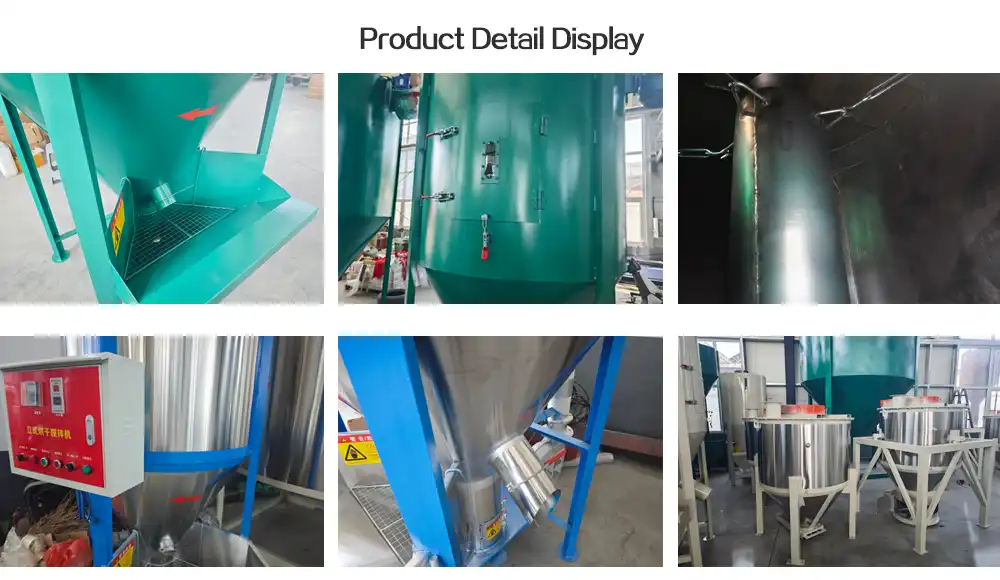
When you choose Q235 carbon steel for barrel building and treat the inside walls to prevent rust, you get good corrosion protection for most uses at a reasonable price. Millions of pellets going through the cylinder every cycle wear down the thickened carbon steel spirals that mix the pellets. Procurement engineers should check the specs for wall thickness and ask for information about how long the service is expected to last under normal working conditions.
The manual butterfly valve discharge port is normal for this type of tools in the business world. There are automatic pneumatic release systems, but operators have more control over manual systems, and they don't have to worry about electrical failure points in dusty production areas.
Energy Efficiency and Operating Costs
When compared to banks of individual hopper dryers that service multiple injection machines, large-capacity 20 Ton vertical plastic particle mixers with heating functions use 30 to 40 percent less energy per ton. The mixing room is well insulated, so it keeps heat in well, and the big thermal mass means that it needs to be heated less often to stay at the setpoint temperature. When comparing different pieces of equipment, don't just look at the listed motor numbers; ask for real power consumption data under normal working conditions as well.
Selecting Your Optimal Mixing Solution
Structured equipment selection starts with a full description of the production needs that are written in measurable terms. Baseline capacity needs are set by the amount of material that needs to be processed (in tons per day), the number of working hours per week, and the types of resin that need to be processed. It is necessary to heat hygroscopic industrial resins before they can be used in injection molding, but mixing common thermoplastics at room temperature may be enough.
More and more, environmental factors affect choices about capital tools. When you compare the energy use predictions of different models, you can see that their total running costs are different, which may mean that the higher initial equipment investment is worth it. Easy-to-disassemble equipment makes it easier to switch materials and clean, which cuts down on both downtime and waste during product changes.
Evaluating Standard Versus Customized Equipment
Standard production models have faster lead times and cheaper costs, but they might have features that aren't needed for certain uses and don't have the capabilities that are wanted. Customization choices, like more heating power, stainless steel construction for corrosive additives, or automatic release systems, meet specific needs but make the process more complicated and expensive.
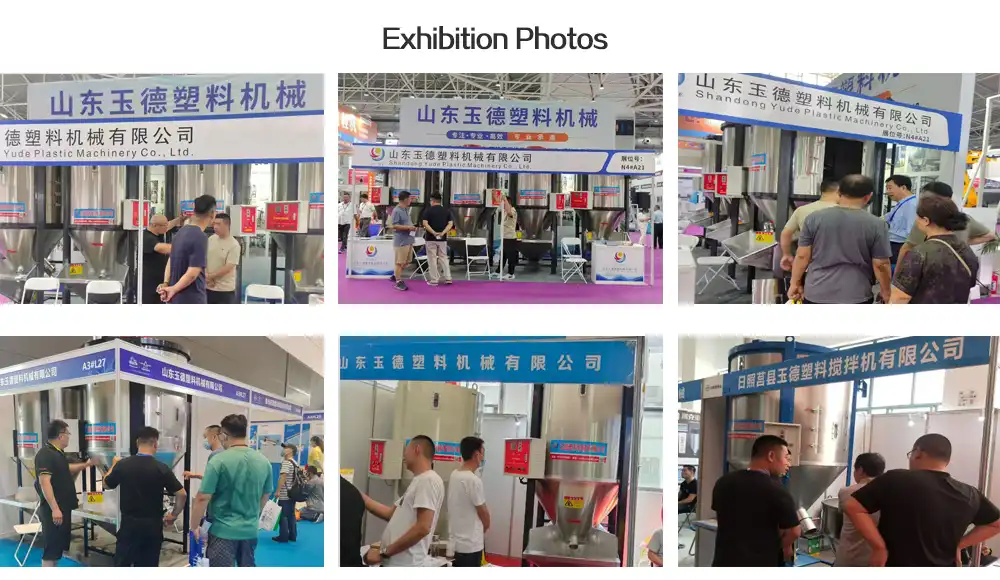
The Yude Plastic Machinery 20 Ton vertical plastic particle mixer with heating function is an example of how standard industrial tools can meet the needs of high-volume injection molding operations without making things too complicated. With a rated loading capacity of 20,000 kg, the 160–200 kW dual-motor configuration ensures reliable performance across popular thermoplastic materials, and the batch size is large enough for multi-machine processes. Mixing accuracy of 98% or more makes sure that the material properties stay the same, which is important for parts in cars, consumer goods, and technical equipment where exact measurements are needed.
Conclusion
When looking for the right vertical plastic particle mixer for injection molding, you have to weigh technical specs against working needs and budget limits. Large-capacity heated mixers are used in high-volume production settings where consistent batches, low work requirements, and energy economy make the investment worthwhile. When making a purchase choice, you should give equal weight to mixing performance, building quality, heating system capability, and supplier support infrastructure. Equipment from well-known companies with strong after-sales service networks lowers the risk for businesses that depend on keeping output going so they can make money. Making sure that the capacity of the mixer matches the real production needs while still leaving room for future growth sets up manufacturing processes to stay competitive.
FAQs
What temperature range is suitable for processing hygroscopic plastics?
To get the moisture level below 0.05%, hygroscopic industrial resins like nylon (PA), polycarbonate (PC), and PET need to be dried at temperatures between 80°C and 120°C for two to four hours. How hot or cold it is varies on the type of glue and how much water was in it to begin with. Heated vertical mixers do this cleaning and mixing of additives at the same time, but the cycle time is longer than just mixing.
How does energy consumption compare between heated and non-heated models?
For the heating parts and airflow fans, heated vertical mixers need more power, usually an extra 30 to 50 kW on top of the base mixing motor needs. However, this unified method works better than using different devices for mixing and drying. The combined equipment cuts down on the number of times that materials have to be moved, and the thermal mass of big amounts is used to keep the temperature stable during short heating cycles.
What safety features should procurement managers prioritize?
Industrial mixing equipment needs emergency stop controls that can be reached from multiple places, interlocked systems that keep people from getting to the equipment while it's running, and grounding that meets electrical code requirements. Over-temperature safety and thermal cutoffs should be built into heating systems. When working with flammable materials or additives, fire monitoring connections that can connect to building safety systems offer extra safety.
Partner with Yude Plastic Machinery for Your Mixing Equipment Needs
Yude Plastic Machinery has a lot of experience making vertical plastic particle mixers. They serve injection molding businesses all over the world with equipment that is built to last and work well. Our 20 Ton vertical plastic particle mixer with heating function has the power, evenness, and temperature control needed for production settings with a lot of parts. As a direct maker and seller, we can offer reasonable prices without adding markups for distributors. We also offer full technical support and quick response times for service needs. Our engineering team creates custom solutions to solve particular material handling problems, such as heating systems that work better or specs that aren't standard. Contact our team at sales@yudemachinery.com to talk about your production needs and get specific information that fits your business. We give you the high-quality tools and quick help that your injection molding lines need to keep working well.
References
- Tadmor, Z., & Gogos, C. G. (2013). Principles of Polymer Processing (2nd ed.). Wiley-Interscience.
- Rauwendaal, C. (2014). Polymer Mixing: A Self-Study Guide. Hanser Publications.
- American Society for Testing and Materials. (2019). ASTM D6940-19: Standard Practice for Measuring Mixing Uniformity of Plastic Materials. ASTM International.
- European Committee for Standardization. (2016). EN 1114-1:2016: Plastics Piping Systems – Polyethylene (PE) – Part 1: Specifications for Materials and Components. CEN.
- Potente, H., & Kretschmer, K. (2005). "Energy Efficiency Analysis in Polymer Processing Equipment." Polymer Engineering & Science, 45(11), 1481-1490.
- Crawford, R. J., & Throne, J. L. (2002). Rotational Molding Technology. William Andrew Publishing.
Learn about our latest products and discounts through SMS or email